
Why Calcium Levels Drop
To understand why this happens, you have to look at the role of the Parathyroid Glands. These four tiny glands in your neck act like a thermostat for your blood calcium. When calcium drops, they release PTH, which tells your bones to release calcium and your kidneys to stop flushing it out. Without enough PTH, your calcium plummets and phosphate levels climb, which is a state known as Hypocalcemia.
Most people develop this condition after thyroid or neck surgery, which accounts for about 75-90% of cases. However, it can also stem from autoimmune issues, radiation therapy, or genetic conditions like DiGeorge syndrome. The core problem is that your body can no longer maintain the delicate equilibrium needed for muscles and nerves to function properly.
The Core Management Strategy
Since the body isn't producing PTH, the goal is to mimic its effects using supplements. This isn't a "cure," but a lifelong replacement strategy. The tricky part is that doctors don't want your calcium to be "perfectly normal." Instead, they aim for the lower half of the normal range (typically 2.00-2.25 mmol/L). Why? Because if your blood calcium is too high, your kidneys will flush the excess, leading to kidney stones or chronic kidney disease.
The standard approach involves a combination of two main tools: elemental calcium and active vitamin D. Unlike regular Vitamin D3, which the kidneys normally activate using PTH, people with this condition need Calcitriol or alfacalcidol. These are "pre-activated" versions that bypass the need for the parathyroid hormone entirely.
| Supplement Type | Elemental Calcium Content | Best Use Case | Typical Dosage Detail |
|---|---|---|---|
| Calcium Carbonate | ~40% | Taken with meals (acts as phosphate binder) | 1,250-2,500 mg for 500-1,000 mg elemental Ca |
| Calcium Citrate | ~21% | Taken without food or for those with low stomach acid | Requires higher milligram dose for same effect |
Step-by-Step Treatment Protocol
Managing this condition requires precision. It's not about taking a generic multivitamin; it's about a specific dosing regimen titrated by an endocrinologist.
- Initiating Calcium: Most start with 1,000-2,000 mg of elemental calcium daily. Splitting this into 4-5 smaller doses throughout the day, rather than 2 large ones, often helps keep levels more stable and reduces the "crash" feeling.
- Adding Active Vitamin D: Calcitriol is typically started at 0.25-0.5 mcg daily. This allows the gut to actually absorb the calcium you're taking.
- Vitamin D3 Support: Even with active analogues, a base of 400-800 IU of standard Vitamin D3 is recommended to keep overall stores healthy.
- Magnesium Check: If your Magnesium levels drop below 1.7 mg/dL, your calcium supplements might not work. Adding 400-800 mg of magnesium oxide can help stabilize the system.
- Monitoring: In the first three months, you'll likely see your doctor every few weeks. Once stable, 24-hour urinary calcium tests are vital to ensure you aren't damaging your kidneys.
Dietary Do's and Don'ts
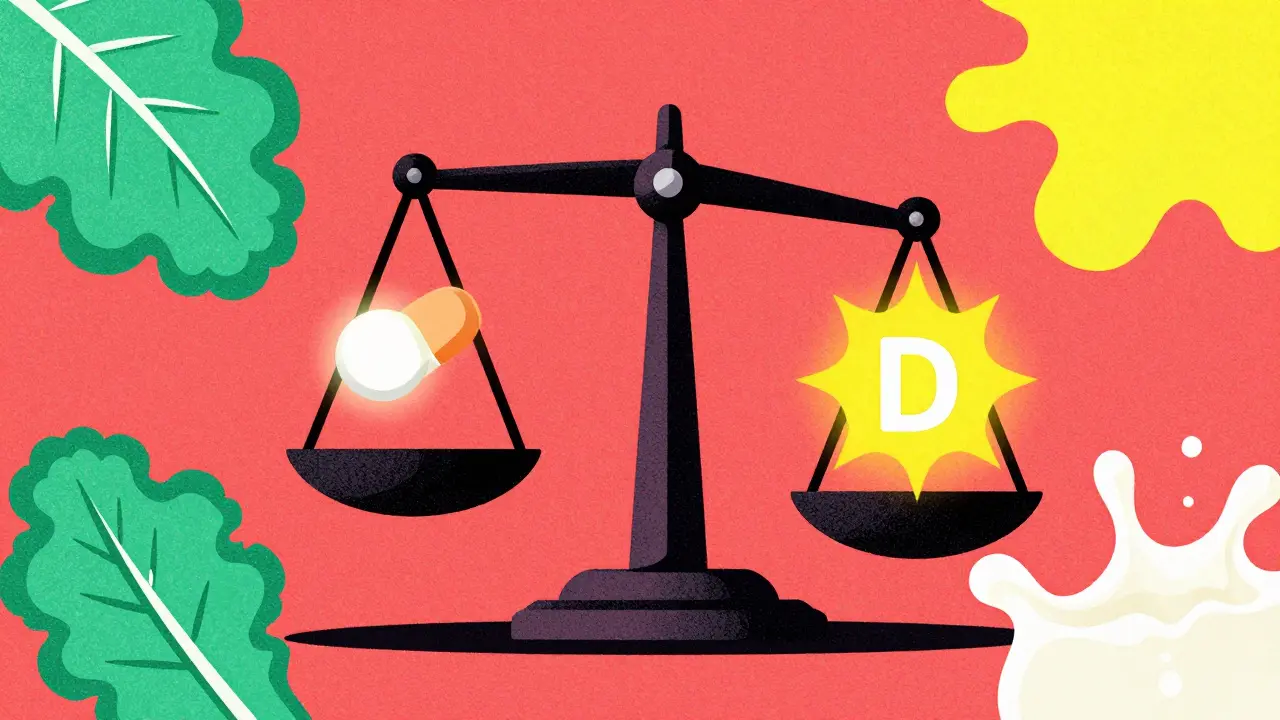
What you eat can either help stabilize your levels or make your medication work harder. The goal is to increase calcium-rich foods while keeping phosphorus low, as high phosphorus can drive calcium levels down further.
Foods to embrace: Focus on dairy products, which provide about 300 mg of calcium per serving. For non-dairy options, kale is a powerhouse with 100 mg per cup, and broccoli adds another 43 mg. These provide a natural buffer to your supplements.
Foods to limit: Watch out for "hidden" phosphorus. Carbonated beverages often contain phosphoric acid (about 500 mg per liter), which is a major culprit. Processed meats and hard cheeses are also high in phosphorus and can interfere with your mineral balance. Aim to keep your daily phosphorus intake between 800-1,000 mg.
When Conventional Therapy Isn't Enough
For some, pills simply aren't enough. About 25-30% of patients find that standard calcium and vitamin D don't stop the symptoms or lead to dangerous levels of calcium in the urine (hypercalciuria). If you need more than 2 grams of calcium or 2 micrograms of active vitamin D daily, you might be a candidate for hormone replacement.
Recombinant Parathyroid Hormone (PTH) therapy, such as Natpara or Teriparatide, provides the actual hormone the body is missing. While these are expensive and require daily injections, they can reduce the need for calcium supplements by 30-40%. Newer options like TransCon PTH are showing even better results by normalizing calcium in nearly 89% of patients in recent trials.
If you're struggling with kidney stones despite treatment, your doctor might suggest a sodium-restricted diet (under 2,000 mg/day) or thiazide diuretics to keep calcium in the blood and out of the urine.
Practical Tips for Daily Life
Living with this condition is a marathon. To avoid the dreaded "calcium rollercoaster," consistency is everything. Take your calcium with meals-this not only helps absorption but also helps bind phosphate in your food. Many find that taking their vitamin D at bedtime works best for their specific rhythm.
You also need an emergency plan. If you feel the onset of muscle cramps or perioral numbness, don't wait for a doctor's call. The standard emergency protocol is to chew 2-3 calcium tablets (providing 500-1,000 mg of elemental calcium) immediately to bring levels up and prevent a full-blown tetany episode.
Why can't I just take a high-dose Vitamin D supplement?
Regular Vitamin D (cholecalciferol) needs to be converted by the kidneys and liver into its active form. This conversion process requires parathyroid hormone (PTH). Since you have a deficiency of PTH, your body cannot efficiently activate regular Vitamin D. That is why you need active analogues like Calcitriol, which go directly to work without needing the hormone.
Is it possible to overdo calcium supplements?
Yes. Taking more than 2,000 mg of elemental calcium daily can increase cardiovascular risk and lead to hypercalciuria, where too much calcium ends up in your urine. This significantly increases the risk of kidney stones and can lead to chronic kidney disease. This is why your doctor targets the lower end of the normal calcium range.
What are the early warning signs of a calcium drop?
The most common early signs are paresthesia-tingling or numbness-around the mouth (perioral) and in the fingertips or toes. You might also experience muscle twitching or cramps. If these progress to severe muscle spasms or a "locked" feeling in the limbs, it is a medical emergency.
How often do I need blood tests once I'm stable?
Initially, you may need tests every 1-3 months to fine-tune your doses. Once your levels are stable and your 24-hour urinary calcium is within target, most patients move to 3-4 visits per year. However, any change in diet, new medications, or sudden symptoms should trigger an immediate check.
Does magnesium really affect calcium levels?
Absolutely. Hypomagnesemia (low magnesium) can impair the secretion and action of PTH. Even if you are taking calcium supplements, if your magnesium is below 1.7 mg/dL, your body may not respond correctly to the treatment, making your calcium levels much harder to stabilize.
Next Steps and Troubleshooting
If you are currently feeling unstable, start by tracking your dosing times. Are you taking calcium on an empty stomach? Try moving it to mealtime. Are you taking one giant dose? Try splitting it into smaller increments every 4 hours.
For those who have been on conventional therapy for years, it's time to ask your endocrinologist for a 24-hour urine calcium collection. If you've been maintaining high blood calcium for a decade, you need to ensure your kidney function is still healthy, as stage 3 chronic kidney disease is a known long-term risk for this patient group.


Nikki Grote
April 16, 2026 AT 00:10The emphasis on the hypocalcemic state and the synergistic relationship between magnesium and the PTH-axis is spot on. For those dealing with refractory cases, it's worth noting that the pharmacodynamics of calcitriol can vary wildly based on gut motility and concurrent phosphate binder use, so precise titration is absolutely critical to avoid hypercalciuria.
The transition to recombinant PTH analogues like TransCon is a total game changer for patients who can't achieve homeostasis with conventional mineral replacement.
Dana Chichirita Nicoleta
April 16, 2026 AT 14:10Oh, my goodness, reading through this has truly illuminated my heart with the most magnificent sense of hope for every single soul who has ever felt the terrifying, icy grip of those fingertips tingling in the dark of the night! It is simply breathtaking to realize that there is such a methodical and scientific path forward to reclaim one's vitality from the clutches of such a rare and daunting endocrine struggle, and I am just overflowing with an exuberant desire to see everyone reach that stable, predictable routine where the rollercoaster finally stops! We must all hold onto the belief that a brighter, more balanced tomorrow is not just a dream but a clinical possibility if we simply follow these guidelines with unwavering faith and precision in our medical teams!
Colleen Tankard
April 17, 2026 AT 11:57This is such a helpful guide for anyone dealing with this 🌟 staying on top of those supplements is a full time job lol
Anmol Garg
April 17, 2026 AT 19:54It's interesting how we try to mimic nature with pills and injections when the body is such a complex machine. It really makes you think about the fragility of our balance and how a few tiny glands can change your entire daily existence. Just keep breathing and taking it one dose at a time, everyone.
Nathan Berlin
April 19, 2026 AT 10:51Typical western medicine obsession with pills 🙄 in india we have far better holistic perspectives on mineral balance though i guess this is basic enough for the masses 💅✨
Sophia Rice
April 21, 2026 AT 08:42thanks for sharing this!! i struggle with the phosporus stuff too, it's so hard to avoid it in everythng these days lol
Ben Ferguson
April 22, 2026 AT 22:12I absolutely cannot emphasize enough how harrowing it is to deal with the dietary restrictions, especially when you're trying to navigate social gatherings where processed meats and carbonated drinks are practically the centerpiece of the table, and it feels like a Shakespearean tragedy when you realize your favorite snack is basically a phosphorus bomb waiting to detonate your calcium levels! It is a truly monumental task to balance the sheer biological necessity of these supplements with the crushing social weight of having to explain why you can't just have a soda, but we persevere through the drama of it all for the sake of our kidney health!
Theresa Griffin MEP
April 23, 2026 AT 17:57Consistency is mandatory. Precision ensures safety.
Rock Stone
April 25, 2026 AT 07:21Just keep pushing forward guys, you got this!