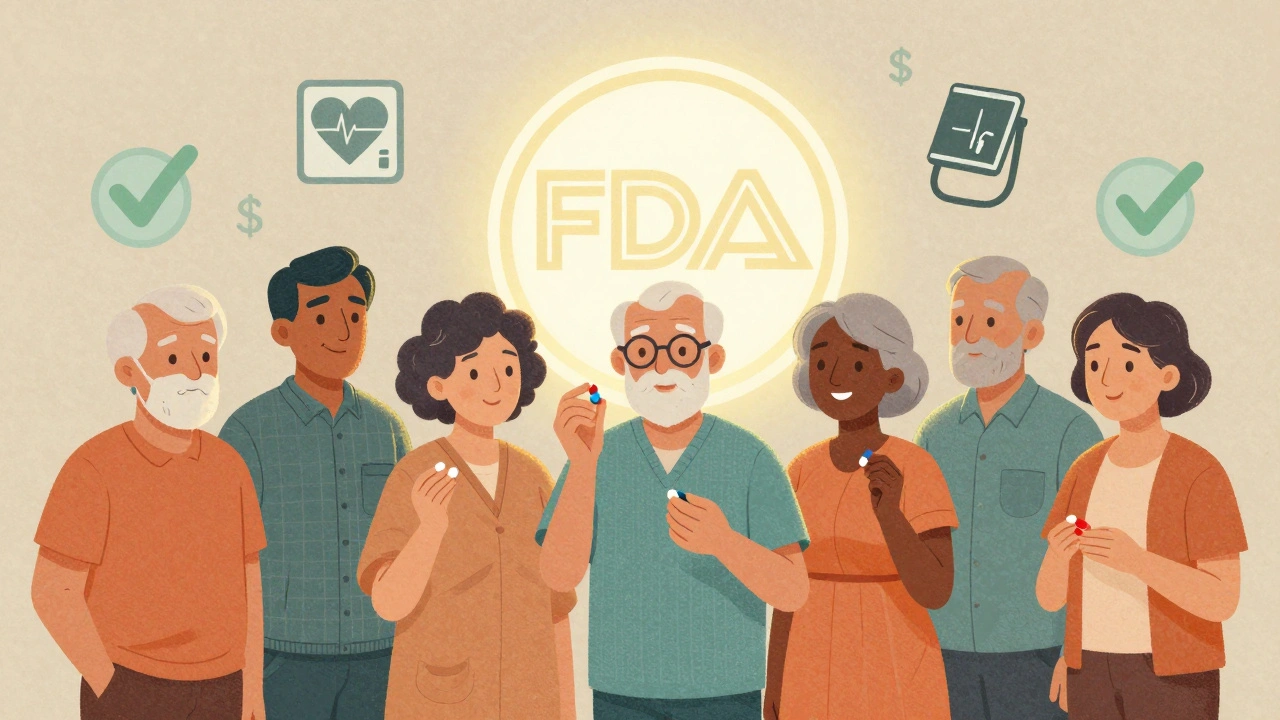
When you fill a prescription for high blood pressure or cholesterol, chances are you’re getting a generic drug. About 90% of all prescriptions in the U.S. are for generics, and cardiovascular meds make up one of the biggest chunks of that number. But even though they’re cheaper, many people still wonder: are they safe? Do they work just as well? The answer isn’t as simple as yes or no.
What Exactly Are Cardiovascular Generics?
Cardiovascular generics are copies of brand-name heart medications like lisinopril, atorvastatin, metoprolol, and losartan. They must contain the exact same active ingredient, strength, and dosage form as the original. The U.S. Food and Drug Administration (FDA) requires them to be bioequivalent-meaning they get into your bloodstream at nearly the same rate and amount as the brand-name version. The acceptable range? Within 80% to 125% of the original’s absorption. That’s not a guess. It’s a strict, science-backed standard. These drugs aren’t cheap knockoffs. They’re made in the same kind of facilities as brand-name drugs, following the same Current Good Manufacturing Practices (cGMP). In fact, many brand-name companies also make their own generics. The difference? Generics don’t carry the marketing costs, so they cost 80-95% less. From 2010 to 2019, generic cardiovascular drugs alone saved the U.S. healthcare system over $300 billion.The Evidence: Do Generics Work as Well?
The most reliable studies-randomized controlled trials-are clear. A 2020 Harvard Health meta-analysis reviewed 38 of these high-quality studies. In 35 of them (92.1%), generic cardiovascular drugs performed just like the brand names. No difference in heart attacks, strokes, hospitalizations, or death. The other three showed tiny, statistically insignificant differences that had nothing to do with the drug’s actual effect. A 2023 meta-analysis of over a million patients found no meaningful difference in major adverse cardiovascular events (MACEs) overall. The risk ratio was 1.02-meaning generics were essentially identical to brand names. Some classes even showed slight advantages: calcium channel blocker generics had fewer side effects (risk ratio 0.90), while statin generics showed a small but statistically significant increase in MACEs (risk ratio 1.13). That last point is important. It doesn’t mean statin generics are dangerous. It means we need to look closer.The Confusing Data: When Generics Seem Riskier
Then there’s the Canadian study from 2019 that made headlines. Researchers tracked 136,177 seniors over 66 who switched from brand-name ARBs (like valsartan and candesartan) to generics. In the first month after the switch, adverse events-like dizziness, low blood pressure, or kidney issues-went up. For candesartan, the rate jumped from 10% to 14%. That’s a real increase. But here’s what the study didn’t say: the patients weren’t randomly assigned. They were switched automatically by their pharmacy. Many were elderly, on multiple medications, and had been stable on their brand-name drug for years. The spike wasn’t because the generic was worse-it was because the switch itself was disruptive. A 2020 study in Circulation: Cardiovascular Quality and Outcomes found similar results. The problem wasn’t the drug. It was the sudden change. Another study looked at all-cause hospital visits. The crude data showed a 14% higher rate for generics. But when researchers narrowed it down to only randomized trials (where patients were assigned fairly), that difference vanished. The higher hospitalization rate? Likely due to older, sicker patients being switched more often, not the drugs themselves.
Why Do Some Patients Have Problems?
Not all generics are identical. They can have different fillers, dyes, or coatings. These inactive ingredients don’t affect how the drug works-but they can affect how your body reacts to it. For example, if you’re allergic to a dye used in one generic version of metoprolol, you might have a rash. That’s rare, but it happens. A bigger issue is pill appearance. A 2019 JAMA Internal Medicine study found that when a patient’s pill changed color or shape during a switch to generic, 14.2% stopped taking it altogether. They thought the new pill was wrong. Or weaker. Or fake. Even if it wasn’t. And then there’s the 2018-2020 nitrosamine contamination crisis. Some generic versions of losartan, valsartan, and irbesartan were found to contain trace amounts of cancer-causing impurities. Over 1,200 lots were recalled. That shook public trust. The FDA now tests for these impurities more rigorously. But the damage was done. Many patients still worry.What Do Doctors and Pharmacists Really Think?
There’s a gap between what the data says and what people believe. A 2021 American Medical Association survey found that 34.7% of cardiologists get asked by patients if generics are safe. About 18% of patients refuse to take them. A Consumer Reports survey in 2023 found that 61% of Americans believe brand-name drugs are more effective-even though the evidence says otherwise. That’s not ignorance. It’s fear. Fear of the unknown. Fear of something cheaper being worse. Pharmacists see this daily. A 2022 National Community Pharmacists Association survey showed that 89% believe generics are just as safe and effective. But 67% say they spend extra time counseling patients who are nervous. That’s not a failure of the drug. It’s a failure of communication. Even some doctors are hesitant. The American College of Physicians found that 25% of physicians say they wouldn’t use generics for their own families. That’s not based on data. It’s based on habit, fear, or anecdote.When to Be Cautious
Not every heart drug is the same. Some have a narrow therapeutic index-meaning the difference between a helpful dose and a dangerous one is tiny. Warfarin is the classic example. Switching brands here can be risky without close monitoring. The American Heart Association recommends against automatic substitution for these drugs unless you’re closely watched. That’s why many pharmacies still require a doctor’s note before switching a patient from brand-name warfarin to generic. Statins are another gray area. The 2023 meta-analysis showed a small but real increase in MACEs with generics. Why? Possibly because patients on statins are often older, sicker, and more likely to be switched mid-treatment. Or because some statin generics have slightly different absorption patterns. More research is needed. But for now, if you’re on a statin and feel worse after a switch, talk to your doctor. Don’t assume it’s all in your head.
What You Can Do
If you’re taking a cardiovascular generic:- Don’t panic if your pill looks different. That’s normal.
- Keep taking it unless you have real side effects-dizziness, swelling, chest pain, or sudden fatigue.
- Ask your pharmacist: “Is this the same generic I’ve been taking?” If the pill changed again, they can help you track it.
- If you feel worse after switching, don’t just stop. Call your doctor. You might need a different generic-or to go back to brand.
- Ask: “Why are we switching?” If it’s just cost, ask if you can stay on brand if you can afford it.
- Ask for a 30-day trial. If you feel fine, keep it. If not, go back.
- Use a pill organizer. It helps you notice if something feels off.
The Bottom Line
For most people, cardiovascular generics are safe, effective, and a smart choice. The data supports it. The savings matter. Millions of people take them without issue. But they’re not magic. They’re medicine. And medicine, even generic medicine, can behave differently in different bodies. The key isn’t to blindly trust or fear generics. It’s to pay attention. To communicate. To speak up if something changes. The real risk isn’t the generic drug. It’s silence. If you don’t tell your doctor when you feel different, you’re not getting the care you need. And that’s the only thing that’s truly dangerous.Are generic cardiovascular drugs as safe as brand-name ones?
For most people, yes. Large studies involving over a million patients show no significant difference in heart attacks, strokes, or death between generics and brand-name drugs. The FDA requires them to be bioequivalent, meaning they work the same way in the body. However, a few studies show small increases in side effects during the first month after switching-likely due to changes in pill appearance or patient anxiety, not the drug itself.
Why do some studies show higher hospital visits with generics?
Early data showed higher hospitalization rates with generics, but that was because the patients switched were often older, sicker, and already at higher risk. When researchers looked only at randomized trials-where patients were fairly assigned-the difference disappeared. The higher numbers were tied to who got switched, not the drug quality.
Can generic heart meds cause side effects brand names don’t?
The active ingredient is the same, so the main side effects are too. But generics can use different inactive ingredients-like dyes or fillers-that might cause rare allergic reactions. Also, if you’re used to a specific pill shape or color and it changes, you might stop taking it, which can lead to health problems. That’s not the drug’s fault-it’s a behavioral response.
Should I avoid generics if I’m on warfarin or statins?
For warfarin, the American Heart Association recommends caution. Because it has a narrow therapeutic window, switching generics without monitoring can be risky. For statins, a 2023 study showed a slight increase in major heart events with generics, but the reason isn’t clear. If you’re stable on a brand-name statin and feel fine, staying on it is fine. If you’re switched and feel worse, talk to your doctor. Don’t assume it’s normal.
What should I do if I think my generic isn’t working?
Don’t stop taking it. Call your doctor or pharmacist. Write down when you started the new pill and what symptoms you’re noticing. Sometimes it’s just your body adjusting. Other times, you may need a different generic brand or to go back to the original. Your doctor can check your blood pressure, cholesterol, or INR levels to see if the drug is working properly.
Are there recalls or contamination issues with cardiovascular generics?
Yes. Between 2018 and 2020, over 1,200 lots of generic ARBs (like losartan and valsartan) were recalled due to cancer-causing impurities called nitrosamines. The FDA now tests for these more strictly, and manufacturers must meet strict limits (96 nanograms per day). While rare, it happened-and it’s why some patients are wary. Always check for recall notices from the FDA or your pharmacy.
Courtney Co
December 1, 2025 AT 09:12And don't get me started on the pill color changes. I thought I was getting scammed.
Priyam Tomar
December 2, 2025 AT 00:08Irving Steinberg
December 2, 2025 AT 20:30My blood pressure is perfect and I saved $1200 a year
Who cares if the pill is blue instead of yellow? 🤑
Stop overthinking it folks
Lydia Zhang
December 3, 2025 AT 02:40Kay Lam
December 3, 2025 AT 14:03And honestly? I'd rather pay more and sleep at night.
Adrian Barnes
December 4, 2025 AT 04:53Dennis Jesuyon Balogun
December 5, 2025 AT 21:03Grant Hurley
December 6, 2025 AT 01:44but then again i'm not a doctor so what do i know 😅
still saved like $80 a month so i'm not complaining
also my pill is now green and i think that's kinda cool
Bee Floyd
December 6, 2025 AT 16:40Turns out, the system works if you’re willing to speak up. You’re not being difficult. You’re being smart.
Jeremy Butler
December 6, 2025 AT 23:17Shashank Vira
December 7, 2025 AT 13:07Eric Vlach
December 8, 2025 AT 08:37Souvik Datta
December 9, 2025 AT 11:00