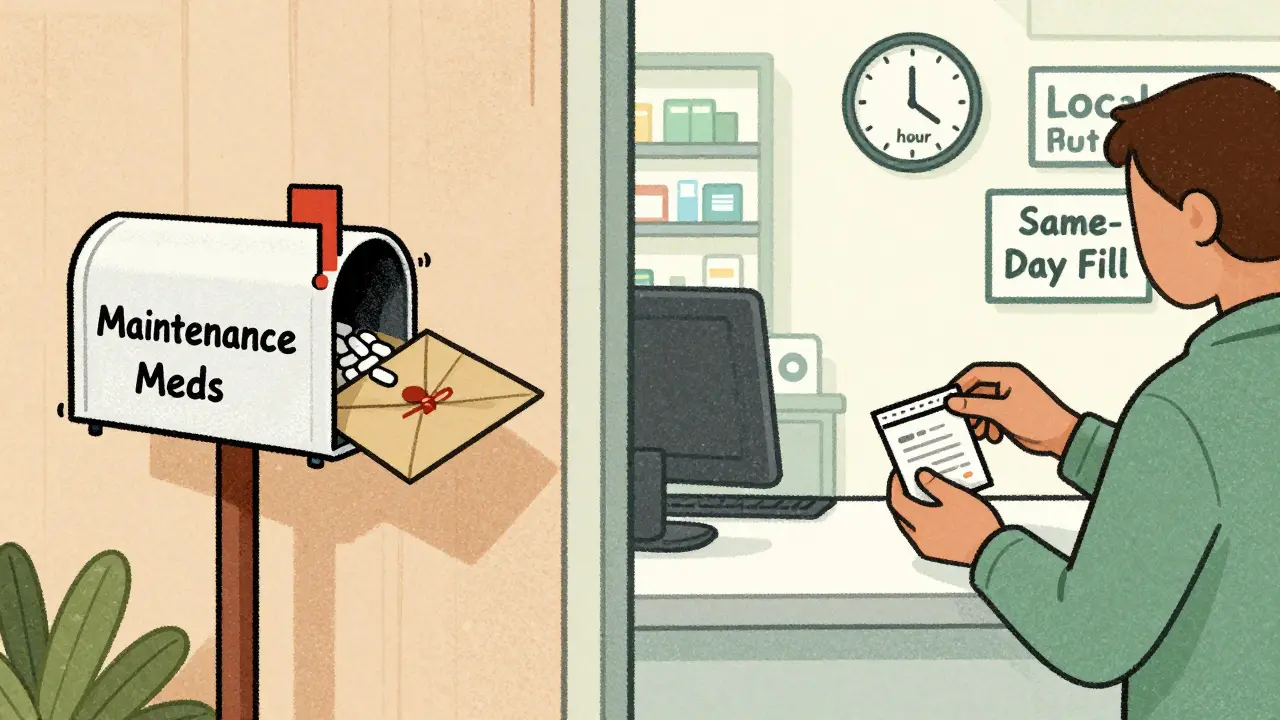
Managing prescription costs doesn’t mean you have to choose between convenience and savings. The smartest way to cut your medication expenses isn’t by sticking to one pharmacy-it’s by using mail-order and local pharmacies together, strategically. Most people don’t realize they can save hundreds a year just by splitting their prescriptions between the two. Here’s how to do it right-without risking your health or wasting money.
Understand Which Medications Belong Where
Not all prescriptions are created equal. The key to saving money is sorting your meds into three groups: maintenance, acute, and variable-dose.Maintenance medications are the ones you take every day, for months or years-like blood pressure pills, diabetes drugs, or cholesterol reducers. These are perfect for mail-order. You get a 90-day supply delivered to your door, often at a fraction of the retail price. For example, a 30-day supply of a generic blood pressure med might cost $45 at your local pharmacy. The same drug as a 90-day mail-order fill? Often $115 or less. That’s $30 saved every three months.
Acute medications are short-term-antibiotics, painkillers after surgery, or inhalers for sudden asthma attacks. These need to be available immediately. Mail-order takes 7-14 days to arrive. If you’re in pain or sick, you can’t wait. That’s where your local pharmacy shines. You walk in, get your script filled, and leave with the medicine in under an hour.
Variable-dose meds are the tricky ones. These are drugs your doctor might adjust often-like antidepressants, thyroid meds, or new diabetes treatments. If your dose changes, you don’t want 90 days of the wrong strength sitting in your cabinet. Fill these at your local pharmacy until your regimen stabilizes.
Check Your Insurance Plan’s Real Costs
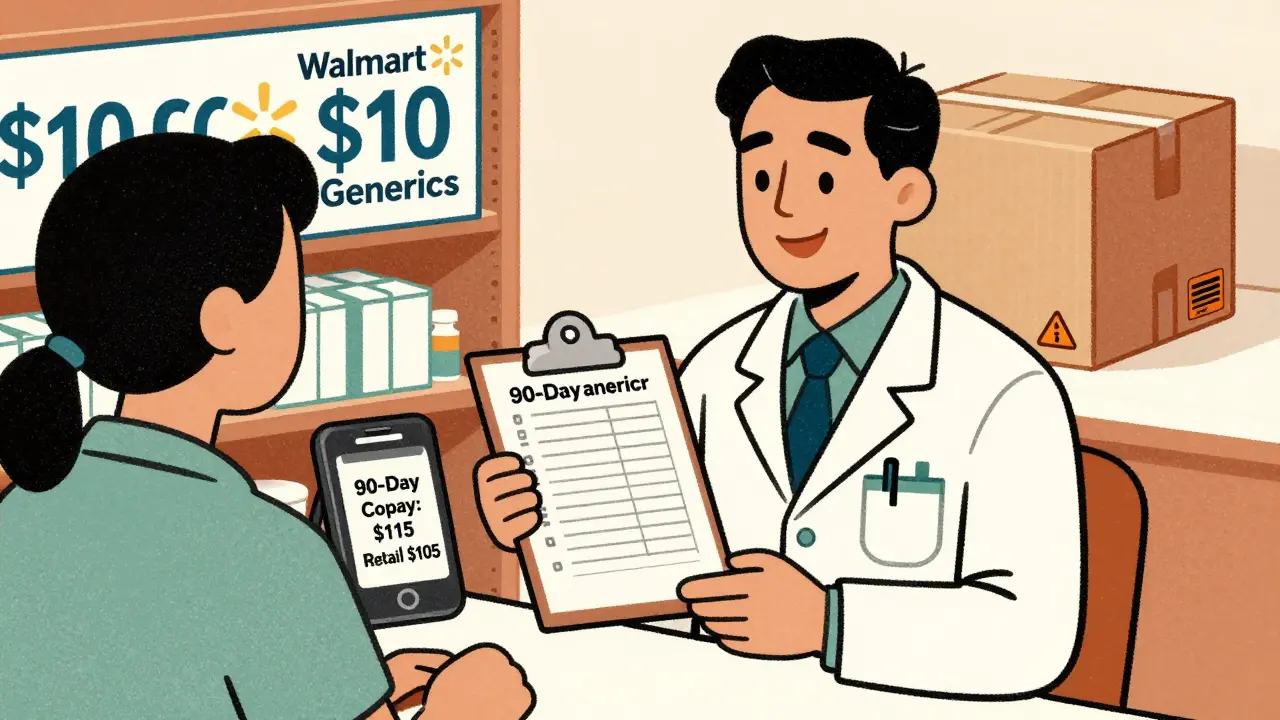
Your insurance might say mail-order is cheaper-but it’s not always true. Many people assume they have to use the mail-order service their plan pushes. That’s a mistake.Some plans charge the same copay for a 90-day supply whether you get it through mail-order or at a local pharmacy. CVS, Walgreens, and Walmart all offer 90-day generic fills at prices matching or beating mail-order. Walmart’s generic program, for instance, lets you get 90 days of common meds for just $10-even without insurance.
Don’t guess. Call your insurance provider and ask: “What’s my copay for a 30-day supply vs. a 90-day supply at a retail pharmacy?” Then ask: “What’s my copay for a 90-day mail-order fill?” Write it down. You might be shocked to find your local pharmacy is just as cheap-or cheaper-for your specific meds.
Also, check your formulary tiers. Most plans have 3-4 tiers. Mail-order often gives you the best deal on Tier 2 and Tier 3 drugs. But if your drug is on Tier 1 (lowest cost), the difference might be negligible. Use Medicare’s Plan Finder or your insurer’s online tool to compare prices by pharmacy type. If you’re on Medicare, the 2024 changes mean 90-day supplies are now standardized across channels-so the old mail-order advantage isn’t automatic anymore.
Set Up a Refill System That Works
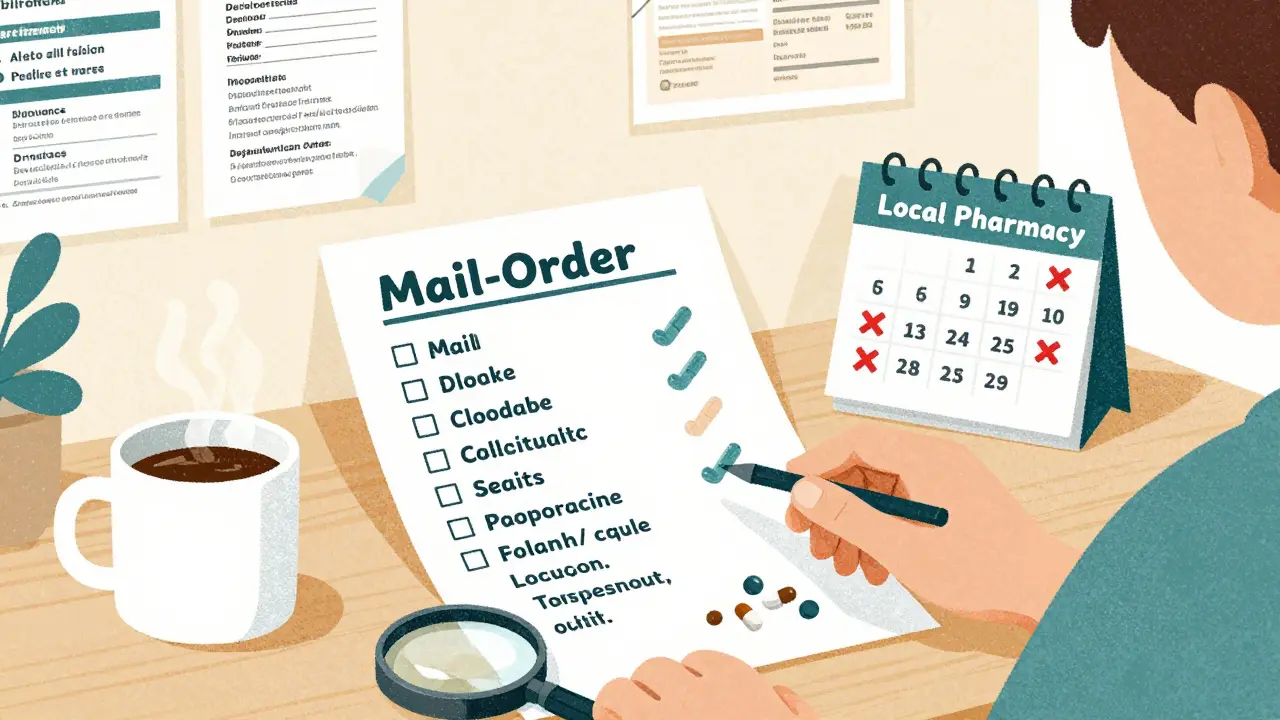
The biggest reason people give up on mail-order? They run out. No one likes calling their doctor for an emergency refill because they forgot to order.Set calendar reminders 10-14 days before your mail-order meds run out. That gives you time to order, account for shipping delays, and still have a buffer. Use your phone’s calendar, a sticky note on your fridge, or a free app like Medisafe. One user on Reddit saved $427 a year just by setting reminders for their amlodipine refill. They never missed a dose.
Keep a simple list: which meds go to mail-order, which stay local, and when each refill is due. Update it every time your doctor changes a prescription. If your antidepressant dose gets adjusted, switch back to local pharmacy until it’s stable again.
Use Your Local Pharmacist as a Free Resource
Local pharmacists aren’t just pill dispensers. They’re trained medication experts who can spot potential problems you might miss.Go in every few months and ask: “Can you review all my meds?” They’ll check for interactions, suggest cheaper alternatives, or tell you if a drug you’re taking by mail-order could be cheaper locally. One study found that 40% of patients could save over $200 a year just by doing this.
Also, ask about discount programs. CVS has a $4/$10/$25 generic program. Walgreens has a similar one. Walmart’s $10 90-day generics are already well-known. But many people don’t know they can use these programs even if they have insurance. Sometimes, the cash price beats your insurance copay.
Watch Out for Common Pitfalls
There are traps. Avoid them.Don’t let mail-order handle new prescriptions. If your doctor prescribes something new, fill it locally first. Give it a few weeks. See how you react. Adjustments happen. Mail-order doesn’t adapt fast.
Don’t ignore shipping risks. Insulin, biologics, and some specialty drugs can lose potency if they’re too hot or too cold during delivery. If your drug needs refrigeration, stick to local pickup. The FDA warns that temperature exposure during shipping can reduce effectiveness.
Don’t assume your plan won’t change. Insurance companies tweak formularies every year. A drug that was $115 via mail-order last year might jump to $150 this year. Review your benefit statement every January. If your savings drop, switch back to local.
Don’t let tech glitches cost you. One user had their antidepressant dose changed by their doctor-but the mail-order pharmacy kept sending the old version for two months because their system didn’t sync with the EHR. They ended up wasting $65 in unused pills. Always confirm your refill with your pharmacist before it ships.
What’s Changing in 2026?
The pharmacy world is shifting. By 2025, 65% of commercial plans are expected to offer integrated pharmacy networks-where mail-order and local pharmacies sync up automatically. UnitedHealthcare’s Optum Perks and Express Scripts’ Pharmacy Choice program already let you switch between channels without hassle.But here’s the catch: 43% of Medicare Advantage plans cut mail-order incentives in 2023. The old model of “always use mail-order for savings” is fading. The new model is “choose the cheapest option per drug, every time.” That’s why coordination matters more than ever.
Tools like Epic’s Pharmacy Navigator, launched in late 2023, now recommend the best fill method based on your drug, insurance, and history. But until those tools are everywhere, you need to do the work yourself.
Start Small. Save Big.
You don’t need to overhaul everything at once. Pick one maintenance medication-maybe your cholesterol pill-and try switching it to mail-order. Compare the cost. If it saves you $20-$30 per refill, do the same with another. In three months, you’ll have a system. In a year, you could save $300-$500.It’s not about being perfect. It’s about being smarter than the system. Most people pay what they’re told to pay. You? You’ll know where to get the best deal-every time.

Jose Mecanico
January 12, 2026 AT 14:39I’ve been doing this for two years now-blood pressure med on mail-order, asthma inhaler local. Saved $380 last year alone. No drama, no missed doses. Just smart splitting.
Walmart’s $10 generics are a game-changer if you’re on a tight budget. No insurance? Still works.
Alex Fortwengler
January 14, 2026 AT 11:27LOL you people actually believe this? Mail-order is just a scam for Big Pharma to lock you in. They delay shipments on purpose so you panic and buy more at retail. I’ve seen it. My cousin’s insulin got stuck in Texas heat for 5 days. He ended up in the ER. Your ‘savings’ are a trap.
And don’t even get me started on insurance formularies-they change overnight. You think you’re saving? You’re just another pawn in their game.
jordan shiyangeni
January 15, 2026 AT 09:28It’s fascinating how casually people dismiss the structural inequities embedded in pharmaceutical distribution systems. The notion that individual behavioral adjustments-like ‘setting calendar reminders’-can meaningfully mitigate systemic cost inflation is not merely naive, it is dangerously capitulatory.
The FDA’s own data shows that 62% of temperature-sensitive biologics shipped via mail-order experience suboptimal thermal exposure, yet regulatory enforcement remains virtually nonexistent. Meanwhile, pharmacy benefit managers extract 23% of the total drug cost as administrative fees, while the actual manufacturing cost hovers at 7%.
When you ‘save’ $115 on a 90-day supply, you’re not winning-you’re subsidizing a corporate structure that commodifies human health. And yet, you pat yourselves on the back for using Walmart’s $10 program like it’s a moral victory. It’s not. It’s survival. And survival is not strategy.
Real reform requires dismantling PBMs, not optimizing refill schedules. But I suppose that’s too much to ask when you’re too busy setting reminders on your phone to notice the machine grinding your dignity into profit margins.
Abner San Diego
January 16, 2026 AT 21:45Who the hell wrote this? Some corporate shill for CVS? You’re telling me to use mail-order but not for insulin? Then why the hell is my plan pushing it for everything?
And Walmart’s $10 generics? Yeah, right. I tried that for my thyroid med-turned out they were giving me the 2019 version. No active ingredient. Had to go to the ER. Now I just pay full price and stop caring.
This whole ‘coordination’ thing is just a fancy way to make you jump through hoops so Big Pharma can keep raking it in. We’re not saving money-we’re being exploited with a smile and a checklist.
Eileen Reilly
January 18, 2026 AT 11:36okay but like… i tried the mail order for my zoloft and it took 3 weeks to get here bc the package got ‘lost’ then came back with the label half melted??
my pharmacist was like ‘lol u good?’ and gave me a 30-day freebie. now i just do local for everything. also they give me free gummy vitamins. 🍬
ps: walmart’s $10 thing is legit tho. my mom gets her metformin there every month. no cap.
Monica Puglia
January 18, 2026 AT 23:25This is so helpful 💙
My grandma just started using mail-order for her blood pressure meds and she’s been so much calmer knowing she doesn’t have to drive in the rain to get refills. And local pharmacy for her antibiotics? Perfect. She says the pharmacist remembers her name now. That matters.
Also, I just asked my pharmacist to review all my meds last week-he found a dangerous interaction I didn’t even know about. Free advice from someone who actually cares? Priceless.
You’re not just saving money-you’re building a smarter, safer system. Keep doing this. 🙏
Faith Wright
January 20, 2026 AT 11:22Wow. So you’re telling me the solution to corporate greed is… doing more work? How cute.
My sister’s insulin got ruined in the mail last winter. She had to pay $800 out of pocket for a new one because the company said ‘it wasn’t their fault the truck broke down.’
They want you to be a logistical ninja just to afford your meds. That’s not ‘smart’-that’s broken.
But hey, at least we can all feel good about our calendars and Walmart coupons while the system burns.
🙄
Rebekah Cobbson
January 21, 2026 AT 15:32Thank you for this. I’m not great with systems, but I printed out your three categories and taped it to my fridge. Changed my life.
Switched my cholesterol med to mail-order. Saved $40 this month. Then I asked my pharmacist about my antidepressant-she said the local price was cheaper than mail-order. I switched back. No guilt. No stress.
You don’t have to be perfect. You just have to be curious. And maybe keep a sticky note. 📝
Audu ikhlas
January 22, 2026 AT 06:21USA so weak. In Nigeria we just go to the market, buy medicine from guy with sack, pay $2, done. No insurance, no mail-order, no apps. No one cares about your calendar.
You Americans turn medicine into a full-time job. Sad.
Also Walmart $10? LOL. We get better drugs for $1. Your system is a joke.