Drug-Induced Tremor Risk Calculator
Is Your Tremor Drug-Induced?
Enter your medication details to assess tremor risk and find safer alternatives
Risk Assessment
Recommended Alternatives:
Ever felt your hands shake out of nowhere - not from caffeine, not from nerves - but right after starting a new pill? You’re not alone. Drug-induced tremor is one of the most common, yet often missed, side effects of prescription medications. It’s not just a nuisance. It can make writing, eating, or even holding a coffee cup feel impossible. And worse, it’s often mistaken for Parkinson’s disease or essential tremor - leading to unnecessary worry and wrong treatments. The good news? In most cases, it’s completely reversible.
What Exactly Is a Drug-Induced Tremor?
A drug-induced tremor is an involuntary, rhythmic shaking caused by certain medications. It’s not something you’re imagining. Your muscles are contracting and relaxing rapidly, usually at a pace of 4 to 12 times per second. These tremors typically show up when you’re trying to hold a position - like reaching for a cup or stretching your arms out - not when you’re resting. That’s a key difference from Parkinson’s tremors, which usually happen when your hands are still. The shaking most often hits your hands (85% of cases), but it can also affect your head, voice, arms, or even your trunk. You might notice it within hours of taking a new drug, or it could creep in after weeks. And here’s the thing: it disappears when you sleep. If you wake up and your hands are steady, that’s a clue this isn’t a brain disorder - it’s a reaction to something you’re swallowing.Which Medications Are Most Likely to Cause Tremors?
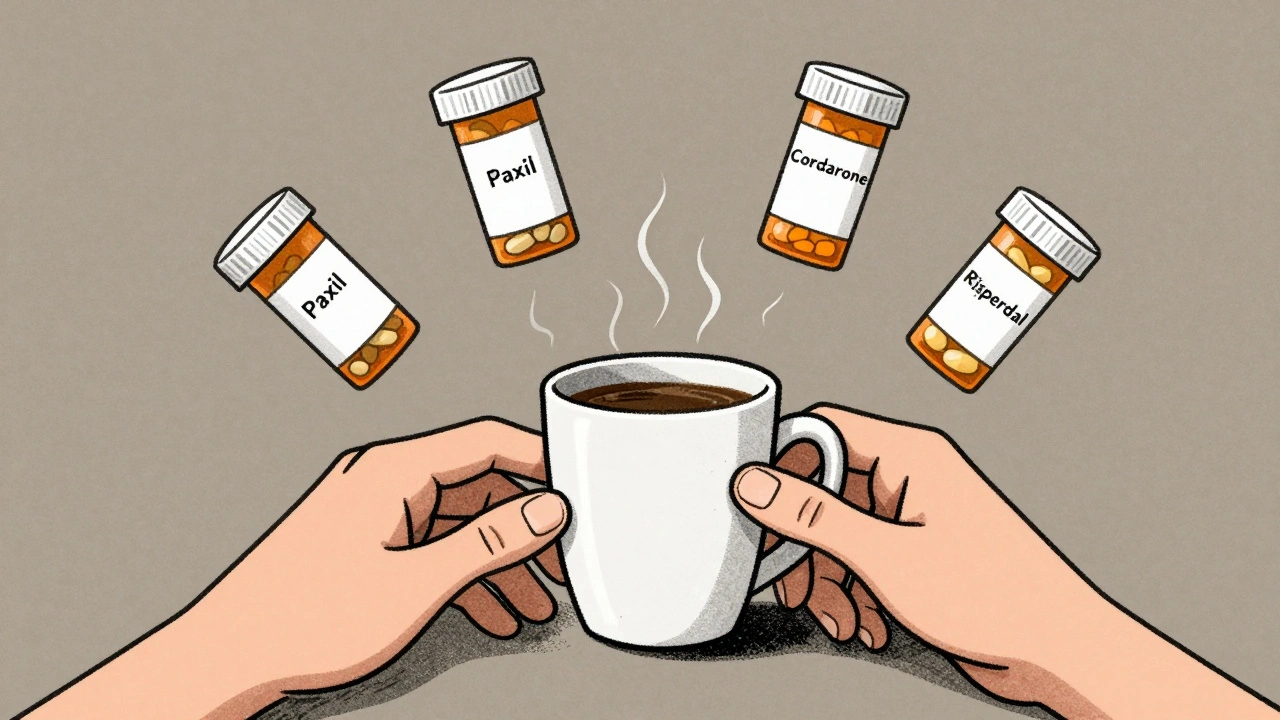
Not all drugs cause shaking, but some are far more likely than others. Based on FDA data from 2018 to 2022, these are the top culprits:- Antidepressants - especially SSRIs and SNRIs like paroxetine (Paxil), fluvoxamine (Luvox), and clomipramine (Anafranil). Tricyclics like amitriptyline are even riskier, with a 3.2 times higher chance than newer antidepressants.
- Heart medications - amiodarone (Cordarone) is a big one, responsible for over 15% of reported cases.
- Antipsychotics - risperidone (Risperdal) and haloperidol can cause tremors in 5-30% of users, depending on the drug and dose.
- Lithium - used for bipolar disorder. At levels above 0.8 mmol/L, nearly 1 in 5 people develop noticeable shaking.
- Asthma inhalers - albuterol (Ventolin) can cause tremors in up to 40% of users. Levalbuterol (Xopenex) is a gentler alternative.
How Is It Different from Parkinson’s or Essential Tremor?
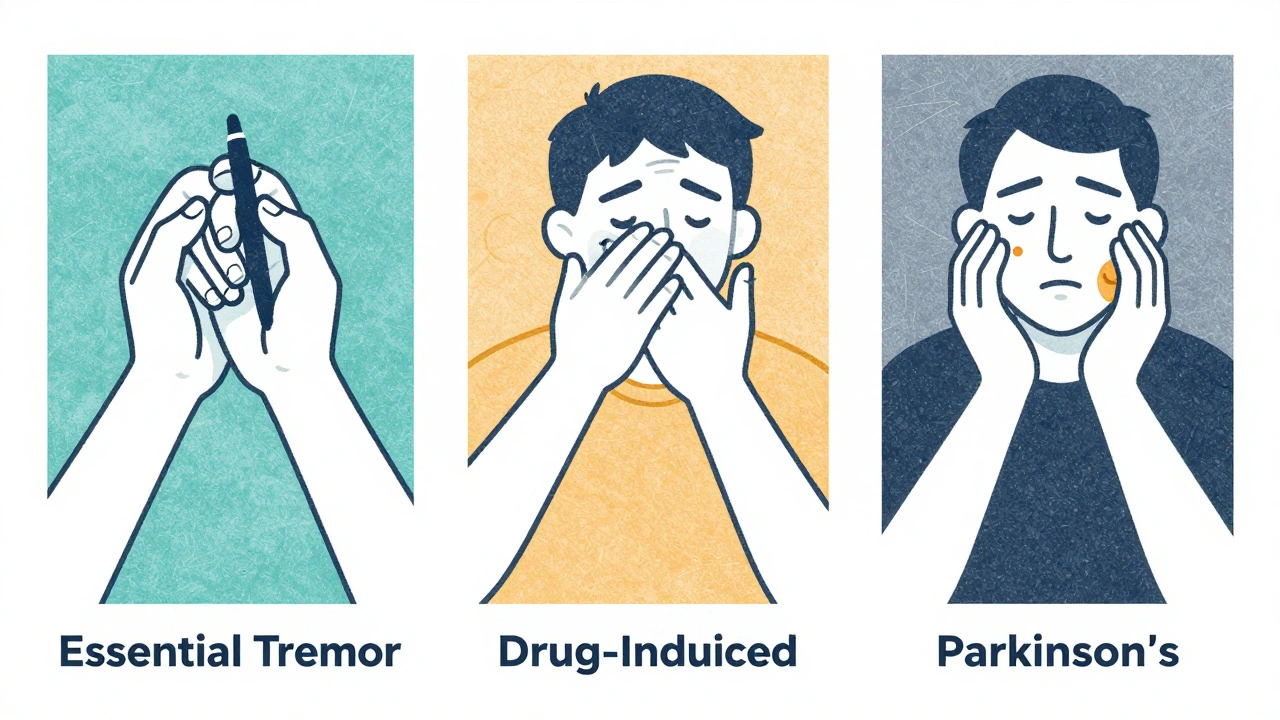
This is where things get confusing - and why so many people get misdiagnosed.- Drug-induced tremor: Starts after you begin a new medication. Happens during movement or holding a pose. Usually goes away when you stop the drug. No other symptoms like stiffness or slow movement.
- Essential tremor: Often runs in families. Gets worse with stress or caffeine. Happens during action, but doesn’t go away when you stop a medication. Gets worse over time.
- Parkinson’s tremor: Happens at rest - like when your hand is resting in your lap. Often described as a “pill-rolling” motion. Comes with stiffness, slowness, and balance issues. Doesn’t improve just by quitting a drug.
What Should You Do If You Think a Drug Is Causing Your Tremors?
Step one: Don’t panic. But also don’t ignore it. Start by tracking your symptoms. Write down:- When you started the medication
- When the shaking began
- What time of day it’s worst
- What makes it better or worse (stress, caffeine, movement)
- Check if the timing matches - if tremors started within 72 hours of starting the drug, it’s highly likely the cause.
- Rule out other causes like thyroid problems or alcohol withdrawal.
- Look at your full medication list. Many people take 5+ drugs, and the combination is what’s triggering the tremor.
How Are Drug-Induced Tremors Treated?
The best treatment? Stopping or switching the drug.- Discontinue the drug - If it’s not essential (like a non-critical painkiller or antihistamine), stopping it usually clears the tremor in 2-8 weeks. Studies show 76% of people improve within two weeks.
- Reduce the dose - If you can’t quit (like with antipsychotics or lithium), lowering the dose helps in 63% of cases.
- Switch to a safer alternative - For depression, sertraline (Zoloft) or escitalopram (Lexapro) have 40% lower tremor risk than paroxetine or fluvoxamine. For asthma, levalbuterol causes 37% fewer tremors than albuterol.
- Add a beta-blocker - Propranolol (Inderal) at 20-80 mg daily reduces tremor severity in about 58% of people who still shake after adjusting their meds.

When Should You Worry? Red Flags to Watch For
Most drug-induced tremors are harmless and go away. But some signs mean you need help right away:- Tremors + fever + confusion - could be neuroleptic malignant syndrome (a life-threatening reaction to antipsychotics).
- Tremors + rapid heartbeat + sweating - could mean thyroid storm from too much levothyroxine.
- Tremors + muscle rigidity + trouble speaking - could signal worsening parkinsonism.





Rudy Van den Boogaert
December 3, 2025 AT 14:59I had no idea my shaky hands from Paxil were even a thing. Thought I was just anxious or getting old. Took me six months to connect the dots after my doc prescribed it for anxiety. Once I switched to sertraline, the tremors vanished in 10 days. No more spilling coffee, no more avoiding handshakes. Seriously, if you’re on an SSRI and shaking, don’t just power through - ask about alternatives. Your hands will thank you.
Also, the CYP2D6 gene thing? Wild. My brother got tested after his tremors and turns out he’s a poor metabolizer. His doc didn’t even know to check. We need more awareness.
Thanks for writing this. It’s the kind of post that saves people from years of unnecessary stress.
Pavan Kankala
December 5, 2025 AT 02:06Big Pharma doesn’t want you to know this. Tremors? They’re not side effects - they’re *warning signals* they buried under 47-page consent forms. The FDA’s ‘updated labels’? A PR stunt. They’ve known for decades. Lithium? Antipsychotics? SSRIs? All designed to keep you dependent. The real cure isn’t switching meds - it’s getting off the pharmaceutical treadmill entirely. Try magnesium, CBD, or even fasting. Your body doesn’t need chemicals to regulate itself. They just profit when you’re shaky.
And don’t get me started on AI ‘predicting’ tremors. That’s just more data harvesting. They’re not helping you - they’re profiling you.
jagdish kumar
December 5, 2025 AT 03:44Shaking is just the soul screaming through the body.
Medication? Just a bandage on a wound that’s deeper than the doctor cares to look.
zac grant
December 5, 2025 AT 23:55As a neurology PA, I see this every week. Drug-induced tremor is massively underdiagnosed - especially in geriatric polypharmacy cases. The key is timing: if tremor onset aligns with new med initiation (within 72 hours), it’s 90% likely causative. Always check for drug-drug interactions - SSRIs + beta-blockers + lithium? Recipe for kinetic chaos.
Propranolol works well as adjunct, but only after addressing the root. And yes - levalbuterol over albuterol is a no-brainer for asthmatics with tremor. 37% reduction is clinically significant.
Also, CYP2D6 phenotyping should be standard before prescribing SSRIs. We’re in 2025. Pharmacogenomics isn’t futuristic - it’s essential.
Gillian Watson
December 6, 2025 AT 11:26Jordan Wall
December 8, 2025 AT 02:55OMG I’m so glad someone finally said this 🙌 Like I’ve been saying since my neurologist misdiagnosed me with essential tremor - turns out it was my *antidepressant* and my *beta-blocker* and my *thyroid med* all doing a little dance in my basal ganglia 😭 I mean… how is this not common knowledge? Like… is the medical industry just… *sleeping*? 🤦♂️ I had to read a Reddit post to figure out I wasn’t ‘getting old’ but was literally being poisoned by my own Rx list 🤯 #PharmacoToxicity #PolypharmacyNightmare
Gareth Storer
December 8, 2025 AT 14:17So let me get this straight - you’re telling me the entire medical establishment is so incompetent they can’t tell the difference between a drug reaction and Parkinson’s? And you’re surprised people are dying from misdiagnoses? I mean… I guess that’s why they call it ‘medicine’ and not ‘science’.
Also, 34% of elderly people on 5+ meds develop tremors? Wow. That’s not a side effect. That’s a public health scandal. And yet we still prescribe like it’s a buffet.
Shofner Lehto
December 9, 2025 AT 00:56For anyone reading this and thinking ‘I don’t want to rock the boat with my doctor’ - you’re not being difficult. You’re being responsible. Your body is telling you something. Don’t let fear of being ‘that patient’ silence you. I had a patient in her 70s who finally spoke up after 18 months of shaking. We switched her from fluvoxamine to escitalopram. Tremors gone in 12 days. She cried. Not from sadness - from relief.
You’re not a burden. You’re a partner in your care. And this post? It’s the kind of thing that helps people find their voice.
Keep asking questions. Keep tracking. Keep showing up.
And if you’re a clinician reading this - thank you. We need more of this.