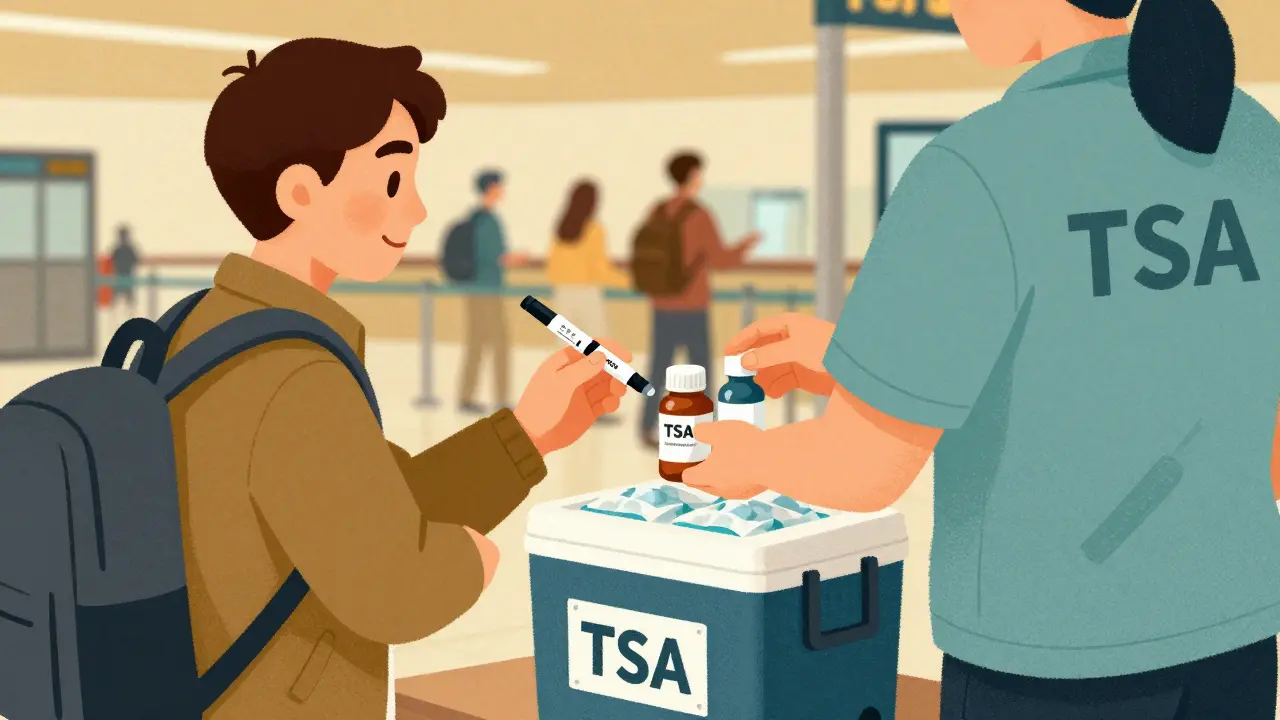
Traveling with medication shouldn’t feel like a gamble. You’ve got your tickets, your bag packed, and your itinerary set - but then you remember: your insulin, your daily pills, your child’s liquid ADHD medication. What happens at security? Will it freeze in the cargo hold? Will they take it away? You’re not alone. Millions of travelers face this every year, and the stakes are high. A single mistake can mean missed doses, ruined medication, or a long delay at the airport. The good news? With the right prep, you can fly with confidence - no panic, no surprises.
Keep Medications in Original Containers
The TSA doesn’t just recommend it - they require it. Every pill, liquid, or injection must stay in its original pharmacy bottle. That means the label must show your full name, the drug name, dosage, and the prescribing doctor’s information. No exceptions. Not even if you’ve been taking the same pill for ten years. Not even if you hate the bulky bottle. Why? Because repackaging meds into pill organizers or small ziplock bags can cause serious problems. A 2023 study by the American Society of Health-System Pharmacists found that transferring medications out of original containers can reduce potency by up to 30% in just 72 hours. Moisture, light, and temperature shifts from handling can degrade active ingredients. And at security? If your meds don’t have the label, they’ll be flagged. You’ll get pulled aside. You’ll waste time. You might even be denied boarding. Real story: A traveler in LAX tried to sneak her Humira pens into a small cooler without labels. TSA agents stopped her. She had to call her pharmacy to fax a copy of the prescription. She missed her flight. Don’t be her.Liquid Medications: Bigger Than 3.4 Ounces? It’s Allowed
You’ve heard the 3.4-ounce rule for liquids. But that rule doesn’t apply to medically necessary liquids. Insulin, liquid antibiotics, liquid pain meds, even feeding formulas - if it’s prescribed for you, you can bring as much as you need. Here’s how to do it right:- Keep it in the original bottle with the prescription label.
- Declare it at the security checkpoint - don’t wait for them to ask.
- Have your prescription or doctor’s note ready. A letter on official letterhead helps, especially for international travel.
Temperature-Sensitive Medications: Don’t Let Them Freeze or Cook
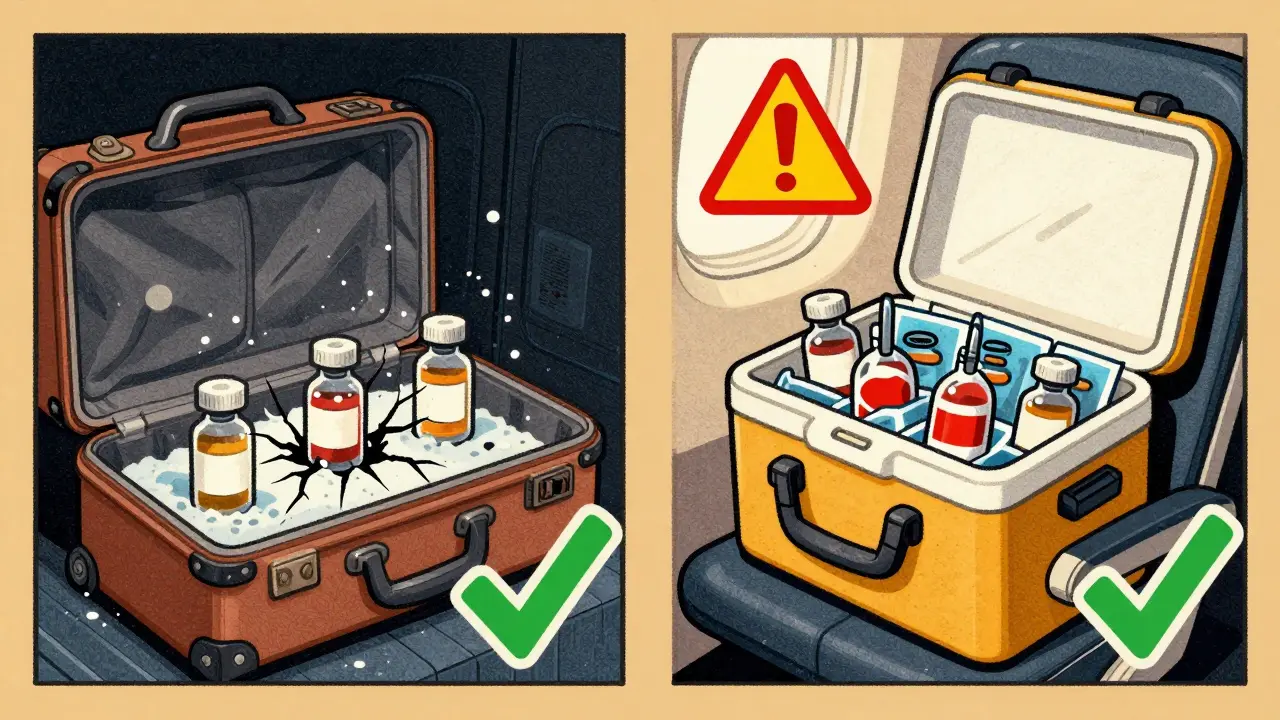
This is where most travelers mess up. Medications like insulin, biologics, certain antibiotics, and even some migraine treatments need to stay between 2°C and 8°C (36°F-46°F). Too cold? They freeze. Too hot? They break down. Cargo holds can drop to -40°C (-40°F). That’s enough to crystallize insulin - permanently ruining it. Overhead bins? On a long flight, they can hit 40°C (104°F). That’s worse than leaving your meds in a car on a summer day. Solution? Use a TSA-approved insulated cooler with frozen gel packs. Here’s how:- Freeze your gel packs for at least 24 hours before you leave.
- Put them in a hard-shell cooler (not a soft lunch bag).
- Make sure the gel packs are fully frozen when you get to security - TSA agents will check.
- Keep your meds in the cooler at all times - never check it.
Injectables and Sharps: Needles, Syringes, Pumps
If you use insulin pens, injectables, or infusion pumps, you’re allowed to bring them - and the needles, syringes, and lancets that go with them. But you must keep them together. Don’t pack your syringes in your toiletries bag. Don’t leave your pen in your checked luggage. TSA requires that:- All sharps go in a FDA-approved sharps container.
- Needles must be accompanied by the medication they’re meant for.
- Infusion pumps and glucose monitors are allowed - no special paperwork needed.
Documentation: The Three Must-Haves
You can’t just show up and hope for the best. Bring these three things:- Original prescription labels - on every bottle, vial, or pen.
- A doctor’s letter - on official letterhead, dated within the last year, explaining your condition and why you need the meds. Include dosage and frequency.
- Translated copies - if you’re flying outside the U.S., Canada, UK, Australia, or EU. Many countries require meds to be labeled in their language. Use a service like ATA Document Translation - it takes 14 days.
International Travel: Know the Rules Before You Go
Rules change by country. What’s legal in the U.S. might be banned in Japan or restricted in the UAE. Here’s what to check:- Japan, South Korea, UAE: Pseudoephedrine (found in cold meds) is illegal unless pre-approved. You need a special permit - apply at least 30 days ahead.
- EU countries: Allow up to 90 days’ supply with a prescription.
- Many Asian countries: Limit you to 30 days’ supply. Exceed that, and you risk confiscation.
- Australia: Requires a declaration for all controlled substances - even ADHD meds like Adderall.
Time Zones and Schedules: Don’t Miss a Dose
Crossing five or more time zones? Your body’s clock gets thrown off. So does your medication schedule. The American Academy of Sleep Medicine recommends adjusting your dose times gradually:- Start 3-5 days before departure.
- Shift your dose by 15-30 minutes each day.
- For example: If you take your pill at 8 a.m. EST and you’re flying to Tokyo (14-hour difference), aim to be taking it at 10 p.m. Tokyo time by the day you leave.
What Not to Do
Here’s a quick list of mistakes to avoid:- Don’t pack meds in checked luggage. Cargo holds are too cold, too hot, and too unpredictable.
- Don’t transfer pills to unlabeled containers. Even if it’s just for a weekend trip.
- Don’t forget your doctor’s letter. It’s not optional - it’s your insurance.
- Don’t assume your meds are legal abroad. Always check.
- Don’t wait until the airport to figure this out. Pack 72 hours before you leave.
What’s New in 2025
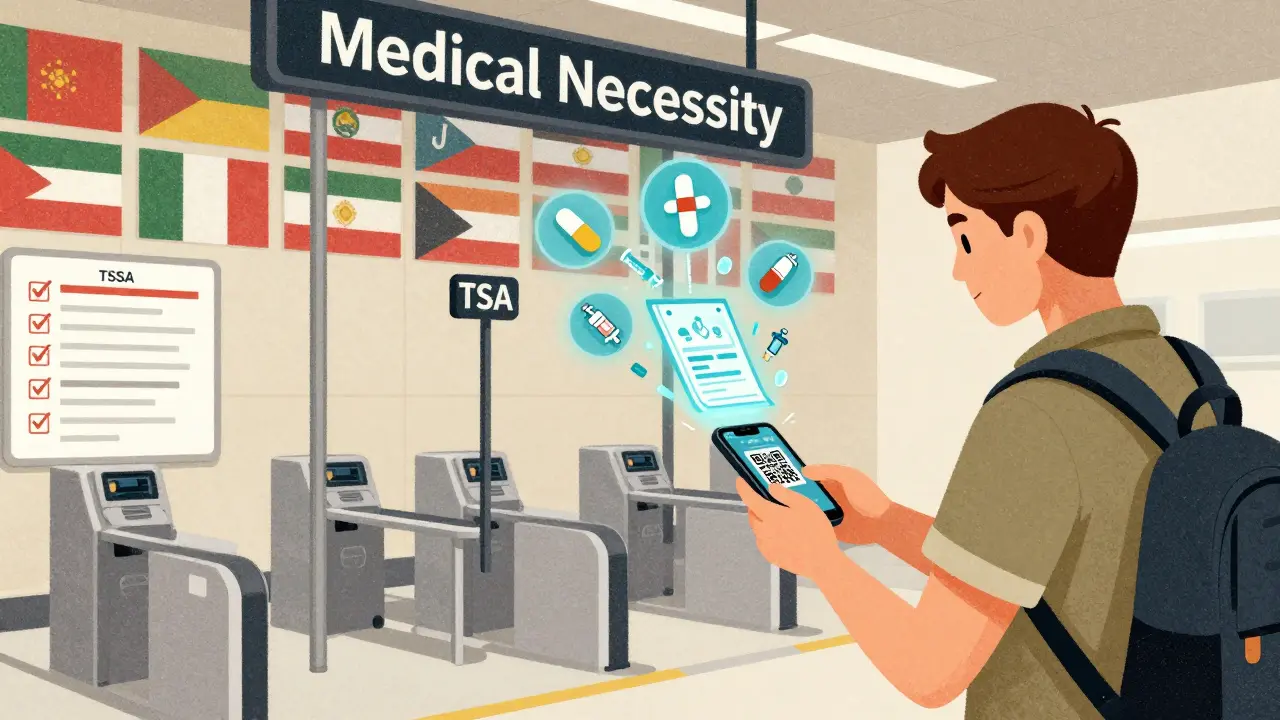
The TSA is rolling out a major upgrade. By December 2025, every major U.S. airport will have a dedicated Medical Necessity screening lane. These lanes are designed for travelers with medications, medical devices, or implants. Pilot programs in Atlanta and Chicago cut average screening time from 14.7 minutes to just 3.2 minutes. There’s also a new digital option: MyMediTravel. It’s a blockchain-based digital passport for your meds. You upload your prescriptions, doctor’s notes, and meds list. At security, you scan a QR code. No paper needed. Over 127,000 travelers are already using it. It’s free. You can sign up at mymeditravel.com.Final Checklist
Before you leave for the airport, check this box:- ☑ All meds in original pharmacy containers with labels
- ☑ Liquid meds in separate clear bag, declared at checkpoint
- ☑ Temperature-sensitive meds in frozen, hard-shell cooler
- ☑ Sharps in FDA-approved container
- ☑ Doctor’s letter on letterhead (with translation if needed)
- ☑ Medication schedule adjusted for time zones
- ☑ Destination country rules verified
- ☑ Digital medication passport uploaded (optional but recommended)
Frequently Asked Questions
Can I bring my medications in a pill organizer?
No. The TSA requires all prescription medications to be in their original containers with the pharmacy label. Pill organizers are fine for daily use at home, but never for air travel. If you’re caught with unlabeled pills, you’ll be pulled aside for additional screening - and your meds might be confiscated. Always keep the original bottle.
What if my medication is not approved in the country I’m visiting?
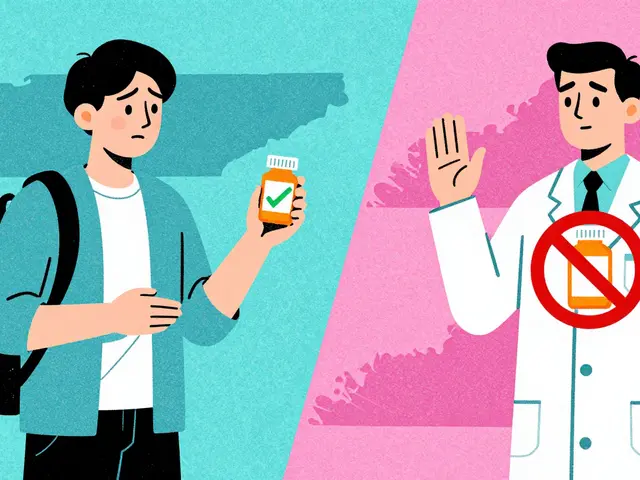
Some countries ban or restrict common U.S. medications - especially ADHD drugs, painkillers, or decongestants like pseudoephedrine. Before you travel, check the U.S. State Department’s travel advisory page for your destination. If your med is restricted, contact the embassy. Some allow you to apply for a special permit ahead of time. Never assume it’s okay. Bringing a banned drug can lead to arrest or deportation.
Do I need a doctor’s note for over-the-counter meds?
Not usually - but if you’re carrying a large quantity (like 100+ pills of ibuprofen or melatonin), TSA may ask why. A simple note from your doctor saying "for occasional use during travel" can prevent delays. It’s not required, but it’s smart. For international travel, always carry documentation - some countries treat even OTC meds as controlled substances.
Can I carry my insulin pump on the plane?
Yes. Insulin pumps, glucose monitors, and continuous glucose sensors are allowed in carry-on luggage. You don’t need to remove them during security screening. Tell the agent you’re wearing a medical device. They may do a pat-down or swab test, but they won’t take it off you. Never check your pump - the pressure changes can damage it.
What if I’m flying with a child’s medication?
You can bring any amount of a child’s liquid medication as long as it’s in the original container and you have a prescription or doctor’s note. TSA agents will inspect it, but they won’t limit the volume. For safety, keep child-resistant caps on. Accidental ingestion is the leading cause of in-flight medical emergencies involving children. Never leave meds unattended, even for a minute.
Is there a limit to how much medication I can bring?
For carry-on, the FAA limits liquids to 2,000 mL unless you have special approval - but medically necessary meds are exempt. You can bring more than that if you have documentation. For checked bags, there’s no official limit, but never check meds. The cargo hold can destroy them. Bring everything you need in your carry-on, plus a little extra for delays.


anthony epps
December 16, 2025 AT 05:01Tiffany Machelski
December 16, 2025 AT 11:59Dave Alponvyr
December 18, 2025 AT 00:25sue spark
December 19, 2025 AT 08:32Ron Williams
December 19, 2025 AT 21:16Souhardya Paul
December 21, 2025 AT 08:26Andrew Sychev
December 21, 2025 AT 11:08Josias Ariel Mahlangu
December 22, 2025 AT 19:00Hadi Santoso
December 24, 2025 AT 07:24Billy Poling
December 25, 2025 AT 04:48Aditya Kumar
December 25, 2025 AT 11:25