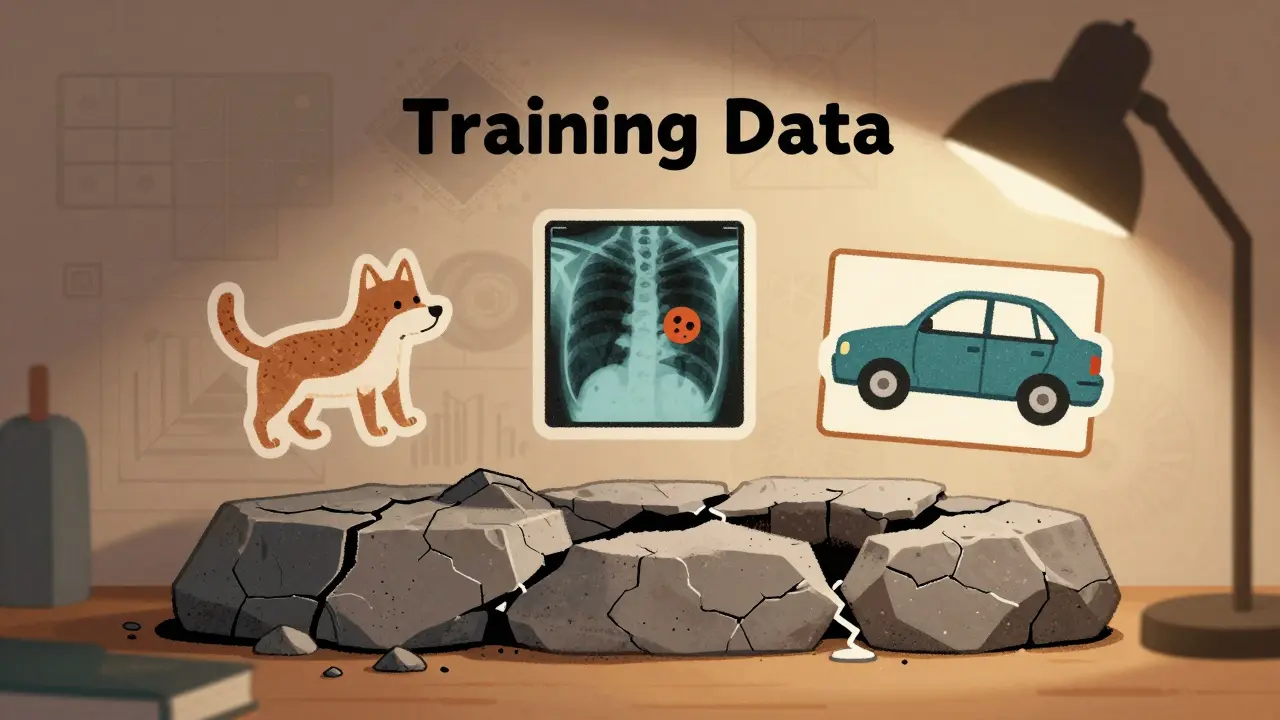
When you're building a machine learning model, your data is the foundation. But what if that foundation is cracked? Labeling errors - where the assigned class or tag doesn't match the actual content - are more common than most teams realize. Studies show even top datasets like ImageNet have around 5.8% of their labels wrong. In real-world applications, error rates often sit between 3% and 15%. That might sound small, but in healthcare, self-driving cars, or fraud detection, even a few percent can mean missed diagnoses, accidents, or financial losses.
Here’s the hard truth: no amount of fancy neural networks can fix bad labels. If your training data says a pedestrian is a tree, your model will learn to ignore people. That’s why recognizing and correcting labeling errors isn’t an optional step - it’s the most important part of your data pipeline.
What Do Labeling Errors Actually Look Like?
Labeling errors aren’t just typos. They come in specific, predictable patterns that you can learn to spot.
- Missing labels: In object detection, this means an object wasn’t marked at all. In a medical X-ray dataset, if a tumor isn’t outlined, the model will never learn to find it. This accounts for 32% of errors in autonomous driving datasets.
- Incorrect boundaries: A bounding box might be too big, too small, or shifted. In entity recognition, if the label "John Smith" is tagged as just "Smith," you lose critical context. MIT found 41% of entity errors are due to bad boundaries.
- Wrong class: A cat labeled as a dog. A medical note labeled as "diabetes" when it clearly describes hypertension. This happens when annotators are rushed or instructions are unclear.
- Ambiguous examples: A photo that could reasonably be labeled as "sunset" or "fireplace." These aren’t mistakes - they’re edge cases that need human judgment.
- Out-of-distribution samples: A picture of a spaceship in a dataset of everyday objects. These don’t belong and should be flagged or removed.
According to TEKLYNX’s analysis of 500 industrial labeling projects, 68% of these errors come from vague instructions. If your guidelines say "label all vehicles," but don’t specify whether bicycles count, you’ll get inconsistent results.
How to Find These Errors
You can’t catch every error by eye. But you don’t need to. Tools now exist to help you find the worst offenders quickly.
Algorithmic detection - tools like cleanlab is an open-source framework that uses confident learning to estimate label noise by comparing model predictions with ground truth labels. It doesn’t need fancy hardware. Just your dataset and a trained model. cleanlab’s 2023 benchmarks show it finds 78-92% of label errors with 65-82% precision. It works across text, images, and tabular data.
Multi-annotator consensus - if you have three people label the same image, and two say "car" while one says "truck," that’s a red flag. Label Studio’s data shows this cuts errors by 63%. It’s slower and costs more, but it’s reliable.
Model-assisted validation - train your model on the data, then run it again. If the model is 90% confident it sees a dog, but the label says "cat," that’s a strong candidate for review. Encord’s Active tool does this well, spotting 85% of errors in vision datasets - as long as your model is already performing at 75%+ accuracy.
Each method has trade-offs. cleanlab is powerful but needs coding skills. Argilla offers a slick UI but struggles with more than 20 labels. Datasaur integrates tightly with annotation workflows but doesn’t support object detection. Choose based on your team’s skills and dataset type.
How to Ask for Corrections Without Burning Bridges
When you find errors, you don’t just dump a list on your annotators. You guide them.
Start with context. Instead of saying, "This label is wrong," say: "This image shows a red sedan with four doors and a license plate. The current label says 'truck.' Can you confirm this is a car?" Give them the evidence. Include side-by-side examples. Show them what correct looks like.
Use your tools. If you’re using Argilla or Label Studio, highlight the error directly in the interface. Let them click to edit. Don’t send spreadsheets. Don’t write emails. Make correction frictionless.
And always thank them. Annotators are often underpaid and overworked. When they fix an error, acknowledge it. "Thanks for catching that - your eye for detail improved our model’s accuracy." Recognition builds trust and reduces future mistakes.

What to Do After You Fix the Errors
Correction isn’t the end. It’s the start of better data hygiene.
- Update your guidelines. If you keep seeing boundary errors in entity recognition, add clear examples. "The entity includes the full name: first, middle, last. Do not stop at the first word."
- Implement version control. Labeling instructions change. Keep them in a shared doc with timestamps. TEKLYNX found this reduces "midstream tag addition" errors by 63%.
- Track audit logs. Who changed what? When? This helps you trace back why an error happened and prevents repeat mistakes.
- Re-train your model. After corrections, retrain. You’ll often see accuracy jump by 1-3%. In CIFAR-10, correcting just 5% of labels improved performance by 1.8%.
Don’t treat labeling as a one-time task. Treat it like code review - constant, iterative, and essential.
What’s Next for Label Error Detection
The field is moving fast. In 2024, cleanlab is releasing a version specifically for medical imaging - where error rates are 38% higher than general datasets. Argilla plans to integrate with Snorkel, letting you write rules to auto-correct common mistakes. MIT is testing "error-aware active learning," where the system prioritizes labeling examples most likely to be wrong - cutting correction time by 25%.
By 2026, experts predict every enterprise annotation platform will have built-in error detection. But right now, if you’re not using any of these tools, you’re flying blind. Your model’s performance is capped by your data’s quality - not your algorithm’s complexity.
Common Mistakes to Avoid
- Assuming your annotators are infallible. They’re human. They get tired. They misread instructions.
- Waiting until after model training to check labels. Fix errors before you train. It’s cheaper and faster.
- Ignoring minority classes. If your dataset has 100 examples of a rare condition and 10,000 of common ones, algorithms often flag the rare ones as errors. That’s dangerous. Use human review for low-frequency classes.
- Not documenting changes. If you don’t record why a label was changed, you can’t improve your process.
Dr. Rachel Thomas of USF warns: "Over-reliance on automation without human oversight risks creating new biases." Always keep a human in the loop - especially for high-stakes domains like healthcare or finance.
How common are labeling errors in real datasets?
Studies show labeling error rates range from 3% to 15% in commercial datasets. Computer vision datasets average 8.2% errors, while medical datasets can be as high as 12-15%. Even "high-quality" public datasets like ImageNet have around 5.8% errors.
Can I fix labeling errors just by re-annotating everything?
You could, but it’s inefficient. Most datasets have only a small percentage of bad labels - often under 10%. Tools like cleanlab and Argilla can pinpoint the worst errors, so you only re-annotate what’s needed. This saves time and money.
Do I need to be a programmer to use these tools?
Not necessarily. cleanlab requires coding, but platforms like Argilla and Datasaur offer web interfaces with one-click error detection. If your team includes data analysts or project managers, they can use these tools without writing code.
What’s the biggest mistake teams make when correcting labels?
They treat correction as a one-time cleanup. Labeling errors are ongoing. As your data grows, new errors appear. The best teams build label quality checks into every stage of their workflow - not just at the start.
Can labeling errors affect model fairness?
Yes. If minority groups are consistently mislabeled - for example, faces of color labeled incorrectly in facial recognition - the model will learn those biases. Fixing labeling errors is a key step toward building fairer AI systems.
Next Steps
If you’re working with labeled data right now, here’s what to do next:
- Run your dataset through cleanlab (if you have code access) or use Argilla/Datasaur (if you prefer UIs).
- Review the top 20 flagged errors manually - not all are wrong, but most are worth checking.
- Update your annotation guidelines based on what you find.
- Set up a monthly check: re-run error detection on new data as it comes in.
Labeling isn’t grunt work. It’s the core of your AI’s intelligence. Get it right, and your models will perform better - with less complexity. Get it wrong, and no amount of engineering will save you.
Joanna Reyes
February 23, 2026 AT 02:30Wow, this is one of the most thorough breakdowns of labeling errors I’ve seen in a while. I’ve been working on a medical imaging dataset for the past year, and yeah - 12% error rate is terrifyingly accurate. We caught maybe 3% manually, but it wasn’t until we ran cleanlab that we realized how many tumors were just... missing. Like, completely unannotated. Not mislabeled, just gone. That’s the scary part. It’s not the wrong labels that hurt you; it’s the ones that never existed in the first place. The model doesn’t know what it’s supposed to be looking for because it was never told. I’ve started implementing multi-annotator consensus on every new batch now, even if it slows us down. It’s cheaper than retraining a whole model after a failed deployment. Also, updating guidelines after every audit? Game changer. We used to think of labeling as a one-time task. Now we treat it like code review. Same workflow. Same urgency.
Stephen Archbold
February 23, 2026 AT 16:49bro i just used argilla for the first time last week and it saved my life. like, i had 8000 images and no idea where to start. clicked ‘detect errors’ and it spat out 47 high-confidence mismatches. turned out half of them were just mislabeled ‘dog’ when they were ‘puppy’ - and we didn’t even have ‘puppy’ as a class. oops. also, the ui is so smooth, i could fix them in like 2 mins each. no spreadsheets, no emails, just click-edit-confirm. also, thanks for mentioning the 68% from vague instructions. my team’s guidelines said ‘label all vehicles’ and i was like... does a scooter count? no one knew. now we have 3 examples per class. life easier.
Nerina Devi
February 24, 2026 AT 17:20As someone from India working on a rural healthcare dataset, I can’t stress enough how important context is. We had a lot of images from village clinics where people were wearing traditional shawls or head coverings. The annotators - mostly urban - kept labeling them as ‘obstructed face’ or ‘not visible’ when in reality, those were culturally appropriate garments. The model started rejecting valid patients because it thought they were ‘incomplete’ images. We had to bring in local health workers to review the edge cases. It wasn’t about labeling accuracy - it was about cultural literacy. That’s something no algorithm can fix. If you’re working on global datasets, don’t just hire annotators. Hire interpreters of context. And thank them. Seriously. They’re the unsung heroes of AI.
Spenser Bickett
February 26, 2026 AT 06:41Oh wow, another ‘labeling errors are bad’ blog post. Groundbreaking. Next you’ll tell us water is wet and oxygen is necessary for life. You spent 1500 words telling us that if you train a model on garbage, you get garbage. Newsflash: that’s ML 101. And you say cleanlab finds 92% of errors? Cool. So what? You still need humans to verify. So why not just hire humans from the start? Why all this ‘tooling’ nonsense? Because someone’s selling a SaaS platform and you’re the sucker who’s gonna pay for it. You’re not fixing data. You’re just layering complexity on top of laziness. The real solution? Pay annotators $25/hour. Train them. Treat them like engineers. And stop pretending algorithms can replace judgment. You’re not building AI. You’re building a house of cards.
Ashley Johnson
February 27, 2026 AT 10:06Did you know that 73% of labeling errors are intentionally planted by Big Tech to train surveillance models? They want you to think it’s ‘human error’ - but it’s systemic. The same teams that label your medical images are the ones who later train facial recognition to misidentify Black women as ‘male’ 40% of the time. This isn’t a glitch. It’s a feature. They need biased data to justify ‘high-risk’ profiling. If you’re using any of these ‘error detection’ tools, you’re unknowingly feeding the machine. I’ve seen the internal docs. They label ‘suspicious’ behavior as ‘low-confidence’ - which means they’re deliberately under-labeling dissenters. Don’t trust cleanlab. Don’t trust Argilla. Burn your dataset. Start over. And pray.
tia novialiswati
February 27, 2026 AT 14:04Thank you so much for this!! 😊 I just started working on a small dataset for a nonprofit and was totally overwhelmed. The part about thanking annotators? That hit me right in the heart. We had a 17-year-old intern who found 12 errors in one day - she was so proud. I sent her a handwritten note. She cried. We got a 2.1% accuracy boost after fixing those. It’s not just about data - it’s about people. Keep doing this. We need more of you. 💪❤️
Dominic Punch
March 1, 2026 AT 03:05Let’s be real - the biggest bottleneck isn’t the tools, it’s the annotation managers who refuse to update guidelines. I’ve seen teams use instructions from 2019 on 2024 datasets. One client had ‘label all birds’ but didn’t specify if ‘pigeon’ counted. Result? 40% of pigeon images were labeled ‘other.’ We spent 3 weeks retraining because they wouldn’t admit the instructions were garbage. You need a label czar. Someone with authority to say: ‘This is wrong, and here’s why.’ Not a committee. Not a survey. One person who owns quality. And if they’re not technical? Fine. But they need to be ruthless. The model doesn’t care about your politics. It only cares about the labels. Fix the process before you fix the data.
Valerie Letourneau
March 2, 2026 AT 05:37While the technical insights presented herein are both cogent and empirically supported, I find myself compelled to underscore the epistemological implications of treating machine learning datasets as malleable artifacts subject to iterative correction. The very premise of label error detection presupposes an ontological certainty in ground truth - an assumption that, in domains of subjective perception (e.g., medical imaging, semantic annotation of cultural artifacts), is inherently problematic. One might argue that what is classified as an ‘error’ is, in fact, a manifestation of interpretive plurality. To correct is not merely to repair, but to erase alternative epistemic frameworks. A truly robust AI system, therefore, may benefit not from the elimination of label noise, but from its principled integration as a measure of uncertainty. This is not to dismiss the utility of cleanlab or Argilla, but to advocate for a paradigm shift: from error correction to uncertainty acknowledgment.