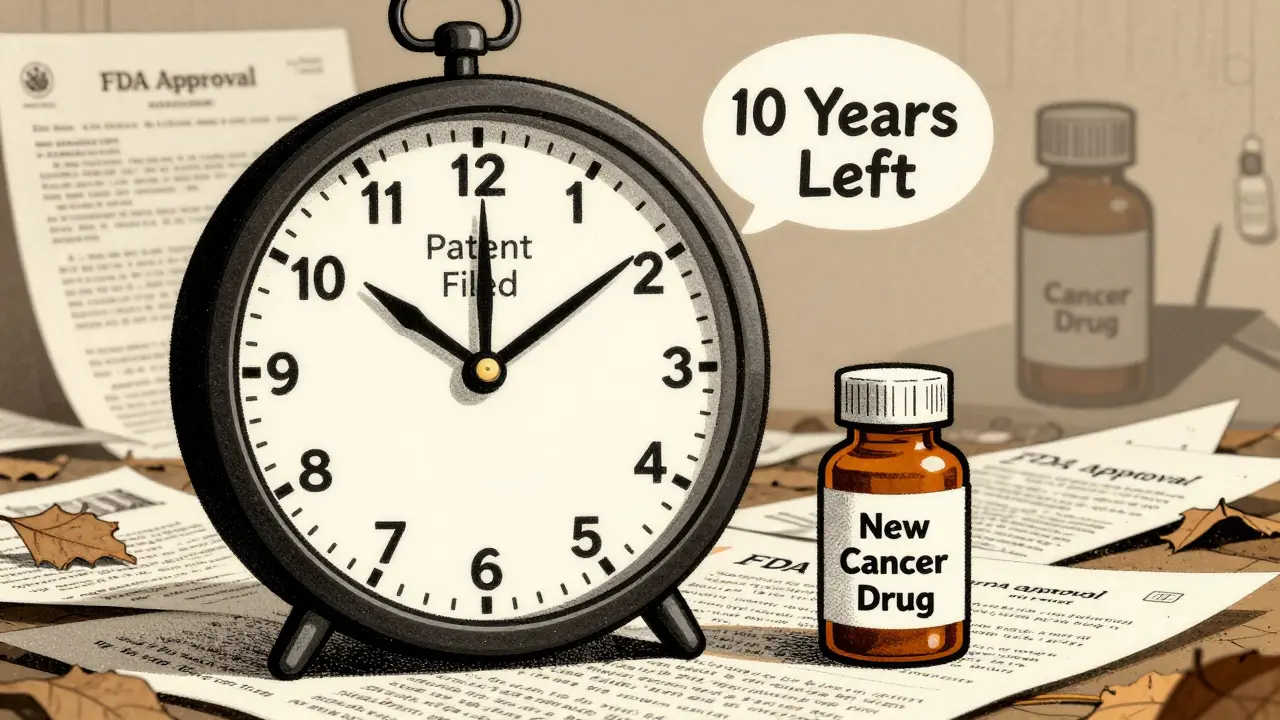
When you hear that a new drug has a 20-year patent, it’s easy to assume the company gets two full decades of exclusive sales. But that’s not how it works in reality. The effective patent life-the actual time a drug enjoys market exclusivity-is often less than half that. In most cases, it’s only 10 to 15 years. And here’s why: the patent clock starts ticking long before the drug even reaches the pharmacy shelf.
The Patent Clock Starts at Filing, Not Approval
Under U.S. law, a patent lasts 20 years from the date it’s filed. That’s straightforward. But here’s the catch: most pharmaceutical patents are filed during early-stage research, often before human trials begin. By the time a drug finishes clinical trials, gets reviewed by the FDA, and finally hits the market, 5 to 10 years have already passed. That means the company might have only 10 to 15 years left to sell the drug without competition. For a medication that costs over $2 billion to develop, that’s not much time to recoup costs.
Take a typical new cancer drug. Scientists file the patent in 2010. By 2015, it’s in Phase 3 trials. The FDA approves it in 2020. That’s already 10 years gone. The patent expires in 2030. So the company has just 10 years of exclusivity after launch. If the drug launches in 2022, they get 8 years. That’s the reality most innovators face.
The Hatch-Waxman Act: A Compromise That’s Being Strained
In 1984, Congress passed the Hatch-Waxman Act to fix this imbalance. The idea was simple: give drugmakers extra time on their patent to make up for the years lost to regulatory review. The law allows a patent extension of up to five years-but with a hard cap: no drug can have more than 14 years of exclusivity after FDA approval. That sounds fair. But in practice, it’s rarely enough.
For biologics, which take longer to develop, the delay can be even worse. The USPTO takes an average of 4.4 years just to issue a patent for these complex drugs. That eats into the clock before sales even begin. And while the law lets companies apply for a patent term extension (PTE), the process is slow, complicated, and only applies to the original patent-not the dozens that follow.
Secondary Patents and the ‘Evergreening’ Game
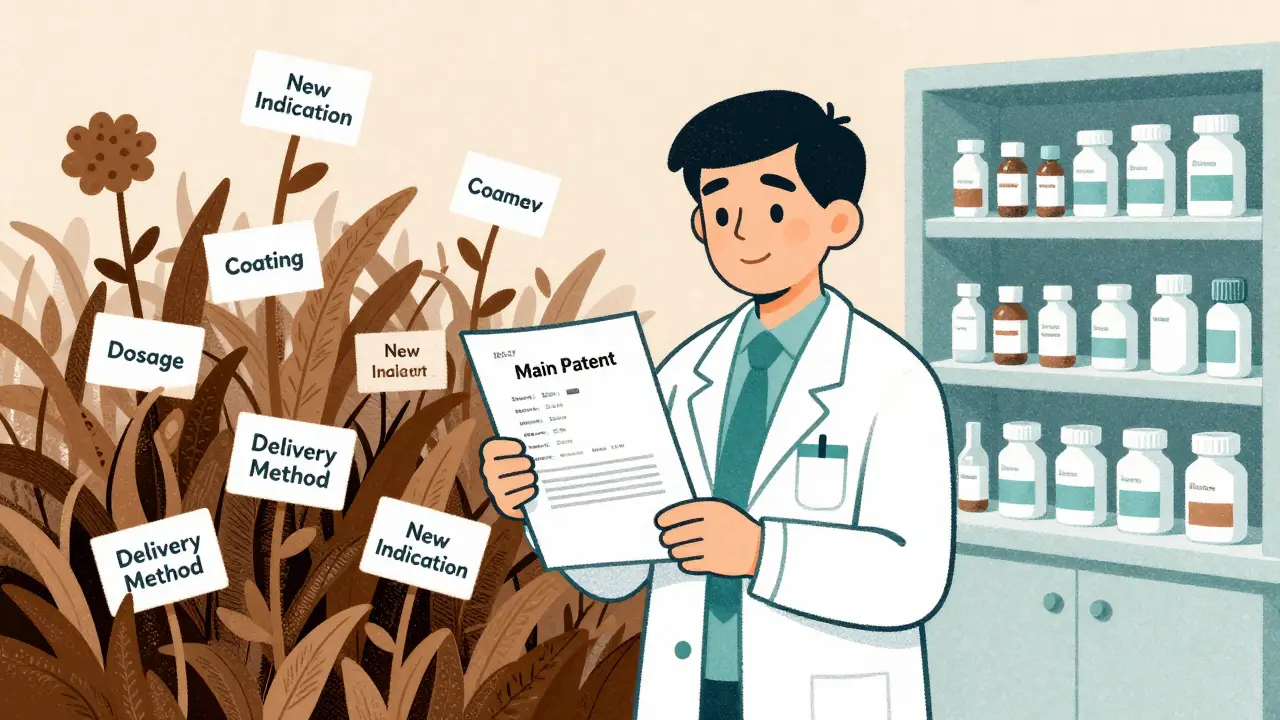
Here’s where things get strategic. When the main patent is about to expire, companies don’t just sit back. They file new patents on small changes: a new pill coating, a different dosage schedule, a combination with another drug, or a new method of delivery. These are called secondary patents. They’re not new drugs. But they’re enough to delay generic entry.
Studies show that blockbuster drugs-those bringing in over $1 billion a year-average 20 to 30 patents each. One drug might have patents covering its chemical structure, its manufacturing process, its tablet shape, its use for a second condition, and its extended-release formula. Each one adds a few more years. This practice, known as evergreening, is legal. But it’s not what the Hatch-Waxman Act had in mind.
A 2023 R Street Institute analysis found that higher-revenue drugs are 37% more likely to get these post-approval patents. The result? A patent thicket-so many overlapping protections that generic manufacturers can’t even get started without a legal battle.
Regulatory Exclusivities: The Hidden Layers
Patents aren’t the only tool. The FDA also grants regulatory exclusivities-separate from patents-that block generics even if the patent has expired. These include:
- New Chemical Entity (NCE) exclusivity: 5 years of market protection for a drug with a completely new active ingredient.
- New Clinical Investigation exclusivity: 3 years for a new use or formulation of an existing drug.
- Orphan Drug exclusivity: 7 years for drugs treating rare diseases (under 200,000 patients in the U.S.).
- Pediatric exclusivity: 6 months added to any existing exclusivity period if the company tests the drug in children.
These don’t extend the patent. But they delay generic approval. And they stack. A drug might have 5 years of NCE exclusivity, then 3 more years of clinical exclusivity, then 6 months for pediatric testing. That’s nearly 9 years of protection even before the patent expires. Combine that with secondary patents, and you get 15+ years of de facto exclusivity.
The 30-Month Stay: A Legal Delay Tactic
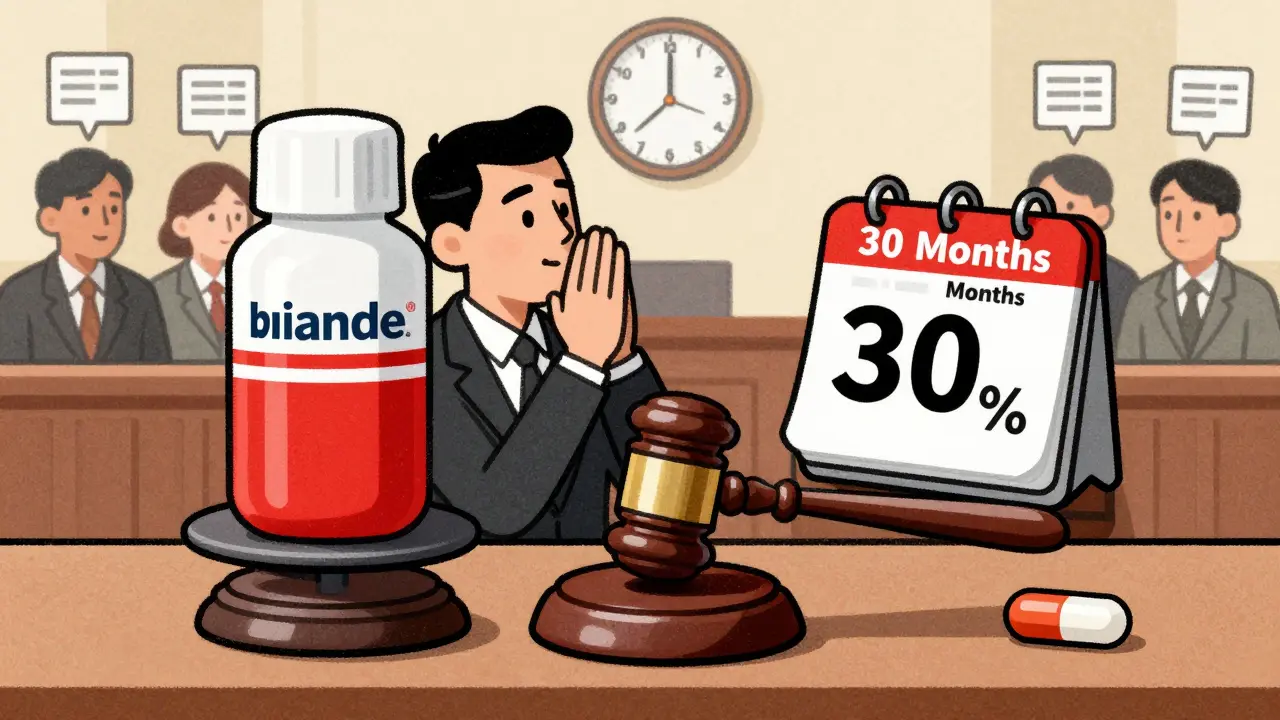
When a generic company files an application to sell a cheaper version, the brand-name company has 45 days to sue for patent infringement. If they do, the FDA can’t approve the generic for 30 months-unless a court rules in the generic’s favor sooner. This is called the 30-month stay.
It’s not a guarantee. But it’s a powerful tool. Many companies use it strategically, even if their patent is weak. The goal isn’t to win in court-it’s to buy time. A 30-month delay can mean hundreds of millions in extra sales. And because lawsuits are expensive, many generic manufacturers settle instead of fighting.
Global Differences: It’s Not Just the U.S.
The U.S. isn’t alone in this system. Canada offers a Certificate of Supplementary Protection (CSP), giving up to 2 years of extra exclusivity after patent expiry. Japan allows up to 5 years of patent term extension for regulatory delays. The European Union has a similar system called Supplementary Protection Certificates (SPCs), which can add up to 5 years.
But even in these countries, the clock starts ticking at filing. The delay between patent application and market approval is universal. The difference? Some countries are stricter about secondary patents. Others, like the U.S., have become more permissive-leading to longer monopolies.
The Economic Impact: Billions at Stake
When a drug loses exclusivity, prices drop fast. Within a year, generics can cut prices by 80% to 90%. For companies, that’s a massive revenue shock. EY estimates that global sales of drugs facing patent expiry will hit $250 billion annually by 2025.
That’s why companies spend so much on lifecycle management: new formulations, new indications, new delivery systems. They’re not just improving the drug-they’re trying to keep the money flowing. The pressure is intense. One lost patent can mean the difference between a profitable division and a financial hole.
For patients and insurers, the delay in generic entry means higher drug costs. For the healthcare system, it means slower access to affordable treatments. And for innovation? It’s a double-edged sword. The system was designed to reward R&D. But now, it often rewards legal strategy more than scientific breakthrough.
What’s Next? Scrutiny and Reform
Regulators and lawmakers are starting to push back. Courts are increasingly questioning whether some secondary patents are valid. The FDA is reviewing how it lists patents in the Orange Book-the official directory of protected drugs. Some proposals aim to limit evergreening by requiring stronger proof of innovation for new patents.
But change is slow. The pharmaceutical industry is powerful. The current system works well for companies with deep pockets and legal teams. For smaller firms and patients, it’s a different story.
For now, the effective patent life remains a game of timing, legal maneuvering, and regulatory loopholes. The 20-year patent? It’s just the starting line. The real race begins after approval-and most of the time, the finish line is much closer than it seems.


Timothy Haroutunian
February 25, 2026 AT 11:40Erin Pinheiro
February 26, 2026 AT 08:14Michael FItzpatrick
February 27, 2026 AT 10:31Brandice Valentino
February 27, 2026 AT 21:16Larry Zerpa
February 28, 2026 AT 07:26Nandini Wagh
March 1, 2026 AT 11:09Holley T
March 2, 2026 AT 20:15Ashley Johnson
March 4, 2026 AT 19:35Lillian Knezek
March 6, 2026 AT 05:37Maranda Najar
March 7, 2026 AT 02:53Christopher Brown
March 8, 2026 AT 05:58Sanjaykumar Rabari
March 9, 2026 AT 23:54Kenzie Goode
March 11, 2026 AT 14:28