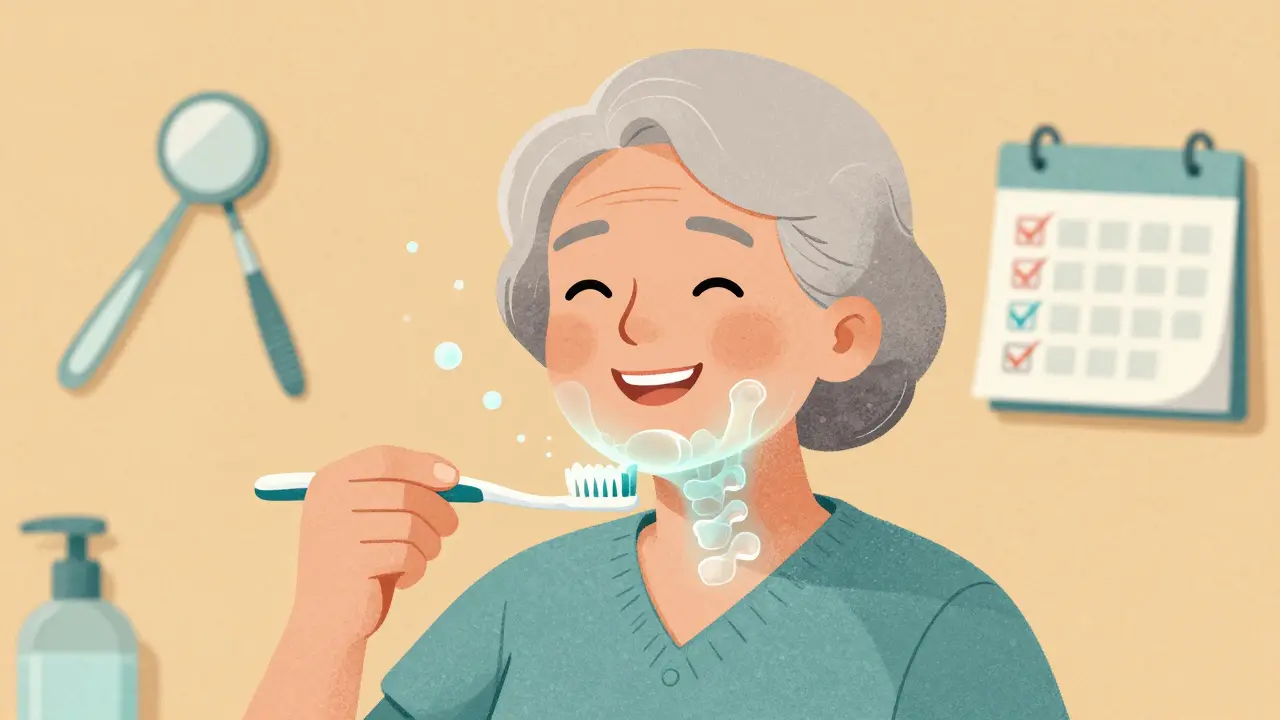
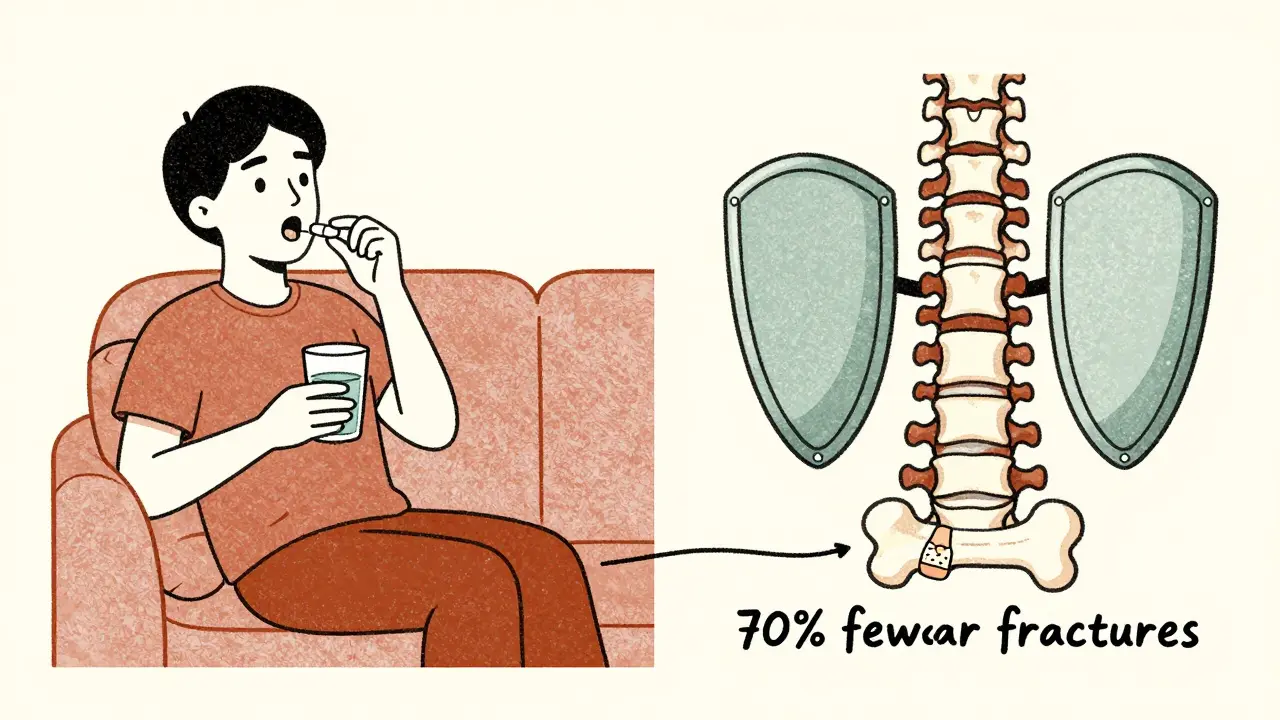
When you’re diagnosed with osteoporosis, your doctor’s main goal is simple: prevent broken bones. That’s why medications like alendronate (Fosamax), risedronate (Actonel), and zoledronic acid (Reclast) are so commonly prescribed. These drugs - known as bisphosphonates - have been used for over 25 years to strengthen bones and slash fracture risk by up to 70%. But there’s a quiet, rarely talked-about side effect that keeps patients and dentists awake at night: medication-related osteonecrosis of the jaw, or MRONJ.
What Is MRONJ, Really?
MRONJ isn’t a quick infection or a minor gum issue. It’s when bone in your jaw becomes exposed and doesn’t heal - for more than eight weeks - even after a tooth extraction, denture adjustment, or even a routine cleaning. The bone literally sticks out through the gum tissue. It can be painful. It can get infected. It can require surgery. And it happens almost exclusively in people taking bone-strengthening drugs like bisphosphonates or denosumab (Prolia).
The name used to be BRONJ - bisphosphonate-related osteonecrosis of the jaw. But in 2014, experts realized other drugs, like denosumab, could cause the same problem. So they renamed it MRONJ: medication-related osteonecrosis of the jaw. The key trigger? Drugs that stop bone from breaking down. That’s exactly what bisphosphonates do. They lock onto bone tissue and silence the cells (osteoclasts) that normally remove old bone so new bone can grow. It’s brilliant for preventing fractures… but it also slows healing.
Why the Jaw? It’s Not Random
You might wonder: why the jaw? Why not the hip or spine? The answer lies in how your jawbone works. Unlike other bones, your jaw is constantly under stress - chewing, talking, brushing. It also has a thin layer of gum tissue covering it and a huge amount of bacteria from your mouth. On top of that, jawbone turns over 10 times faster than the bone in your legs or hips. That means it absorbs more of the drug. When bisphosphonates pile up there, they don’t just slow bone loss - they slow healing too.
Think of it like this: if you cut your finger, your body rushes in to fix it. But if your jawbone is frozen in place by medication, that repair process stalls. A small cut from a tooth extraction becomes a wound that never closes. That’s when exposed bone appears.
The Real Risk: It’s Extremely Low - But Real
Here’s what most people don’t know: if you’re taking an oral bisphosphonate like alendronate for osteoporosis, your chance of developing MRONJ is about 0.7 in 100,000 per year. That’s less than one case in every 140,000 people taking the drug annually. To put that in perspective, you’re far more likely to be struck by lightning than to get MRONJ from Fosamax.
But here’s the catch: the risk isn’t the same for everyone. If you’re getting bisphosphonates through an IV - like zoledronic acid once a year - your risk jumps to about 1 in 100,000 per year. Still low. But it’s higher. And if you’ve had cancer and received high-dose IV bisphosphonates (like 4mg monthly), your risk jumps to 3-12%. That’s why cancer patients get the warnings - not because the drug is unsafe, but because the doses are much higher and the treatment lasts longer.
Denosumab (Prolia) carries a slightly higher risk than oral bisphosphonates - about 1.7 to 2.5 times more likely to cause MRONJ. But even then, for osteoporosis patients, it’s still rare. The big problem? Once you start, the drug stays in your bones for years. Even if you stop taking it, the risk doesn’t vanish overnight.
Dental Work Is the Main Trigger
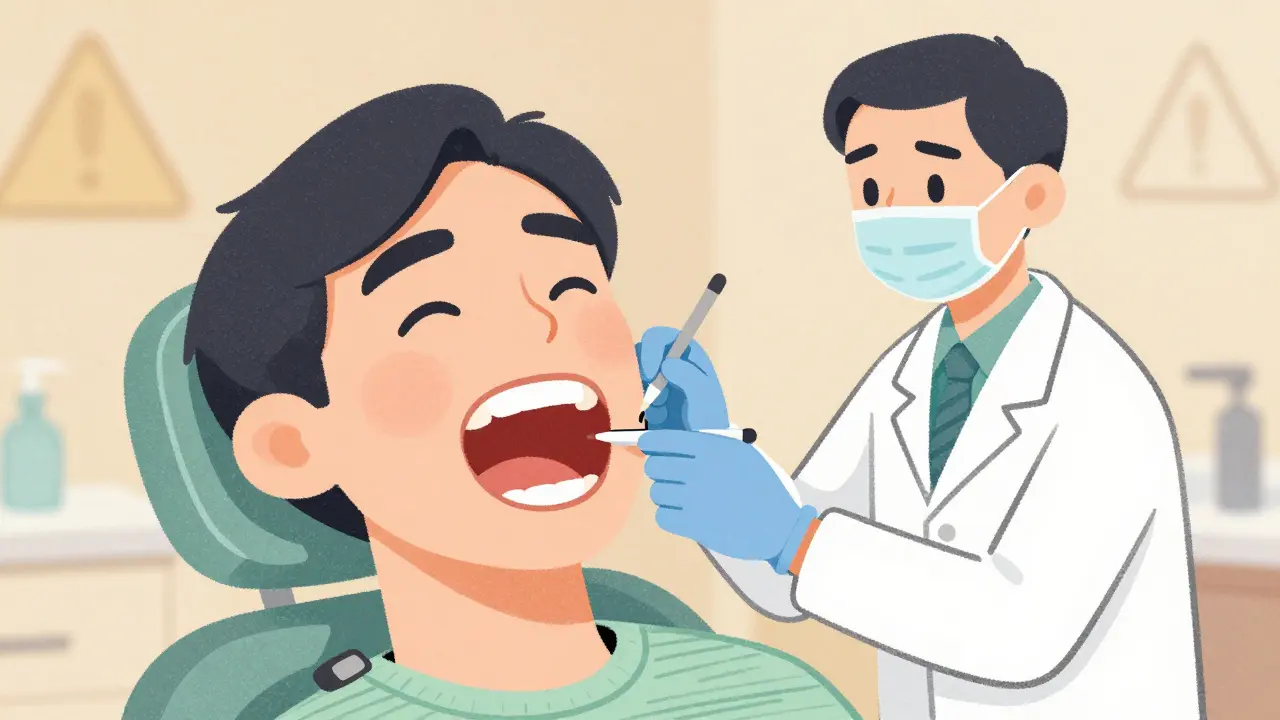
Most cases of MRONJ happen after something invasive: a tooth extraction, a root canal, or even aggressive cleaning. A 2023 survey by the American Association of Oral and Maxillofacial Surgeons found that 63% of MRONJ cases in osteoporosis patients followed a dental procedure. The median time from the procedure to exposed bone? About two years. That’s why dentists are so cautious.
But here’s the irony: many dentists now refuse to pull teeth or do implants for patients on bisphosphonates - even if the patient is healthy and has no signs of infection. That’s because they’re scared of causing MRONJ. And while that fear comes from good intentions, it’s often overblown. For someone on oral bisphosphonates with no dental disease, the risk is so low that routine dental work is still considered safe.
What’s the real danger? Pre-existing gum disease. If you have untreated periodontitis, infected teeth, or ill-fitting dentures before starting bisphosphonates, your risk goes up dramatically. That’s why experts say: get your dental work done before you start the medication. Clean out the infections. Fix the loose teeth. Get a full checkup. It’s not about avoiding dental care - it’s about starting with a clean slate.
Drug Holidays: A Double-Edged Sword
Some doctors recommend a “drug holiday” - stopping bisphosphonates for a few months before major dental surgery. The idea is that if you pause the drug, your jawbone might heal better. But here’s what the latest science says: stopping zoledronic acid for more than a year reduces MRONJ risk by 82%. Sounds great, right? But it also increases your risk of a hip or spine fracture by 28%.
That’s the trade-off. You’re trading a 1-in-100,000 chance of jaw necrosis for a 28% higher chance of breaking a bone. For someone with severe osteoporosis, that’s not a fair swap. That’s why most guidelines now say: don’t stop the drug unless you’re at high risk for MRONJ and your fracture risk is low. And even then, it’s a decision made with your doctor and dentist - together.
What You Should Do Now
If you’re on bisphosphonates, here’s your action plan:
- See your dentist now. Get a full exam. No X-rays? No cleaning? No implants? Get it done. Fix cavities, treat gum disease, remove loose teeth. Do this before you start or soon after.
- Keep your mouth clean. Brush twice a day. Floss daily. Use antibacterial mouthwash. The less bacteria in your mouth, the lower your risk.
- Tell every dentist you see. Don’t assume they know. Say: “I’m on a bisphosphonate for osteoporosis.” Give them the name and how long you’ve been taking it.
- Don’t skip dental care. Regular cleanings are safe. In fact, they’re protective. Avoiding them because you’re scared of MRONJ is like avoiding car seats because you’re scared of car crashes.
- Don’t panic over a small sore. If you have a tiny gum wound that doesn’t heal in a few weeks, see your dentist. Don’t wait for bone to show. Early signs are often painless.
Alternatives? Yes - But With Trade-Offs
If you’re terrified of MRONJ, you might wonder: is there a better drug? Denosumab (Prolia) is an option. It works differently - it’s a monoclonal antibody, not a bisphosphonate - and it’s just as good at preventing fractures. But it carries a slightly higher MRONJ risk. And you have to get a shot every six months. Miss a dose? Your bone protection drops fast.
Then there’s romosozumab (Evenity). It actually builds new bone - not just slows loss. But it’s expensive, only approved for one year, and carries a heart risk. Teriparatide (Forteo) is another option - a daily injection that stimulates bone growth. But it’s not for everyone, and it’s also pricey.
The truth? No drug is perfect. Bisphosphonates are still the gold standard because they’ve been used by millions, studied for decades, and proven to save lives by preventing hip fractures - which can be deadly in older adults. The fracture risk reduction is real. The MRONJ risk? Tiny.
The Bigger Picture
Over 8 million Americans take bisphosphonates for osteoporosis. Only a few hundred cases of MRONJ are reported each year. That’s a success story. But the fear around it has caused real harm. A 2021 study found that 22% fewer people started bisphosphonates after hearing about jaw necrosis - even though their fracture risk was high. That’s tragic. Because for every person who gets MRONJ, hundreds of people avoid broken hips, spines, and wrists.
The best protection isn’t avoiding the drug. It’s managing your mouth. It’s knowing the facts. It’s talking to your doctor and dentist as a team. You don’t need to be afraid. You need to be informed.
Can I still get a tooth pulled if I’m on alendronate?
Yes, you can - but only if your dentist knows you’re on the medication. For most people taking oral bisphosphonates, tooth extractions are safe, especially if your gums are healthy. The key is to have a full dental exam before starting the drug. If you’re already on it, your dentist may recommend antibiotics before and after the procedure to reduce infection risk. The chance of developing MRONJ after a simple extraction is still less than 1 in 100,000.
Is MRONJ reversible?
In early stages, yes. Stage 1 MRONJ - where bone is exposed but not infected - often improves with antibiotics, mouth rinses, and avoiding trauma. Stage 2 (with pain and infection) may require surgery to remove dead bone. Stage 3 (with fractures or fistulas) is harder to treat and may need long-term care. The earlier you catch it, the better the outcome. Many patients heal completely with proper treatment.
Do I need to stop bisphosphonates before dental work?
For oral bisphosphonates like alendronate, stopping the drug is usually not recommended. The risk of fracture increases faster than the benefit of reducing MRONJ. For IV bisphosphonates like zoledronic acid, a drug holiday of 3-6 months may be considered if you’re having major surgery - but only if your fracture risk is low. Never stop the medication on your own. Talk to your doctor and dentist together.
How do I know if I have early MRONJ?
Early signs are often painless. Look for: exposed bone in your mouth that doesn’t go away after 2-3 weeks, swelling or redness in the gums around a tooth socket, or a feeling that your denture doesn’t fit like it used to. If you notice any of these and you’re on a bisphosphonate, see your dentist right away. Don’t wait for pain. Early detection means easier treatment.
Are there tests to check my MRONJ risk?
Not yet for routine use. Researchers are studying biomarkers like urinary NTX (a bone turnover marker) to predict who’s most at risk. Some clinics offer bone scans or genetic testing, but these aren’t standard. Right now, the best predictor is your dental health history. If you’ve had gum disease, tooth loss, or infections before starting bisphosphonates, your risk is higher. Keep your mouth healthy - that’s your best defense.
Todd Scott
December 27, 2025 AT 21:21I've been on alendronate for six years now, and I've had three cleanings and one filling since starting. No issues. My dentist, who's seen dozens of patients on these meds, says the real danger isn't the drug-it's the fear. People avoid dental care because they think they're one extraction away from losing their jaw. That's not how it works. The 0.7 in 100,000 stat? That's not a scare tactic-it's the truth. If you're healthy, your mouth is clean, and you're not on IV chemo doses, you're fine. Stop letting anecdotal horror stories override data.
Also, the jaw heals slower because it's under constant mechanical stress and has high bacterial load. It's not magic. It's biology. Treat it like you'd treat any other tissue: keep it clean, avoid trauma, and don't panic over a little redness. Most cases of MRONJ are preventable with basic hygiene and pre-treatment dental work. Simple as that.
Andrew Gurung
December 28, 2025 AT 14:22OMG I CAN’T BELIEVE YOU’RE STILL TAKING THIS TOXIN 😱💀
Alendronate is basically chemical castration for your bones. You think you’re ‘preventing fractures’? Nah. You’re just turning your jaw into a slow-motion horror movie. My cousin’s dentist had to remove half his mandible. He was 58. He took Fosamax for 3 years. Now he can’t eat an apple. 😭
And don’t even get me started on ‘drug holidays’-that’s just corporate spin so Big Pharma can keep selling. Wake up, people. There are NATURAL ways to rebuild bone. Bone broth. Magnesium. Sunlight. Not poison pills.
Paula Alencar
December 30, 2025 AT 08:41While I deeply appreciate the thoroughness of this post, I feel compelled to underscore the profound ethical responsibility we bear as patients and practitioners alike in navigating pharmacological interventions that intersect with oral health.
The data presented-though statistically reassuring-is insufficient to mitigate the psychological burden carried by individuals who have witnessed, or experienced, the devastating consequences of medication-related osteonecrosis. To dismiss fear as irrational is to ignore the lived reality of those whose bodies have become battlegrounds between systemic healing and localized failure.
Furthermore, the assertion that dental procedures remain 'safe' for those on oral bisphosphonates, while technically accurate, fails to account for the systemic inequities in access to dental care. Not everyone can afford a pre-treatment comprehensive exam. Not everyone has a dentist who understands the nuances of MRONJ. Not everyone lives in a state where Medicaid covers periodontal therapy.
Therefore, while the risk may be low, the impact is absolute. And in medicine, absolute impact demands absolute caution-not just for the individual, but for the collective conscience of our healthcare system.
Nikki Thames
December 31, 2025 AT 09:36You're all missing the deeper philosophical question here: Are we, as a society, willing to sacrifice the integrity of our physical form-our very bones-for the illusion of longevity?
Bisphosphonates don't cure osteoporosis. They suppress its symptoms. And in doing so, they force the body into a state of unnatural stasis. The jaw necrosis isn't a side effect-it's a message. A biological rebellion against pharmaceutical domination.
When you silence osteoclasts, you silence the body's natural wisdom. You are not 'strengthening' bone-you are fossilizing it. And the jaw, being the most metabolically active bone, becomes the first to scream.
Perhaps the real solution isn't more drugs. Perhaps it's learning to live with vulnerability. To accept that aging is not a disease to be medicated away, but a process to be honored.
Just a thought.
Raushan Richardson
January 1, 2026 AT 21:16My grandma’s on Prolia and she’s 82. She had a tooth pulled last year and it healed fine. She brushes twice a day, flosses with those little picks, and her dentist knows she’s on meds. No drama. No panic. Just good habits.
Don’t let scary stories scare you out of living. If you’re scared, talk to your doc and dentist. Don’t Google it at 2 a.m. Like, seriously. Your jaw isn’t going to melt. You’re not a walking zombie. Just keep it clean and get your checkups. You got this 💪
Robyn Hays
January 3, 2026 AT 11:43This post felt like a love letter to bone health-and honestly, I needed it. I’ve been on alendronate for four years and I used to lie awake wondering if my next dental visit would be my last.
But reading this? It’s like someone turned on the lights in a room I thought was pitch black. The jaw isn’t random. The risk isn’t random. The prevention isn’t random. It’s all connected.
I started flossing daily. I switched to a soft brush. I asked my dentist for a full X-ray. Turns out I had a tiny cavity I didn’t know about. Fixed it. Now I feel like I’m not just surviving on meds-I’m thriving alongside them.
And yeah, I still get nervous sometimes. But now I’m nervous in a productive way. Like, ‘I’m going to call my dentist if this sore doesn’t heal in two weeks’-not ‘I’m never going back to the dentist again.’
Thank you for the clarity. This is the kind of info that saves lives, not just bones.
Liz Tanner
January 4, 2026 AT 21:19One thing that’s rarely mentioned: the psychological toll of being told you’re at risk for something so rare that it’s statistically negligible. You start second-guessing every sore gum, every loose tooth, every bit of discomfort. It turns routine care into a minefield.
But the truth is, avoidance is the real danger. Skipping cleanings because you’re afraid of MRONJ is like refusing to drive because you’re afraid of being hit by lightning.
I’m on risedronate. I’ve had two cleanings, a crown, and a root canal since starting. All fine. My dentist keeps a note in my file: ‘Patient on oral bisphosphonate-no contraindications to routine care.’ That’s all you need. Knowledge. Communication. No fear.
Babe Addict
January 6, 2026 AT 01:46Everyone’s missing the point. Bisphosphonates don’t cause MRONJ. Dentists do.
It’s not the drug-it’s the trauma. If you’re extracting teeth in patients on bisphosphonates without proper protocols, you’re doing it wrong. Not because the drug’s dangerous-but because you’re an untrained hack.
Also, denosumab? Same mechanism, different name. It’s literally the same thing with a bigger price tag and a prettier label. And don’t get me started on Evenity-heart risks? That’s just a fancy way of saying ‘we’re trading one death for another.’
Real talk: the only reason this is even a debate is because pharma wants you to think there’s a ‘better’ option. There isn’t. Bisphosphonates are still the gold standard because they work. The rest is marketing.
Stop overthinking it. Get your teeth checked. Don’t get extractions unless necessary. Done.
Satyakki Bhattacharjee
January 8, 2026 AT 00:38Why do you trust Western medicine so much? In India, we use herbs, milk, sunlight, and yoga to heal bones. No poison. No side effects. You think your jaw is the only thing that breaks? Look at your spine. Look at your soul. You are broken by fear, not by osteoporosis.
Stop taking pills. Walk in the sun. Drink warm milk with turmeric. Sleep early. Your bones will thank you. Medicine is not science-it is control.