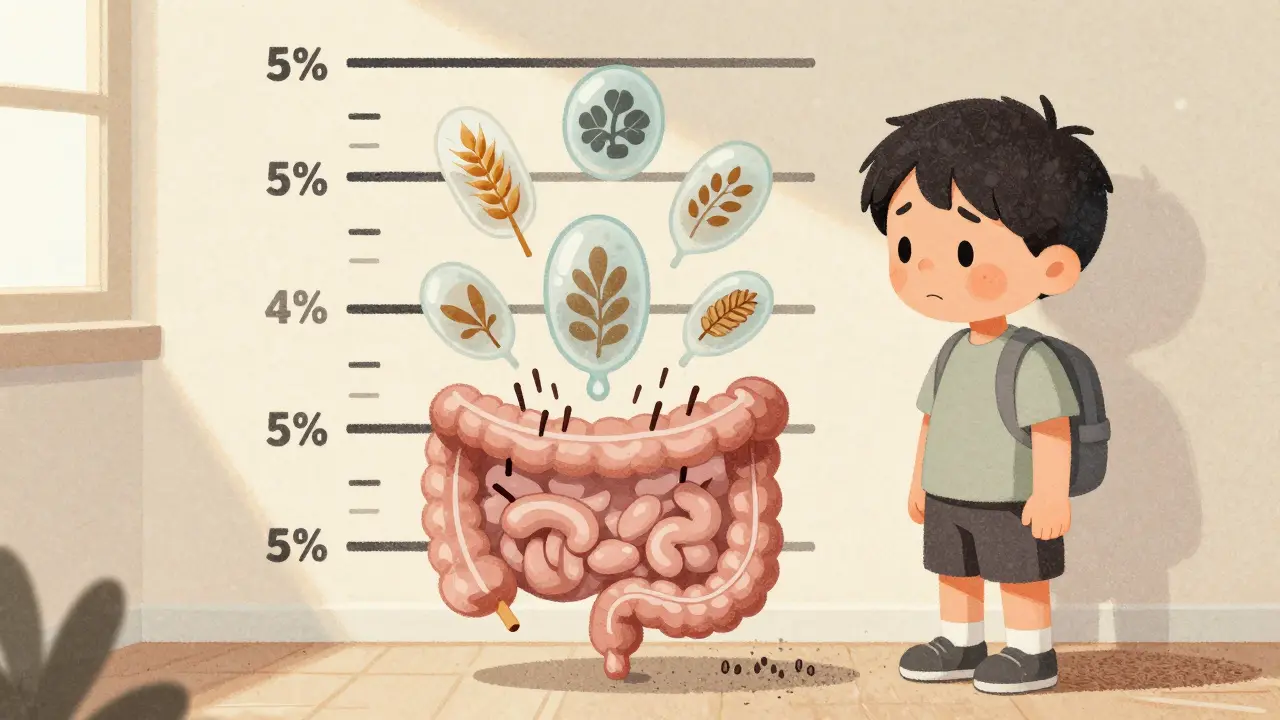
When a child isn’t growing like they should, parents often worry about nutrition, sleep, or genetics. But what if the real issue is something hidden in their food? Celiac disease is one of the most common yet underdiagnosed causes of growth problems in kids. It’s not just a stomach upset or food intolerance-it’s an autoimmune condition that attacks the gut every time gluten is eaten. And in children, the signs aren’t always obvious. Many don’t have diarrhea or bloating. Instead, they’re simply shorter than their peers, tired all the time, or struggling to gain weight. The good news? Once diagnosed and managed properly, most kids catch up completely. But that only happens if testing is done right and the diet is followed without compromise.
How Celiac Disease Stops Growth
Celiac disease triggers an immune response when gluten-found in wheat, barley, and rye-is consumed. This response damages the tiny finger-like projections in the small intestine called villi. These villi are responsible for absorbing nutrients. When they’re flattened, the body can’t absorb iron, calcium, vitamin D, or protein properly. For a growing child, that’s catastrophic. Studies show that up to 90% of children newly diagnosed with celiac disease have some form of growth delay. Their height may fall below the 5th percentile. Weight might be normal or low. Bone age, which measures skeletal maturity, is often delayed by 1.5 to 2.5 years. That delay isn’t a problem-it’s actually a clue. It means the body is still trying to grow, just slower than it should. Once gluten is removed, the villi heal, and the body gets back on track. There are three common growth patterns after starting a gluten-free diet. Some kids bounce back fast, gaining height rapidly within the first year. Others grow a little slower than normal but keep growing longer, eventually reaching their full potential. A third group grows at a normal rate but takes longer to hit their target height because their bones mature slowly. The key point? Growth recovery isn’t instant. It takes time-often 18 to 24 months. But 85% of children reach their expected adult height if they stick to the diet.Testing for Celiac Disease: What Actually Works
Many pediatricians still think celiac disease means chronic diarrhea. That’s outdated. Today, the most common reason kids are tested is because they’re short for their age, have delayed puberty, or have iron-deficiency anemia that doesn’t improve with supplements. In fact, up to 4% of children evaluated for short stature turn out to have undiagnosed celiac disease. The first step is a blood test: tissue transglutaminase IgA (tTG-IgA). This test is over 98% accurate when done correctly. But it’s not enough on its own. You also need to check total serum IgA because 2-3% of people with celiac disease are IgA deficient, which can give false negatives. If the tTG-IgA is more than 10 times above the normal limit, and the child has symptoms and carries the HLA-DQ2 or DQ8 gene (which 95% of celiac patients do), a biopsy might not even be needed. That’s according to the 2020 guidelines from ESPGHAN, the leading pediatric gastroenterology group in Europe. For others, an endoscopy with biopsy is still required. During the procedure, tiny samples are taken from the small intestine. In active celiac disease, the villi are flattened-what’s called Marsh 3 damage. This is the gold standard. Bone age X-rays of the hand and wrist are also helpful. If the bones are delayed, it’s a strong sign the child will recover height after going gluten-free. Don’t skip testing just because a child seems “fine” otherwise. Many kids with celiac have no stomach symptoms at all. They might just be quiet, tired, or falling behind in school. That’s why screening is recommended for kids with type 1 diabetes, Down syndrome, or a first-degree relative with celiac. About 5-10% of these children will develop the disease by age 10.
Going Gluten-Free: The Only Treatment
There’s no pill, no shot, no cure. The only treatment for celiac disease is a strict, lifelong gluten-free diet. That means no bread, pasta, cereal, or anything made with wheat, barley, or rye. But it’s not just about obvious foods. Gluten hides in soy sauce, malt flavoring, some medications, and even lip balm. Cross-contamination is a huge problem. A slice of toast in a toaster that’s also used for regular bread can expose a child to enough gluten to trigger damage. The international standard for “gluten-free” is 20 parts per million (ppm) or less. That’s tiny-but enough to harm someone with celiac. Most grocery stores now carry gluten-free products, but only 15-20% of standard items are safe. And they cost 156% to 242% more than regular versions. That’s a major burden for families. The good news? Kids often feel better fast. Energy levels improve within 2 weeks. Abdominal pain and bloating clear up in days. Weight gain happens quickly-often 15 to 30 grams per day in infants. But height recovery? That’s slower. It takes 6 to 12 months for antibodies to drop to normal levels. Height velocity increases by 2 to 4 cm per year above expected growth, but full catch-up can take two years or more.Keeping Kids on the Diet: The Real Challenge
The hardest part isn’t finding food. It’s keeping kids from cheating. Adolescents are especially vulnerable. Social pressure, school lunches, birthday parties, and peer behavior make adherence drop by 25-35% compared to younger children. One 14-year-old told a support group: “I stopped eating gluten-free at school. I got sick every week, but I didn’t want to be the weird kid with the special lunch.” Parents need support too. Most need 3 to 5 sessions with a registered dietitian who specializes in celiac disease. Learning to read labels takes 4 to 6 months. Common mistakes include assuming “wheat-free” means “gluten-free,” or thinking oats are always safe (they’re often contaminated unless labeled certified gluten-free). Schools play a big role. In one study, 58% of children with celiac had gluten exposure at school. That’s why a 504 plan is critical. It legally requires the school to provide safe meals, prevent cross-contamination, and train staff. No child should have to risk illness just to fit in. Regular follow-up is non-negotiable. tTG-IgA levels should be checked every 6 to 12 months. If they stay high, it means gluten is still getting in-either by accident or on purpose. Nutrient levels matter too. Iron, vitamin D, folate, and B12 are checked quarterly. Many kids need supplements for a year or two until their gut heals fully.
What Happens If You Don’t Stick to the Diet?
Some parents think, “My child feels fine now. Maybe they don’t need to be so strict.” That’s dangerous. Even small amounts of gluten keep the immune system activated. Over time, that increases the risk of other autoimmune diseases like thyroid disorders or type 1 diabetes. It also raises the risk of intestinal lymphoma-by two to three times. Long-term studies show children diagnosed before age 5 and who stick to the diet have a 98% chance of reaching their full adult height. Those diagnosed after age 10? Only 85%. And if they don’t follow the diet? Growth doesn’t recover. Puberty may be delayed. Bone density stays low. The damage isn’t always visible, but it’s there. There’s hope on the horizon. Clinical trials are testing drugs like larazotide acetate that might help block gluten’s effects. But none are approved yet. Until then, the gluten-free diet remains the only proven solution.Real Stories, Real Results
One mother in Brisbane shared: “My daughter was 7, in the 5th percentile for height. We tested for celiac because she was always tired. The diagnosis was a shock. But after 6 months on the diet, she gained 3 kg and started growing like a normal kid. By 18 months, she was at the 50th percentile. She’s now 12 and taller than most of her classmates.” Another parent said: “We spent $200 a week on gluten-free food. It broke our budget. But when we joined a local celiac support group, we found recipes, discounts, and people who got it. Adherence went from 60% to 90%.” The message is clear: early diagnosis, strict diet, and ongoing support make all the difference. Celiac disease doesn’t have to limit a child’s growth. With the right steps, it can be completely reversed.Can a child outgrow celiac disease?
No. Celiac disease is a lifelong autoimmune condition. Once diagnosed, the gluten-free diet must be followed forever. Even small amounts of gluten can trigger immune damage, even if there are no symptoms. There is no cure, and no evidence that children outgrow it.
What if my child’s tTG-IgA levels don’t go down?
If antibody levels stay high after 6-12 months on a gluten-free diet, it means gluten is still being consumed. This is often due to cross-contamination-shared toasters, utensils, or hidden gluten in sauces and medications. A dietitian should review the child’s food diary. In rare cases, it could signal another condition like refractory celiac disease, which needs specialist evaluation.
Is a gluten-free diet healthy for a child without celiac disease?
No, not necessarily. Gluten-free processed foods are often lower in fiber, iron, and B vitamins, and higher in sugar and fat. Unless a child has celiac disease, non-celiac gluten sensitivity, or a wheat allergy, there’s no health benefit to avoiding gluten. Cutting it out without medical reason can lead to nutritional gaps, especially in growing children.
How do I know if my child is getting enough nutrients on a gluten-free diet?
Regular blood tests are key. Check iron (ferritin), vitamin D, folate, and B12 every 6 months for the first year, then annually. Many children need supplements initially. Focus on whole foods: fruits, vegetables, lean meats, eggs, dairy, rice, quinoa, and certified gluten-free oats. Avoid relying too much on processed gluten-free snacks, which are often low in nutrients.
Can my child eat oats?
Pure, uncontaminated oats are safe for most children with celiac disease. But most oats are processed in facilities that also handle wheat, so they’re often contaminated. Only use oats labeled “certified gluten-free.” Start with small amounts and monitor for symptoms. Always check with your dietitian before introducing them.
What should I do if my child is still short after being gluten-free for two years?
If growth hasn’t improved after two years on a strict gluten-free diet, consult a pediatric endocrinologist. There could be another issue, like growth hormone deficiency, thyroid problems, or a genetic condition. About 5-10% of children with celiac don’t fully catch up, even with perfect diet adherence. Early evaluation is crucial to find and treat the underlying cause.



Ian Long
January 9, 2026 AT 13:23My kid was in the 3rd percentile for height until we tested for celiac. Turned out he was gluten intolerant. We went gluten-free and within 6 months he started shooting up like a weed. Now he’s taller than half his class. I wish we’d known sooner - could’ve saved a lot of sleepless nights.
Don’t wait for diarrhea or bloating. If they’re just… slow to grow, get tested. It’s not a fad diet. It’s medicine.
Pooja Kumari
January 10, 2026 AT 07:09Oh my god I’m crying reading this because my 9-year-old daughter was diagnosed last year and I’ve been Googling everything since. We thought she was just picky, tired, and shy - turns out her body was literally starving because of gluten. The first week on the diet she asked if she could hug me again because she didn’t feel like she was going to collapse anymore. I didn’t know a child could feel that bad and not scream about it.
Now we buy all our oats certified gluten-free, we have separate toasters, and I read every label like it’s a legal contract. It’s exhausting. But she’s gaining weight, her hair stopped falling out, and she’s smiling again. I’d do it all over again. Even if it costs $300 a week. Even if I have to pack her lunch every day. She’s alive. She’s thriving. That’s worth everything.
Jacob Paterson
January 11, 2026 AT 16:48Let me guess - you’re one of those parents who thinks gluten-free is a lifestyle choice. Newsflash: celiac isn’t a trend. It’s a genetic autoimmune disorder. You don’t get to ‘try it out’ or ‘do it for fun.’
And no, your kid doesn’t need to be gluten-free just because they’re ‘sensitive.’ That’s not a thing. Stop listening to influencers and start listening to science. If your child’s tTG-IgA is elevated, you’re either a hero or a negligent parent. Pick one.
Angela Stanton
January 12, 2026 AT 23:25So we’re talking about villi damage, Marsh 3 classification, and tTG-IgA titers >10x ULN - but the real bottleneck is social compliance in adolescents? Interesting. The biopsychosocial model is clearly underleveraged here. The gut-brain axis isn’t just metaphorical - it’s a feedback loop where peer pressure = cytokine release.
Also, certified GF oats are a regulatory loophole. The 20ppm threshold is based on adult thresholds. Pediatric mucosal recovery thresholds? Still undefined. We need longitudinal cohort studies. And funding. Always funding.
Jerian Lewis
January 14, 2026 AT 13:18My cousin’s kid had celiac. She was 12, diagnosed late. She never caught up to her height potential. Now she’s 25 and still shorter than her little sister. I don’t care what anyone says - if you don’t test early, you’re gambling with their future. No excuses.
Kiruthiga Udayakumar
January 15, 2026 AT 22:36My sister’s daughter was diagnosed at age 4. We were so scared - but then we found a local support group. We started cooking together, sharing recipes, trading gluten-free snacks. Now she’s 8 and loves making her own GF pancakes. She says she’s the ‘gluten-free queen’ of her class. I cried when she said that. Not because she’s different - because she’s happy.
Don’t let fear make you isolate. Let community make you strong.
Chris Kauwe
January 17, 2026 AT 13:46America’s obsession with ‘personal responsibility’ is why this is still a problem. You want kids to thrive? Ban gluten from school cafeterias. Make it mandatory. Make it law. No more ‘special requests.’ No more ‘I’ll just sneak a bite.’
Other countries do it. Why can’t we? Because we’d rather argue about ‘freedom’ than protect our children. Pathetic.
RAJAT KD
January 18, 2026 AT 03:12Test early. Stay strict. No exceptions. Growth delay is the only symptom many kids show. If you wait for stomach issues, it’s too late.
Phil Kemling
January 19, 2026 AT 15:04There’s a quiet tragedy in every child who grows slower than their peers - not because they’re broken, but because the world refuses to see what’s hidden. We measure height in centimeters, but we don’t measure the silence of a child who stops asking for bread because they know it will make them sick.
Celiac isn’t just a disease of the gut. It’s a disease of invisibility. And the cure isn’t just gluten-free bread - it’s awareness, empathy, and the courage to change the system.
Drew Pearlman
January 20, 2026 AT 08:48I just want to say - if you’re reading this and you’re a parent of a child with celiac - you’re doing an incredible job. It’s not easy. It’s not glamorous. You’re reading labels at 2 a.m., arguing with school nurses, and paying more for pasta than your rent used to cost.
But your child is alive, growing, and healing because of you. You’re not just a parent - you’re a warrior. And I see you. We all see you. Keep going. One gluten-free meal at a time.
Johanna Baxter
January 20, 2026 AT 23:42My daughter ate a slice of pizza at a birthday party last year. She was in bed for 3 days. Cried nonstop. Couldn’t walk. I thought she had the flu. Turns out it was gluten. I screamed at the mom. I cried. I still haven’t forgiven myself for not watching her closer.
Now I carry my own gluten-free snacks everywhere. Even to church. Even to the park. Even to funerals. I don’t care what people think. I’d rather be the weird mom than bury my kid.
Patty Walters
January 22, 2026 AT 12:29So I’m a nurse and I’ve seen this a million times. Parents think ‘gluten-free’ means ‘healthier.’ It doesn’t. My kid was on a gluten-free diet for a year because we thought it was ‘better’ - ended up with vitamin deficiencies because we fed her nothing but GF crackers and cookies.
Real talk: eat real food. Meat, eggs, veggies, fruit, rice, quinoa. Skip the processed crap. And if you’re not sure? Talk to a dietitian. Don’t guess. Your kid’s bones are counting on you.
tali murah
January 22, 2026 AT 23:53Let’s be brutally honest: 90% of parents who claim to be ‘strict’ with gluten-free diets are lying. Cross-contamination? ‘Oh, we just wiped the counter.’ Oats? ‘They’re naturally gluten-free!’
And then they wonder why their child’s tTG-IgA is still sky-high. It’s not magic. It’s science. If you’re not measuring antibodies, you’re not treating - you’re pretending.
Diana Stoyanova
January 23, 2026 AT 01:40My son was diagnosed at 6. We were devastated. But then we started a YouTube channel called ‘Gluten-Free Kids Club’ - we post videos of us making GF cupcakes, trying new snacks, even visiting gluten-free bakeries. Now we have 200k followers. Kids from all over write us saying, ‘I thought I was the only one.’
Turned our trauma into a movement. If you’re feeling alone - you’re not. We’re here. We’re loud. And we’re not going back to wheat bread.
Jenci Spradlin
January 23, 2026 AT 17:07My son’s doctor said ‘wait and see’ for a year before testing. We lost 18 months. He’s 11 now and still 2 inches below where he should be. Don’t wait. Test. Now. Your kid’s future is not a waiting game.