Medication Stomach Safety Checker
Check Your Medication Safety
Enter the name of your medication to see if it commonly causes stomach issues and how to take it safely
Many people take pills every day without thinking twice-until their stomach starts burning, or they feel that sharp, sour taste rising in their chest. It’s not just spicy food or stress. Medications are one of the most common but overlooked causes of heartburn and upset stomach. You might be taking something life-saving, like blood pressure medicine or antibiotics, and still end up feeling worse than before. The good news? Most of these symptoms aren’t unavoidable. With simple, science-backed changes, you can keep your meds working while keeping your stomach calm.
Why Your Pills Are Causing Heartburn
It’s not magic. It’s chemistry. Many drugs directly irritate the lining of your esophagus or stomach, or they mess with the muscle that keeps stomach acid where it belongs-the lower esophageal sphincter (LES). When that muscle relaxes too much, acid flows back up. Other drugs boost acid production or strip away the protective mucus layer in your stomach. The result? Burning, bloating, nausea, or even painful swallowing. Some of the biggest offenders are common, everyday medications:- NSAIDs like ibuprofen and aspirin: These reduce inflammation but also block protective chemicals in your stomach lining. About 20-30% of people who take them regularly get heartburn.
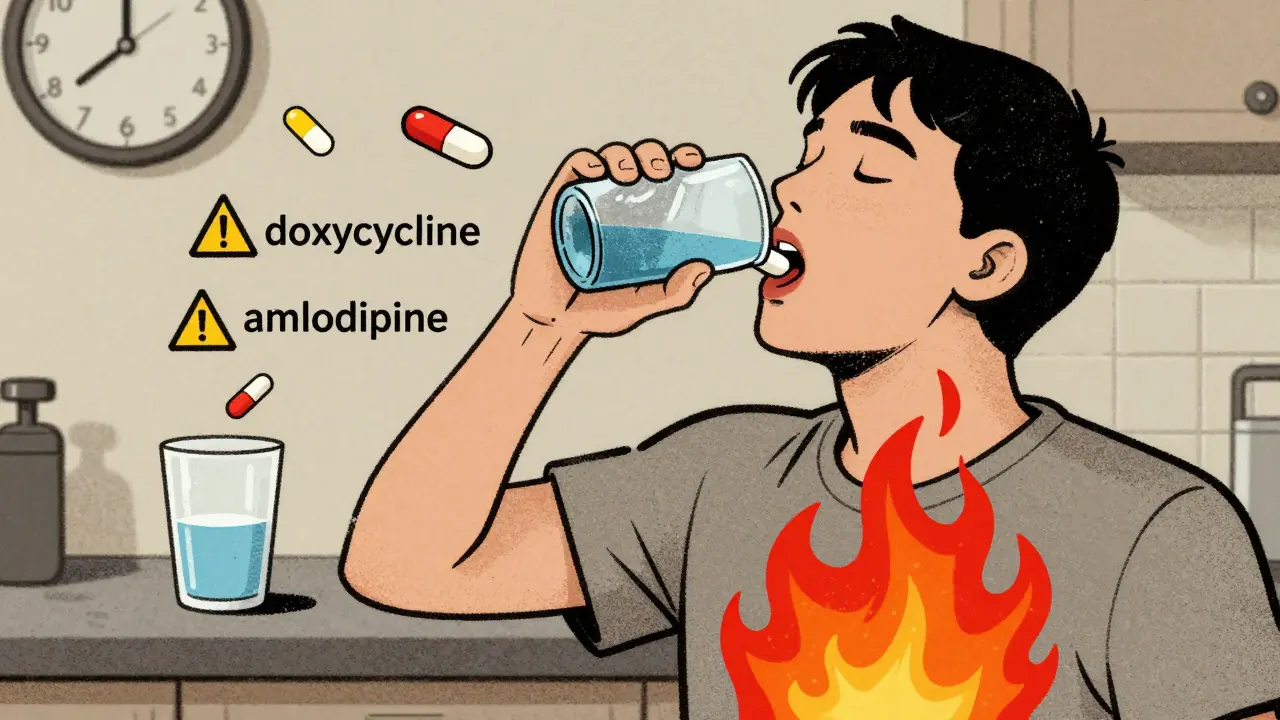
- Tetracycline antibiotics (especially doxycycline): These can stick to your esophagus if not washed down properly, causing ulcers. Up to 12% of users get pill-induced esophagitis if they take them lying down or with too little water.
- Calcium channel blockers like amlodipine: Used for high blood pressure, they relax the LES, letting acid creep up. Around 10-20% of users report reflux symptoms.
- Theophylline (for asthma): Weakens the LES by 30-50%, leading to heartburn in 25-30% of users.
- Metformin (for diabetes): About 1 in 3 new users get nausea, bloating, or heartburn-but for most, it fades after 2-4 weeks.
- Bisphosphonates like alendronate: Used for osteoporosis, these can cause severe esophageal injury if not taken with a full glass of water and kept upright for an hour.
What’s surprising is how often these reactions are dismissed. People think, “It’s just indigestion,” and keep taking the pill. But untreated, this can lead to real damage-like scarring in the esophagus or even Barrett’s esophagus, a condition that increases cancer risk.
What to Do When Your Medicine Upsets Your Stomach
You don’t have to quit your meds. You don’t have to suffer. Here’s what actually works, backed by clinical guidelines and real patient outcomes.1. Take Pills with a Full Glass of Water
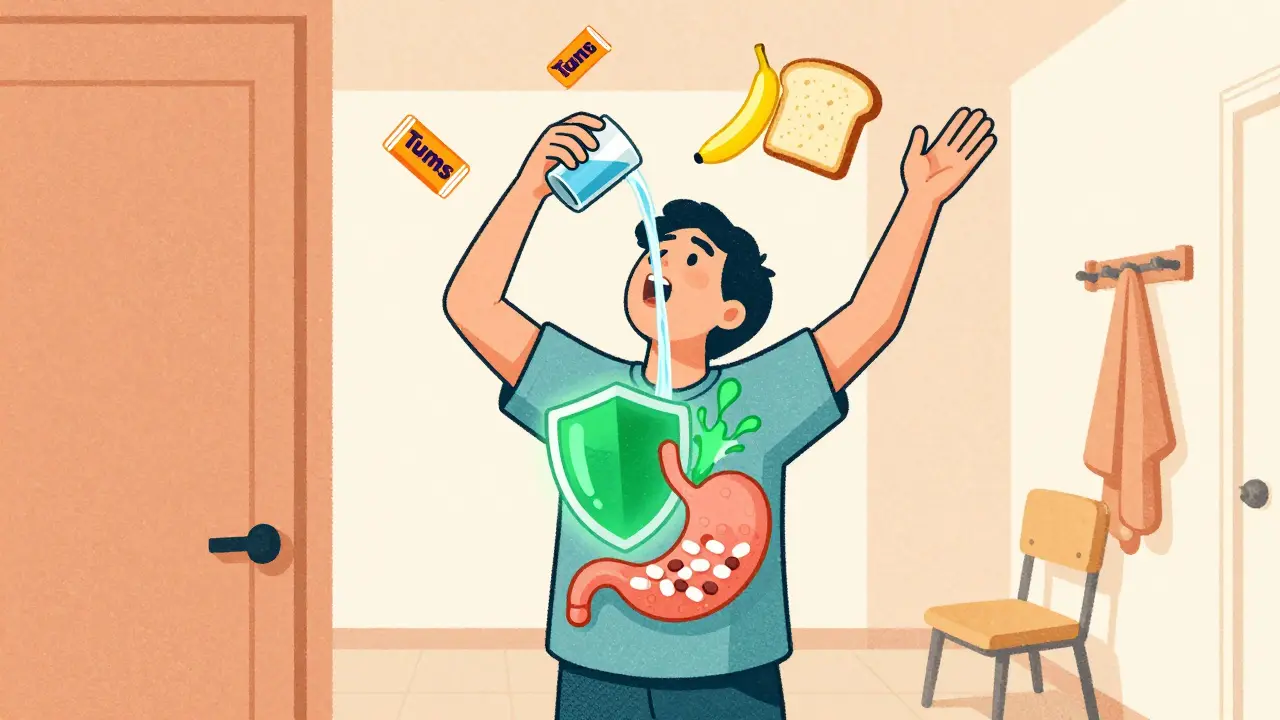
This isn’t just advice-it’s a medical protocol. Swallowing a pill with just a sip of water lets it sit in your esophagus. That’s how doxycycline and bisphosphonates cause ulcers. Drinking 8 ounces (about 240 ml) of water right after takes the pill down fast and flushes it out. Studies show this cuts esophagitis risk by 60-70%.2. Stay Upright for at Least 30 Minutes After Taking Pills
Lying down or slouching after you take a pill gives it time to stick. Stay standing or sitting. Even walking around helps. For high-risk drugs like bisphosphonates, staying upright for 60 minutes is non-negotiable. This simple step prevents 80-90% of pill-induced esophagitis cases.3. Take NSAIDs with Food
If you’re on ibuprofen or naproxen, never take them on an empty stomach. Food acts like a buffer. It reduces the direct contact between the drug and your stomach lining. Clinical data shows this cuts heartburn by 40-50%. You don’t need a big meal-just a slice of toast or a banana.4. Try OTC Antacids or PPIs (But Only If Advised)
Over-the-counter antacids like Tums or Rolaids can help if taken 30 minutes before your NSAID. They neutralize acid before it starts. For long-term NSAID users at risk of ulcers, proton pump inhibitors (PPIs) like omeprazole are proven to reduce ulcer risk by 70-80%. But don’t self-prescribe PPIs. They’re powerful and can cause side effects if used long-term without a reason.5. Know When to Call Your Doctor
Not all heartburn is harmless. If you have any of these, get checked immediately:- Chest pain that feels like pressure or tightness
- Difficulty swallowing or feeling like food gets stuck
- Black, tarry stools or vomiting blood
- Unexplained weight loss
These aren’t normal side effects. They signal serious damage. Don’t wait. Don’t assume it’s “just acid.”
Medications That Are Easier on the Stomach
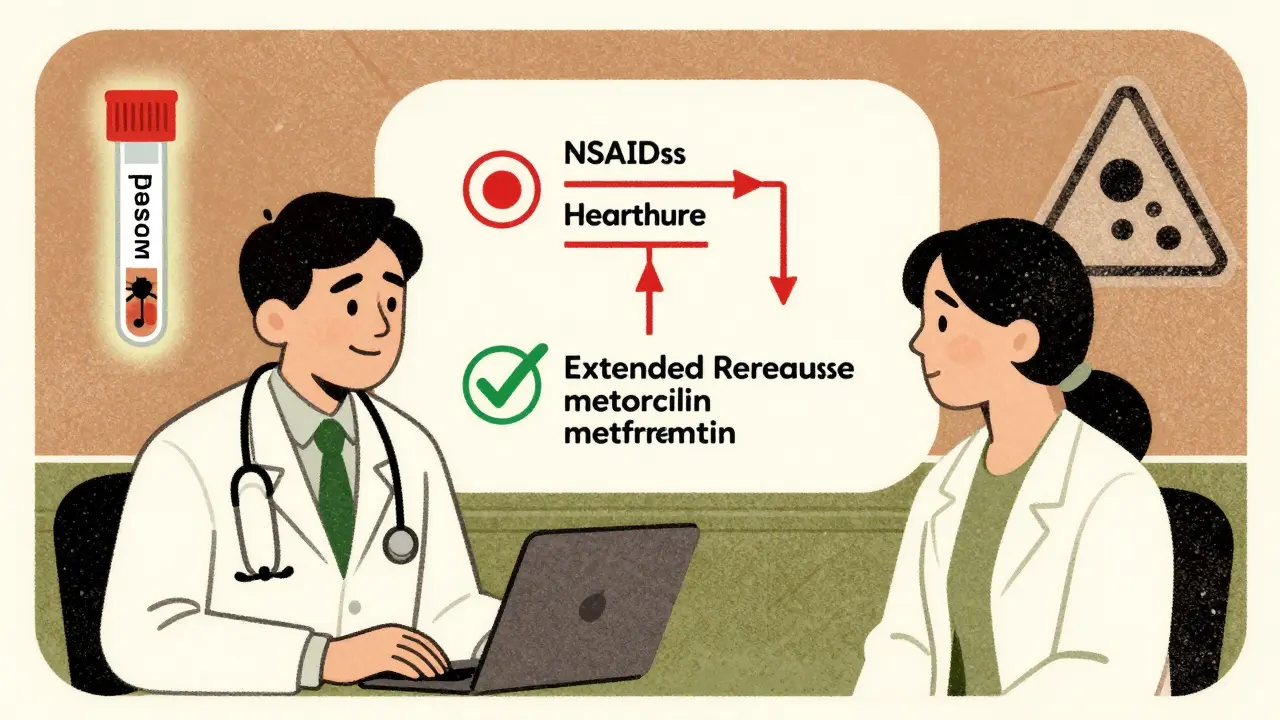
Sometimes, switching meds is the best solution. And yes, there are often alternatives.If you’re on a calcium channel blocker and get constant heartburn, ask your doctor about beta blockers. They cause reflux in only 5-10% of users-half the rate of calcium channel blockers. For pain relief, acetaminophen (Tylenol) doesn’t irritate the stomach like NSAIDs do. It’s not as strong for inflammation, but it’s much gentler on your gut.
For antibiotics, newer formulations of doxycycline (approved in 2022) are designed to dissolve slower and reduce esophageal exposure by 40-50%. Ask your pharmacist if a delayed-release version is available.
And if you’re on metformin and your stomach’s been upset for weeks, don’t panic. Sixty to seventy percent of people find their symptoms fade within 2-4 weeks. Try taking it with meals, start with a lower dose, or ask about the extended-release version. It’s designed to release slowly, reducing GI upset.
What Not to Do
There are dangerous myths out there. Avoid these:- Don’t crush or chew pills unless your doctor says it’s okay. Some are coated for a reason-crushing them can trigger irritation.
- Don’t lie down right after taking meds. Even if you’re tired, wait. Gravity is your friend.
- Don’t stop your meds because of heartburn. A 2017 study found 7% of people quit life-saving drugs over manageable stomach issues. That’s dangerous. Talk to your doctor first.
- Don’t use alcohol or caffeine to “soothe” the burn. They make reflux worse.
What’s New in 2025
The field is evolving. In 2023, new NSAID formulations with protective coatings hit the market. They reduce heartburn by 30-35% in clinical trials. Electronic health records now flag patients at risk for drug-induced reflux-like someone on both an NSAID and a calcium channel blocker-automatically. And researchers are testing patches and under-the-tongue versions of drugs to skip the stomach entirely.Genetic testing is also becoming more common. About 15-20% of people of European descent have a gene variation (CYP2C9) that makes them process NSAIDs slower, increasing their risk of stomach damage. If you’ve had bad reactions before, ask your doctor if genetic testing could help guide your treatment.
The bottom line? Medication-induced heartburn isn’t something you just have to live with. It’s a solvable problem. And fixing it isn’t just about comfort-it’s about staying healthy, keeping your treatment on track, and avoiding serious complications down the road.
Can I take ibuprofen without getting heartburn?
Yes, but you need to take it the right way. Always take ibuprofen with food and a full glass of water. Avoid taking it on an empty stomach or right before bed. If you still get heartburn, ask your doctor about switching to acetaminophen or using a low-dose proton pump inhibitor like omeprazole as a protective measure.
Does doxycycline always cause heartburn?
No. Doxycycline causes heartburn or esophagitis only if it’s not taken properly. Taking it with 8 ounces of water and staying upright for at least 60 minutes prevents it in 95% of cases. Newer delayed-release versions also reduce the risk significantly. Never take it lying down or with just a sip of water.
How long does metformin stomach upset last?
For most people, nausea, bloating, or heartburn from metformin lasts 2 to 4 weeks. Around 60-70% of users find their symptoms improve on their own. Taking it with meals, starting with a low dose, or switching to the extended-release form can speed up the process. If symptoms persist beyond a month, talk to your doctor.
Should I stop my blood pressure medicine if it gives me heartburn?
No. Stopping blood pressure meds suddenly can cause dangerous spikes in pressure. Instead, talk to your doctor. You may be able to switch to a different class of medication, like a beta blocker, which is less likely to cause reflux. Never adjust your dose or stop without medical advice.
Are there natural remedies for medication-induced heartburn?
Some people find relief with ginger tea or chewing gum after meals-it boosts saliva, which helps neutralize acid. But don’t rely on these alone. If your heartburn is caused by a medication, the real solution is changing how you take the pill or switching the drug. Natural remedies won’t fix the root cause and can delay proper care.
Can heartburn from meds lead to cancer?
Chronic, untreated reflux from medications can lead to Barrett’s esophagus, a condition where the lining of the esophagus changes and increases the risk of esophageal cancer. This happens in 1-2% of long-term cases. It’s rare, but preventable. The key is managing symptoms early and avoiding prolonged exposure to acid. Regular check-ups matter if you’ve been on reflux-causing meds for years.


suhani mathur
December 23, 2025 AT 13:19Okay but have you tried taking your ibuprofen with a banana instead of food? It’s weirdly effective. My grandma swore by it and now I’m converted. No more burning, no more drama. Also, don’t lie down after. I know you’re tired but gravity is not your enemy.
Diana Alime
December 24, 2025 AT 19:09i took doxycycline once and my throat felt like sandpaper for 3 days. i didnt even drink water. my bad. but also why is this even a thing? why dont they make pills that dont feel like glass shards going down? i hate my body right now.
Bartholomew Henry Allen
December 25, 2025 AT 12:49Stop the nonsense. Americans treat medicine like candy. Take your pills properly or stop complaining. This is not a parenting blog. If you cant follow basic instructions then dont expect your body to cooperate. The science is clear. Water. Upright. No exceptions. End of story.
Raja P
December 27, 2025 AT 06:14Really appreciate this breakdown. I’ve been on metformin for 6 months and the bloating was killing me. Switched to ER version and it’s night and day. Also took the advice to take it with dinner - no more midnight stomach revolutions. Small changes, huge difference.
niharika hardikar
December 27, 2025 AT 17:28It is imperative to underscore that the pathophysiological mechanism underlying pharmacologically induced gastroesophageal reflux involves dysregulation of the lower esophageal sphincter tone, concomitant with diminished mucosal defense mechanisms mediated by prostaglandin E2 suppression. Noncompliance with hydration protocols exacerbates mucosal adherence of crystalline pharmaceutical agents, thereby increasing the incidence of chemical esophagitis. Adherence to evidence-based protocols is non-negotiable.
John Pearce CP
December 28, 2025 AT 22:02Most people are too lazy to read the damn leaflet. They pop pills like candy and then blame the medicine. You think your body is a magic box that fixes itself? No. It’s chemistry. Follow the rules or suffer the consequences. And no, ginger tea won’t fix a broken esophagus.
EMMANUEL EMEKAOGBOR
December 29, 2025 AT 20:58This is very good. In Nigeria, many people take antibiotics with just a sip of water and then lie down. I have seen friends get sick from this. I always tell them: drink water like you are washing your throat. Stand up. Walk. Even if you are tired. Your body will thank you later.
CHETAN MANDLECHA
December 30, 2025 AT 15:26Wait so you’re telling me I don’t have to suffer through metformin for months? I’ve been taking it on an empty stomach because I’m a morning person and I forget to eat. Now I’m gonna start eating toast before my pill. Maybe I won’t feel like a sick dragon anymore.
Jillian Angus
December 31, 2025 AT 04:26took my amlodipine with a glass of water and stayed up for 45 mins. no heartburn today. small win
Ajay Sangani
January 1, 2026 AT 06:24if medicine is meant to heal why does it hurt so much to take it? maybe we’re treating the body like a machine that needs a key to turn, but it’s more like a garden. you can’t force growth with chemicals and ignore the soil. maybe the real solution isn’t just how you take the pill… but why you need it in the first place.
Pankaj Chaudhary IPS
January 1, 2026 AT 16:39As a public health advocate, I commend this clear, actionable guidance. In rural India, we see patients discontinuing life-saving antihypertensives due to unaddressed GI discomfort. This is not just medical advice - it’s a lifeline. Please share this widely. Your clarity may save lives.
Gray Dedoiko
January 2, 2026 AT 09:18Thank you for this. I’ve been on NSAIDs for years and never realized food was that big of a deal. I started taking mine with a handful of nuts and my stomach hasn’t complained since. Also - never thought about the extended-release metformin. My doctor never mentioned it. Gonna ask next visit.
Katie Taylor
January 4, 2026 AT 07:13THIS IS SO IMPORTANT. I almost quit my blood pressure med because I thought the heartburn was ‘just me’. Then I read this and tried the water + upright thing. 100% better. Stop suffering. Talk to your doctor. You deserve to feel good while staying healthy.