Storing controlled substances properly isn’t just about following rules-it’s about keeping patients safe. Every year, tens of thousands of pills, vials, and patches go missing from hospitals, clinics, and pharmacies. Many end up in the wrong hands. Some are stolen by staff. Others are swapped with saline or water during administration. The result? Patients don’t get the pain relief they need. Some even suffer harm from contaminated or missing doses. And facilities face fines, lawsuits, and loss of licensure.
What Counts as a Controlled Substance?
Controlled substances are drugs regulated under the U.S. Controlled Substances Act (CSA). These include opioids like oxycodone and fentanyl, sedatives like midazolam, stimulants like Adderall, and other medications with high abuse potential. They’re grouped into Schedules II through V, with Schedule II being the most tightly controlled due to high addiction risk and limited medical use.
It doesn’t matter if you’re in a 500-bed hospital or a small rural clinic-if you handle these drugs, you’re legally required to store them securely. The DEA requires all registrants to implement effective controls and procedures to guard against theft and diversion. This isn’t optional. It’s enforced.
Physical Storage Requirements: Locks, Limits, and Location
Simply locking a cabinet isn’t enough. The DEA and ASHP guidelines demand more structure. Here’s what works:
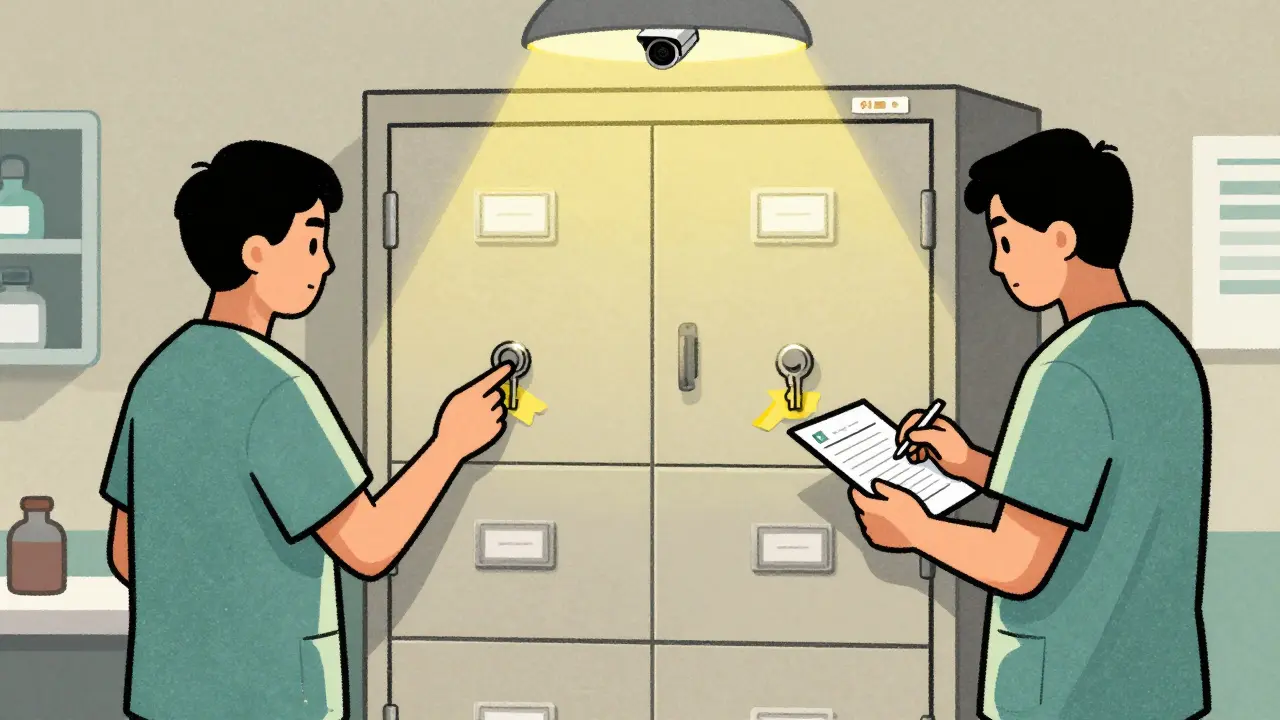
- Use a locked, tamper-evident cabinet or vault for all Schedule II-V drugs. Never leave them on counters, in unlocked drawers, or in open bins.
- Limit access to one or two trusted staff members-usually pharmacists or designated nurses. The fewer people who can open the storage area, the lower the risk.
- Position storage units where they’re visible to surveillance cameras. Hidden lockers or back-room cabinets are red flags for inspectors.
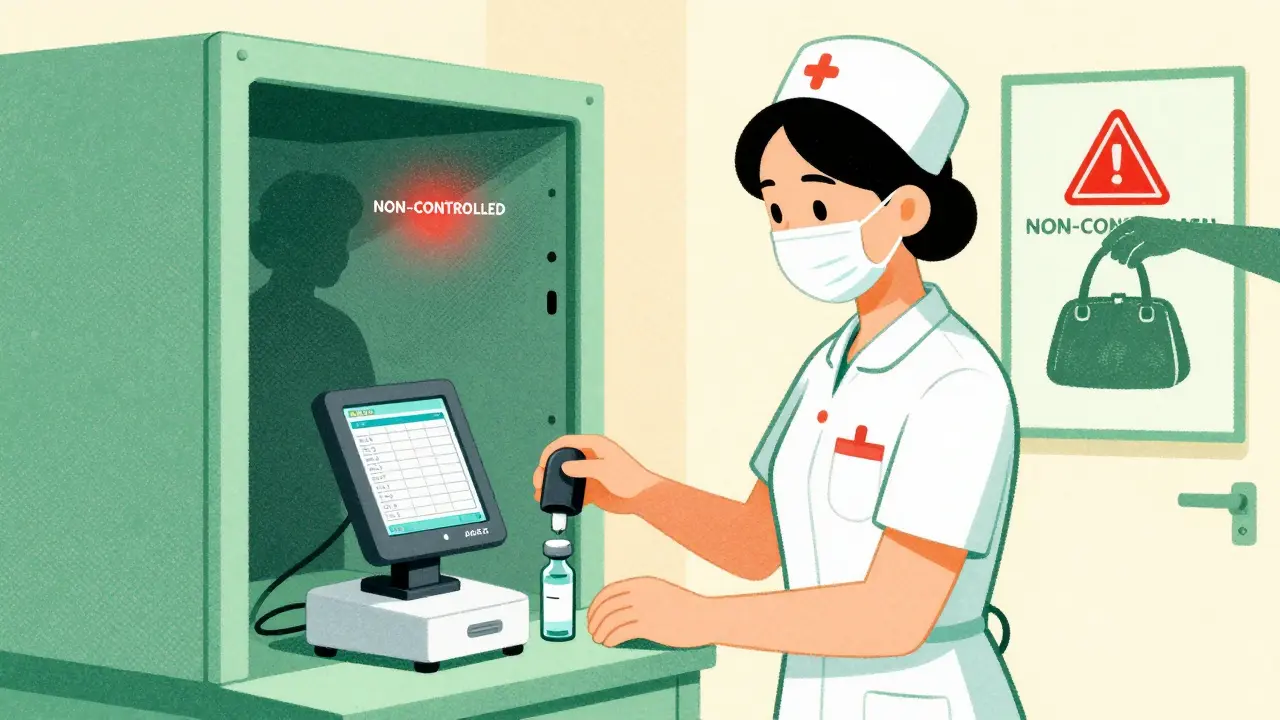
- Never allow personal bags, purses, or coats near storage areas. In 31% of documented diversion cases, staff used bags to conceal stolen drugs.
For smaller facilities without automated systems, dual-control protocols are critical. That means two authorized people must be present every time a controlled substance is accessed-whether it’s retrieving a vial, refilling a cabinet, or disposing of waste. One person opens the lock. The other verifies the count. Both sign off. This isn’t bureaucracy-it’s a safety net.
Automated Dispensing Cabinets (ADCs): The Gold Standard
If your facility has more than 100 beds, an Automated Dispensing Cabinet (ADC) isn’t just a nice-to-have-it’s a necessity. ADCs are smart cabinets that require biometric login (fingerprint or ID badge) and log every single transaction. They track who took what, when, and why.
Studies show ADCs reduce diversion incidents by up to 73%. Why? Because they eliminate manual errors and create an audit trail. Every time a nurse pulls a dose, the system records it. If a vial disappears without a matching patient order, the system flags it immediately.
But ADCs aren’t perfect if misused. One hospital installed only one ADC for 12 operating rooms. Nurses started overriding the system to get quick access. Within six months, two staff members were caught diverting fentanyl. The fix? One ADC per OR, plus daily audits by pharmacists.
Cost is a barrier. A single ADC runs $45,000-$75,000, with annual maintenance around 15% of that. But the cost of a single diversion case-legal fees, patient testing, reputational damage-can exceed $287,000. For most hospitals, the ROI is clear.
Manual Systems: How to Make Them Work
If you’re in a small clinic or critical access hospital without an ADC, you can still stay compliant-but you have to work harder.
- Use double-locked storage: One lock on the cabinet, another on the room door. Keys are held by different people.
- Conduct daily inventories. Count every tablet, every vial. Compare counts to electronic records. If something’s off, investigate immediately.
- Document every transfer manually. If you move a box of morphine from the pharmacy to a floor unit, write down the date, time, person who transferred it, and person who received it. Signatures are mandatory.
- Use pre-filled, tamper-proof syringes when possible. They’re harder to refill with saline.
A Mayo Clinic study found manual systems require 37% more staff time than ADCs. But they’re still viable-if you’re consistent. The biggest failure? Skipping daily counts. That’s where most thefts go unnoticed.
High-Risk Moments: Where Diversion Happens
Diversion rarely happens during routine dispensing. It happens in the gaps.
- Compounding medications: When a pharmacist mixes a batch of IV morphine, someone could siphon off a portion before it’s labeled.
- Waste disposal: A nurse flushes a vial down the sink and claims it was unused. But the system shows it was dispensed to a patient who never received it.
- Transfer between units: Moving drugs from pharmacy to floor stock without a digital record creates blind spots.
- Post-operative recovery: Fentanyl patches and syringes are stolen from bedside tables or trash bins.
These are the moments you must audit. The DEA found that 68% of major diversion cases involved manual handoffs with no electronic record. Fix this by:
- Using barcode scanning for every transfer
- Requiring witness signatures for waste disposal
- Installing cameras near waste disposal stations
Monitoring and Auditing: The Real Defense
Storage is only half the battle. You need to watch what’s happening.
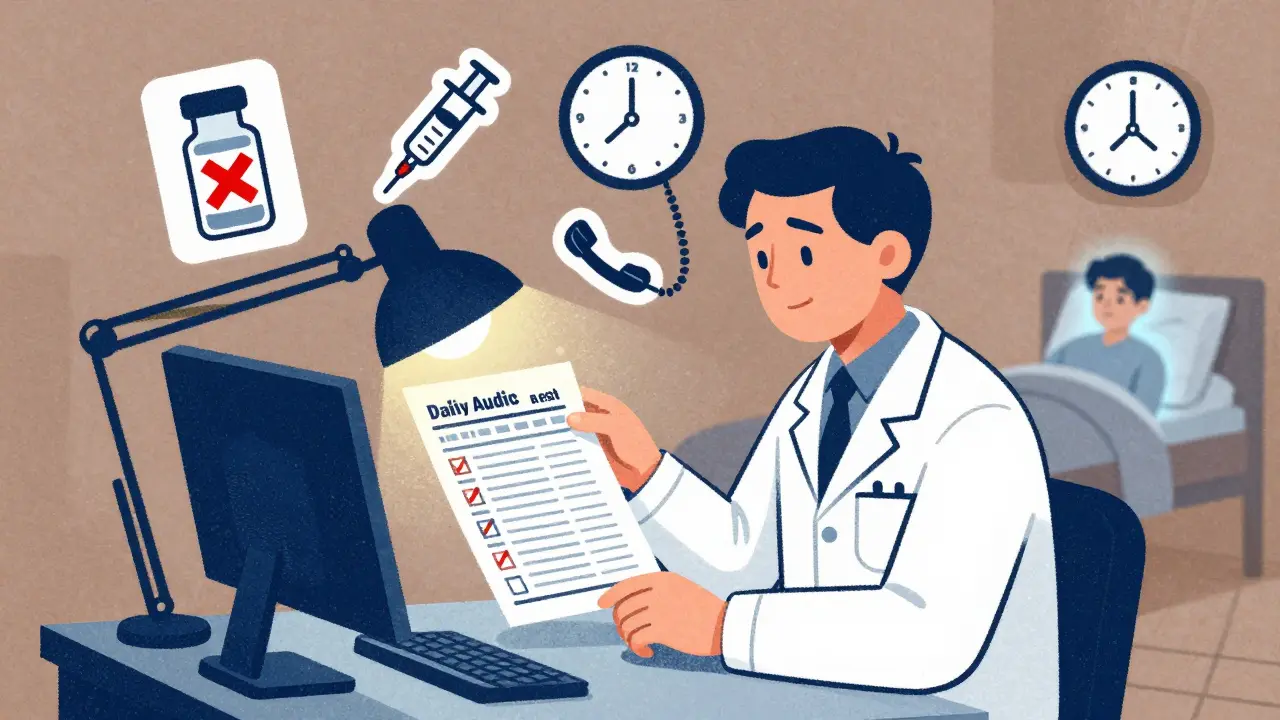
Every day, a pharmacist should review:
- Unusual spikes in drug usage
- Patients who never received their meds but were billed for them
- Staff who consistently work late, access drugs outside normal hours, or refuse to let others observe their actions
AI-powered systems now flag anomalies automatically. At Johns Hopkins, a new algorithm spotted a nurse who was taking 10x more fentanyl than others-within 48 hours. The nurse was later convicted of diversion.
Don’t wait for AI. Start simple: Look for outliers. If one nurse is using 30% more opioids than their peers, ask why. Don’t assume it’s just busy. Assume it’s a red flag.
Training, Culture, and Staff Buy-In
Even the best locks fail if staff don’t care. A 2022 survey found 63% of healthcare workers resisted new storage rules at first. But after six months of consistent enforcement, 89% said they felt safer.
Training isn’t a one-time PowerPoint. It’s ongoing. Hold monthly 15-minute huddles to review diversion cases (anonymized). Show staff how theft impacts real patients-like the one who didn’t get pain meds after surgery because someone stole them.
Encourage reporting. Create a confidential hotline. Reward staff who spot suspicious behavior. Make it clear: protecting drugs isn’t about policing-it’s about protecting people.
New Rules for 2025 and Beyond
As of January 1, 2025, the DEA requires all facilities handling more than 10kg of Schedule II substances annually to use real-time inventory tracking. That means your system must update instantly when a drug is taken or returned. No delays. No batch uploads.
ASHP’s updated guidelines (coming in Q2 2024) will add new rules around saline flushes. Many thieves now replace stolen fentanyl with saline and flush it down the drain. The new rules will require double verification for all flushes-both the original dose and the flush must be documented.
Technology is catching up. AI, blockchain inventory logs, and smart vials with embedded sensors are on the horizon. But for now, the basics still win: lock it down, track it all, watch for changes, and train your team.
What Happens If You Don’t Comply?
The DEA doesn’t warn. They show up. In 2022, 98% of inspections included a physical check of storage areas. If they find unlocked cabinets, missing logs, or unexplained discrepancies, you’re looking at:
- A civil penalty of up to $187,500
- Loss of DEA registration (which means you can’t prescribe or dispense controlled substances)
- Criminal charges if theft is proven
- Lawsuits from patients harmed by missing or contaminated drugs
One clinic in Ohio lost its license after a nurse stole 1,200 oxycodone tablets over nine months. The DEA found the cabinet was unlocked at night. No logs. No cameras. No audits. The clinic closed within six weeks.
Can I store controlled substances in a regular locked cabinet?
A regular locked cabinet isn’t enough unless it’s part of a dual-control system. The DEA requires "effective controls"-meaning you need more than just a lock. You need access logs, limited personnel, surveillance, and daily audits. For small facilities, a double-locked cabinet with two separate keys held by different people is acceptable. But for any facility handling more than a few hundred doses per month, an automated dispensing cabinet (ADC) is strongly recommended.
Do I need to count controlled substances every day?
Yes. Daily inventory counts are a mandatory part of DEA compliance for all facilities handling controlled substances. Even if you use an ADC, pharmacists must review dispensing logs daily for anomalies. For manual systems, a physical count of every vial, tablet, or patch is required before and after each shift. Missing counts or unexplained discrepancies must be reported immediately to your pharmacy director and the DEA if significant.
What should I do if I suspect a coworker is diverting drugs?
Report it immediately through your facility’s confidential reporting system. Don’t confront the person. Don’t investigate on your own. Diversion is a serious legal and ethical issue. Your role is to protect patients and follow protocol. Most facilities have a Drug Diversion Response Team. If yours doesn’t, escalate to your pharmacy manager or compliance officer. Retaliation against reporters is illegal under federal law.
Are there alternatives to expensive automated cabinets?
Yes, but they require more labor. For small clinics, use dual-control protocols: two people must be present for every access. Install surveillance cameras focused on storage areas. Use pre-filled, tamper-evident syringes. Conduct daily audits. Keep detailed handwritten logs with signatures. While this works, it’s more prone to human error and takes 37% more staff time than ADCs. If your budget allows, even a basic ADC with a single login system is better than manual tracking.
Can I use the same cabinet for controlled and non-controlled drugs?
No. Controlled substances must be stored separately from non-controlled medications. Mixing them increases the risk of theft and makes audits impossible. Even if state law doesn’t require it, DEA regulations do. Use separate locked cabinets or clearly divided sections within a single cabinet with physical barriers and separate locks. Never store controlled substances in the same drawer as antibiotics, vitamins, or IV fluids.
Final Thoughts: It’s Not Just About Compliance
Storing controlled substances securely isn’t about avoiding fines. It’s about making sure the person in Bed 4 gets their pain meds. It’s about knowing the nurse who just worked a 12-hour shift isn’t stealing fentanyl to get high. It’s about trusting your team-and giving them the tools to do their job safely.
The best storage system isn’t the most expensive one. It’s the one that’s used consistently, audited daily, and supported by a culture that says: we don’t tolerate this. Not here. Not ever.




Haley Parizo
January 4, 2026 AT 13:01They talk about locks and audits like it’s a checklist, but the real issue is the system that turns nurses into thieves. When you’re overworked, underpaid, and watching a patient scream in pain because the meds are locked away-what’s left to do? This isn’t about crime. It’s about a broken system that demands perfection from people who are already drowning.
innocent massawe
January 6, 2026 AT 09:22Man, this hit different where I come from. In Nigeria, we don’t even have locked cabinets sometimes. We just pray the drugs make it to the patient. But I see your point-this isn’t just about theft. It’s about dignity. Everyone deserves their pain meds. 💔
Philip Leth
January 7, 2026 AT 01:36Been there. Worked ER in rural Ohio. We used a dumb old safe with two keys-one with the charge nurse, one with the pharmacy tech. One night, I caught a guy trying to swap a fentanyl vial with saline. He said he was ‘just making sure the patient got it.’ Bullshit. We fired him. But honestly? We were lucky he got caught before someone died.
Angela Goree
January 8, 2026 AT 20:09DEA doesn’t play. No excuses. Locks? Fine. Cameras? Fine. But if you’re not doing daily counts, you’re not just negligent-you’re complicit. And if your facility can’t afford ADCs, then you’re not a hospital-you’re a liability waiting for a lawsuit. Stop pretending you’re doing enough. You’re not.
Joy F
January 9, 2026 AT 05:34Let’s be honest-this whole system is performative. We build cages for drugs like they’re dangerous animals, but the real predator is the system that creates burnout, isolation, and despair among staff. The fentanyl isn’t the problem. The 14-hour shifts, the 20-patient load, the lack of mental health support-that’s the poison. We’re treating symptoms while the disease eats the soul of healthcare.
Palesa Makuru
January 10, 2026 AT 18:51Look, I’ve worked in three countries. The U.S. spends $75k on a cabinet but can’t afford to hire a second nurse. Meanwhile, in South Africa, we use handwritten logs and prayer. Guess what? The diversion rate is lower here. Why? Because people still care. You don’t need tech to be ethical-you need humanity. And we’ve lost that.
Hank Pannell
January 11, 2026 AT 18:53Interesting how we frame this as ‘diversion’ like it’s some abstract crime. But it’s not. It’s a symptom of systemic neglect. Nurses aren’t stealing because they’re evil-they’re stealing because they’re exhausted, underpaid, and watching patients suffer while the system polices them like criminals. The real audit? Look at the staffing ratios. That’s where the theft begins.
Lori Jackson
January 13, 2026 AT 03:50Let’s not romanticize this. People who steal drugs are predators. Period. They don’t ‘need’ them-they want them. And if you’re defending them because they’re ‘overworked,’ you’re just enabling a moral collapse. This isn’t a social justice issue-it’s a criminal one. Lock them up. Fire them. End of story.
Wren Hamley
January 13, 2026 AT 05:19My cousin’s a nurse in Arizona. She told me they started using smart vials last year-tiny chips that ping when opened. If someone tries to swap it, the system auto-flags. She said it felt like Big Brother… until she realized it saved her from being accused of theft when someone else stole from her cart. Now she calls them ‘silent bodyguards.’
erica yabut
January 14, 2026 AT 04:36Oh, so now we’re supposed to feel bad for the nurse who stole 1,200 pills? Please. She wasn’t ‘burnt out’-she was addicted. And you’re all just gaslighting the fact that this is a drug epidemic disguised as a compliance issue. Stop pretending this is about ethics. It’s about addiction. And addiction doesn’t care about your audit logs.
Vincent Sunio
January 14, 2026 AT 16:24The term ‘effective controls’ is not a suggestion-it is a statutory obligation under 21 U.S.C. § 823(a)(2). The failure to implement dual-control protocols, maintain contemporaneous inventory records, and ensure surveillance coverage constitutes a prima facie violation of DEA regulations. Any institution that substitutes procedural convenience for legal compliance is not merely noncompliant-it is criminally negligent.
Ian Detrick
January 15, 2026 AT 23:26Yeah, the tech helps-but the real game-changer is culture. I used to work at a place where the pharmacist would high-five nurses after audits. ‘Good job keeping us safe.’ No punishment, no fear-just pride. Diversion dropped 80% in six months. People don’t steal from teams that treat them like humans.
Sarah Little
January 16, 2026 AT 12:01Per DEA 21 CFR 1301.71(b), controlled substances must be stored in a securely locked, substantially constructed cabinet. The term ‘substantially constructed’ implies structural integrity beyond standard cabinetry-e.g., bolted to the floor, reinforced with steel, and resistant to forced entry. Additionally, per ASHP Guidelines on the Safe Storage of Controlled Substances, 2023 Edition, any facility utilizing manual inventory systems must conduct dual verification during each access event, with real-time documentation in a tamper-evident log. Failure to meet these criteria renders compliance null and void.