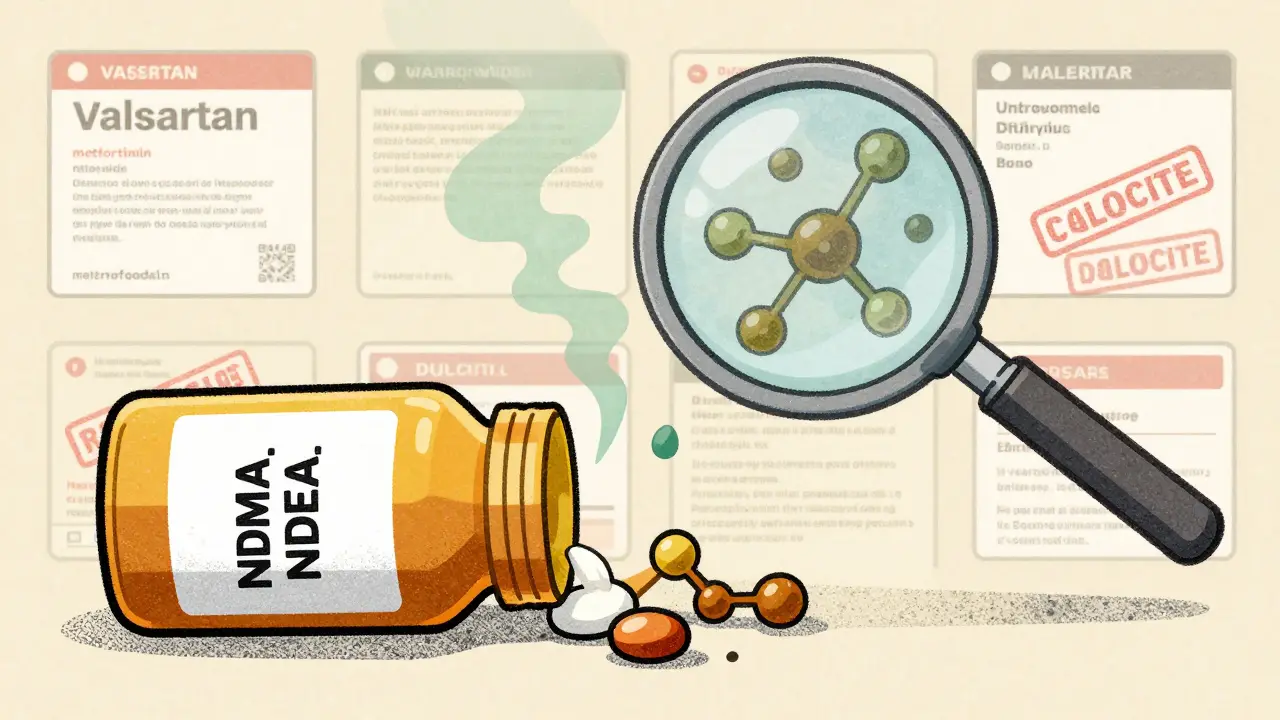
Since 2018, a quiet but dangerous problem has shaken the generic drug industry: nitrosamine contamination. These aren’t just impurities-they’re potent carcinogens found in pills millions take daily. What started with a single recall of valsartan for high blood pressure exploded into a global crisis affecting dozens of medications, from antidepressants to diabetes drugs. By mid-2025, the FDA had overseen more than 40 product recalls directly tied to nitrosamines, and over 500 total recalls involving contaminated active ingredients. The scary part? These chemicals form in ways no one fully predicted-and they’re still turning up in new places.
How Nitrosamines Got Into Your Medicine
Nitrosamines like NDMA and NDEA don’t just appear out of nowhere. They form during manufacturing when certain chemicals react under heat, pressure, or storage conditions. Specifically, they happen when nitrites (common in some excipients) meet secondary or tertiary amines (often part of the drug molecule itself). It’s not a flaw in the active ingredient-it’s a side reaction in the process. For example, in metformin, a common diabetes drug, nitrosamine formation was traced back to nitrite impurities in raw materials. In ranitidine (Zantac), the molecule itself had the right structure to create NDMA under normal storage conditions. Even packaging became a culprit. Blister packs and bottle liners made with amine-based adhesives started releasing nitrosating agents over time, contaminating tablets months after they were made. The FDA’s September 2024 guidance made it clear: even tiny amounts matter. Acceptable intake limits are measured in nanograms per day-less than a grain of salt in a swimming pool. For NDMA, it’s 96 ng/day. For NDEA, it’s 26.5 ng/day. Some newer nitrosamines tied directly to the drug molecule (NDSRIs) like N-nitroso-varenicline also fall under the 96 ng/day limit. But here’s the catch: if two nitrosamines are present together, their combined levels can’t exceed 100% of the total risk. Two at 80% each? That’s a violation.Drugs Affected: More Than Just Blood Pressure Meds
The first wave hit ARBs-valsartan, losartan, irbesartan. Then came ranitidine, pulled from shelves in 2020 after it was found to produce NDMA over time. But the list kept growing. By 2025, nitrosamines had been found in:- Metformin (diabetes)
- Duloxetine (depression, nerve pain)
- Varenicline (smoking cessation)
- Rifampin (tuberculosis)
- Generic versions of Vyvanse (ADHD)
- Several antihypertensives and antibiotics
FDA’s Response: From Panic to Practicality
At first, the FDA reacted fast. Recalls were issued. Warning letters followed. But by 2024, it became clear that the scale of the problem was too big for a one-size-fits-all solution. Smaller generic makers couldn’t afford $2 million lab upgrades or 18-month reformulation cycles. In June 2025, the agency quietly changed its stance. Instead of demanding full compliance by August 1, 2025, the FDA now accepts detailed progress reports. Manufacturers must show they’ve identified root causes, started testing, and are working on solutions-but they don’t need to have everything fixed yet. This shift, confirmed in the April 2025 Generic Drugs Forum, was a direct response to industry feedback. "Nitrosamine mitigation strategies vary widely and can demand extensive time and supply-chain adjustments," said FDA officials. The agency now recognizes that fixing one pathway can accidentally create another. One company in Texas spent 14 months replacing a single excipient supplier, only to find a new nitrosamine popping up in a different step. It took three more rounds of reformulation to get it right.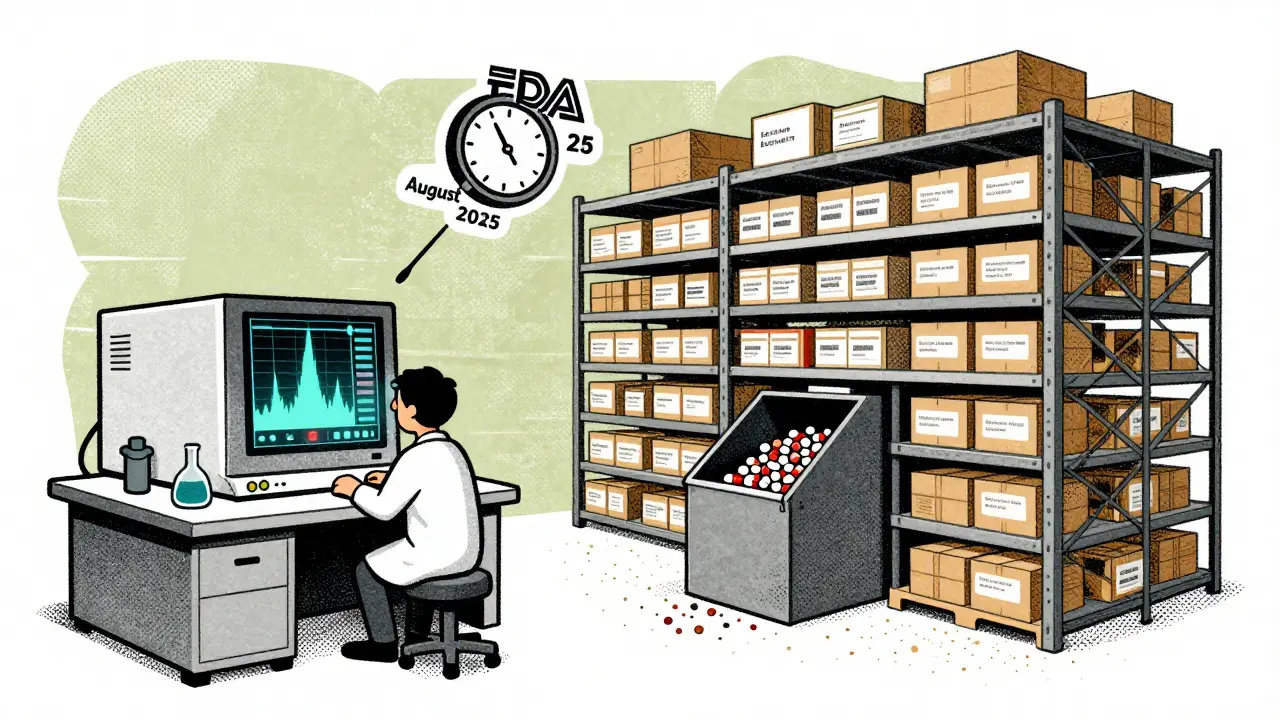
Global Differences: Who’s Doing What
The U.S. isn’t alone, but it’s the strictest. The European Medicines Agency (EMA) has issued 32 recalls through mid-2025. Health Canada, the UK’s MHRA, and Japan’s PMDA have each handled between 5 and 15 cases. But their timelines are looser. EMA allows a staggered approach through 2026. The FDA’s original August 2025 deadline was the most aggressive-and now, the most flexible. The U.S. also leads in defining compound-specific limits for NDSRIs. While EMA sometimes applied generic thresholds, the FDA requires manufacturers to prove exactly how much of each unique nitrosamine is present and how it’s controlled. That’s more work-but it’s also more precise.Who’s Paying the Price?
The cost isn’t just financial. It’s structural. Smaller generic manufacturers are disappearing. One mid-sized company in Ohio spent $2.1 million and 18 months just to fix its metformin line. They hired new chemists, bought LC-MS/MS machines capable of detecting 0.3 ng/mL, and revalidated every batch. Their profit margin dropped by 7%. They’re still in business-but barely. Meanwhile, bigger players like Teva, Fresenius Kabi, and Sun Pharma invested early. They now use proactive testing during development, not just post-market. One manufacturer avoided a recall entirely by switching excipients before launching a new generic version of an ARB. That’s now their selling point: "We tested for nitrosamines before we sold a single pill." Evaluate Pharma estimates that compliance costs have cut industry-wide generic profit margins by 3-5 percentage points. That’s billions in lost revenue. And it’s reshaping the market. Consolidation is accelerating. New entrants are rare. The FDA is now giving preferential review to companies with proven nitrosamine controls.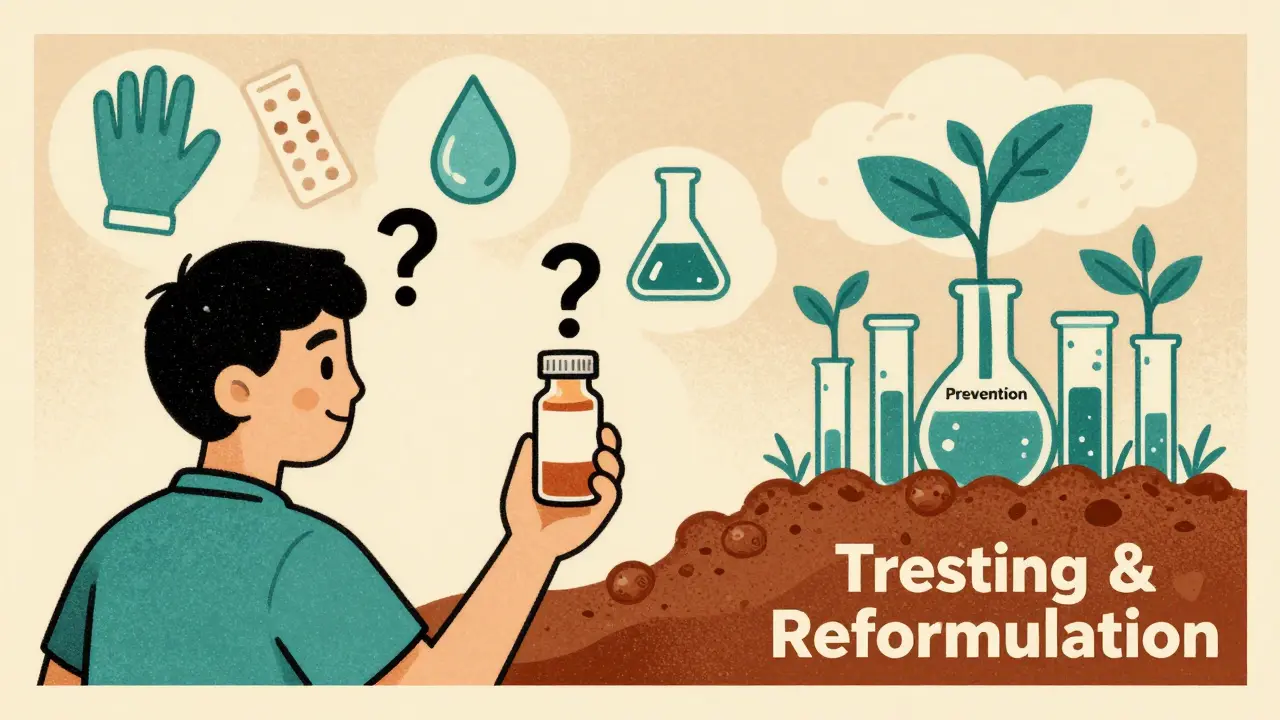
What This Means for You
If you take a generic drug, here’s what you need to know:- Recalls happen. If your medication is pulled, it’s not because it’s unsafe-it’s because regulators found a risk that’s now considered unacceptable.
- Not all generics are equal. Some brands have invested heavily in quality control. Others haven’t.
- There’s no need to panic. The actual cancer risk from trace nitrosamines is extremely low for most people taking short-term meds. But long-term users of contaminated drugs may face slightly elevated risk.
- Don’t stop your medicine without talking to your doctor. The risk of untreated high blood pressure, diabetes, or depression is far greater than the nitrosamine risk.
What’s Next?
Experts believe the list of affected drugs will keep growing. Nitrosamines are hard to predict. They form in unexpected places-like in the solvent used to clean equipment, or in the water supply used in manufacturing. The FDA is now looking at more drug classes: statins, antifungals, even some OTC pain relievers. Manufacturers are learning. The worst mistakes happened when companies assumed nitrosamines only came from APIs. Now, they test packaging, water, air, and even the gloves workers wear. The focus has shifted from reaction to prevention. The crisis has forced the industry to mature. What was once seen as a "quality issue" is now understood as a core safety requirement. The days of cutting corners on testing are over. For generic drugs to stay trusted, they have to be as clean as brand-name ones.What are nitrosamines and why are they dangerous?
Nitrosamines are chemical compounds that can form during drug manufacturing or storage. They’re classified as probable human carcinogens by the International Agency for Research on Cancer (IARC). Even tiny amounts-measured in nanograms per day-can increase cancer risk over long-term exposure. Common types found in drugs include NDMA, NDEA, and NDSRIs like N-nitroso-varenicline.
Which generic drugs have been recalled for nitrosamine contamination?
Recalls have affected multiple classes: ARBs like valsartan and losartan (blood pressure), ranitidine (Zantac, for heartburn), metformin (diabetes), duloxetine (antidepressant), varenicline (Chantix, for smoking cessation), rifampin (antibiotic), and some generic ADHD and antibiotic medications. The FDA has issued over 40 specific product recalls since 2018, with more than 500 total recalls tied to contaminated active ingredients.
Is it safe to keep taking my generic medication?
If your drug hasn’t been recalled, it’s likely safe. The FDA only recalls products when nitrosamine levels exceed strict safety limits. The actual cancer risk from trace amounts is very low for most people. However, if you’re on long-term therapy, talk to your doctor. Never stop taking your medication without medical advice-untreated conditions like high blood pressure or diabetes carry much higher risks.
Why did the FDA soften its August 2025 deadline?
The FDA realized many manufacturers, especially smaller ones, couldn’t meet the deadline due to the complexity of identifying root causes and reformulating products. Nitrosamines can form in multiple ways-through excipients, packaging, or manufacturing processes-and fixing one issue often creates another. The agency now accepts detailed progress reports instead of full compliance, acknowledging that solving this problem takes time, resources, and testing.
How are manufacturers fixing nitrosamine contamination?
Companies are using advanced testing (LC-MS/MS) to detect nitrosamines at parts-per-billion levels. They’re changing excipients, redesigning synthesis routes, switching suppliers, and even modifying packaging to eliminate amine-based materials. Some are testing raw materials before use, while others are running stability studies to see if nitrosamines form over time. The goal is prevention, not just detection.
Will this affect the price or availability of generic drugs?
Yes. Compliance costs have increased by $500,000 to $2 million annually for mid-sized manufacturers. Some smaller companies have exited the market, reducing competition. This has led to temporary shortages, especially in ARBs and metformin during 2018-2020. Prices may rise slightly over time as manufacturers pass on testing and reformulation costs. But the bigger impact is consolidation-larger firms with better resources now dominate the market.


Milla Masliy
January 14, 2026 AT 01:55Wow, this is one of those posts that makes you realize how much we take for granted. I never thought about packaging materials being a source of contamination-blister packs with amine-based adhesives? That’s wild. It’s not just about the drug anymore; it’s the whole ecosystem. I work in pharma logistics, and this changes how I see quality control. We’re not just moving pills-we’re moving potential time bombs.
Pankaj Singh
January 14, 2026 AT 04:55Let’s be real-this isn’t a ‘quiet crisis.’ It’s corporate negligence dressed up as regulatory science. Companies knew about nitrosamine risks for years but kept cutting corners because generics are a race to the bottom. Now they want sympathy because they can’t afford $2M in upgrades? Too bad. Patients aren’t lab rats.
Scottie Baker
January 15, 2026 AT 07:59I took metformin for 3 years. When I heard about the recall, I freaked out. Like, full-on panic. I went to the pharmacy and they gave me a different brand-same generic, different label. I asked if it was safe. They shrugged. That’s it? No test results? No transparency? I’m not sleeping until I know what’s in my damn pills.
Anny Kaettano
January 16, 2026 AT 18:20As someone who’s been on duloxetine for anxiety for over a decade, I’m terrified but also hopeful. The FDA’s shift to progress reports feels like the first real acknowledgment that this isn’t a bug-it’s a system failure. But we need more than reports-we need public dashboards. Patients deserve to see which manufacturers are actually cleaning up their act. Transparency isn’t optional anymore.
Angel Molano
January 18, 2026 AT 15:32Stop crying about costs. If your drug gives people cancer, you don’t get a pass. Period.
Gregory Parschauer
January 20, 2026 AT 00:30Oh please. The FDA’s ‘flexibility’ is just a cover for regulatory capture. Big pharma played the long game-bankrolled the testing labs, lobbied for ‘risk-based’ thresholds, and now they’re getting a free pass while small manufacturers bleed out. This isn’t pragmatism-it’s institutional betrayal. And don’t tell me ‘the risk is low.’ If I’m taking a pill daily for 20 years, that’s 7,300 doses. Multiply that by millions. That’s not a risk-it’s a public health experiment. And we’re all the lab mice.
Robin Williams
January 21, 2026 AT 00:28Bro, imagine if we treated food like this. ‘Oh, there’s a trace of carcinogen in your ketchup? Eh, it’s under 96 ng/day. Chill.’ We’d riot. But pills? Nah, we just shrug and pop another. We’ve normalized chemical roulette. And now we’re surprised when people get sick? 🤦♂️
Alan Lin
January 22, 2026 AT 00:58While the systemic failures described are deeply concerning, it is imperative to recognize the unprecedented technical challenges involved in detecting and mitigating nitrosamine impurities at sub-parts-per-billion levels. The analytical methodologies required-LC-MS/MS with isotope dilution, rigorous method validation, and cross-contamination controls-are not merely expensive; they are scientifically complex and require highly specialized expertise. The FDA’s pivot toward phased compliance reflects a mature understanding of industrial-scale process chemistry, not regulatory capitulation. To dismiss this as corporate appeasement is to misunderstand the nature of chemical equilibrium, reaction kinetics, and supply-chain interdependency. The goal is not perfection overnight-it is sustainable, science-based safety.
Angel Tiestos lopez
January 22, 2026 AT 06:54so like… if my ranitidine got recalled in 2020 and i switched to famotidine… am i safe? or is famotidine just the next one waiting to explode? 😅 i mean, what’s next? the pills themselves are made of nitrosamines and we just don’t know yet? 🤯
jefferson fernandes
January 22, 2026 AT 08:32This isn’t just about drugs-it’s about trust. When you take a generic, you’re trusting that someone else did the hard work so you don’t have to pay $500 a month. But now? That trust is broken. And it’s not because of lazy manufacturers alone. It’s because regulators let the market dictate safety instead of enforcing it. We need independent, publicly funded testing labs-not corporate labs with conflict-of-interest disclosures buried in footnotes.
Vinaypriy Wane
January 23, 2026 AT 07:54It’s not just the drugs… it’s the water. The air. The gloves. The cleaning solvents. The fact that nitrosamines can form from *any* amine-nitrite interaction means we’re playing whack-a-mole with chemistry itself. And yet, we still expect pills to be ‘safe’? We need a new paradigm: zero tolerance isn’t feasible, but zero ignorance is non-negotiable. Every batch, every supplier, every step-documented. Publicly. No exceptions.
Kimberly Mitchell
January 25, 2026 AT 06:16So basically, the government is letting drug companies off the hook because they’re too lazy to fix their own mess? And we’re supposed to be grateful for ‘progress reports’? What a joke. I’m switching to brand-name. Screw the extra $200/month. I’m not dying because someone didn’t want to spend $2 million.