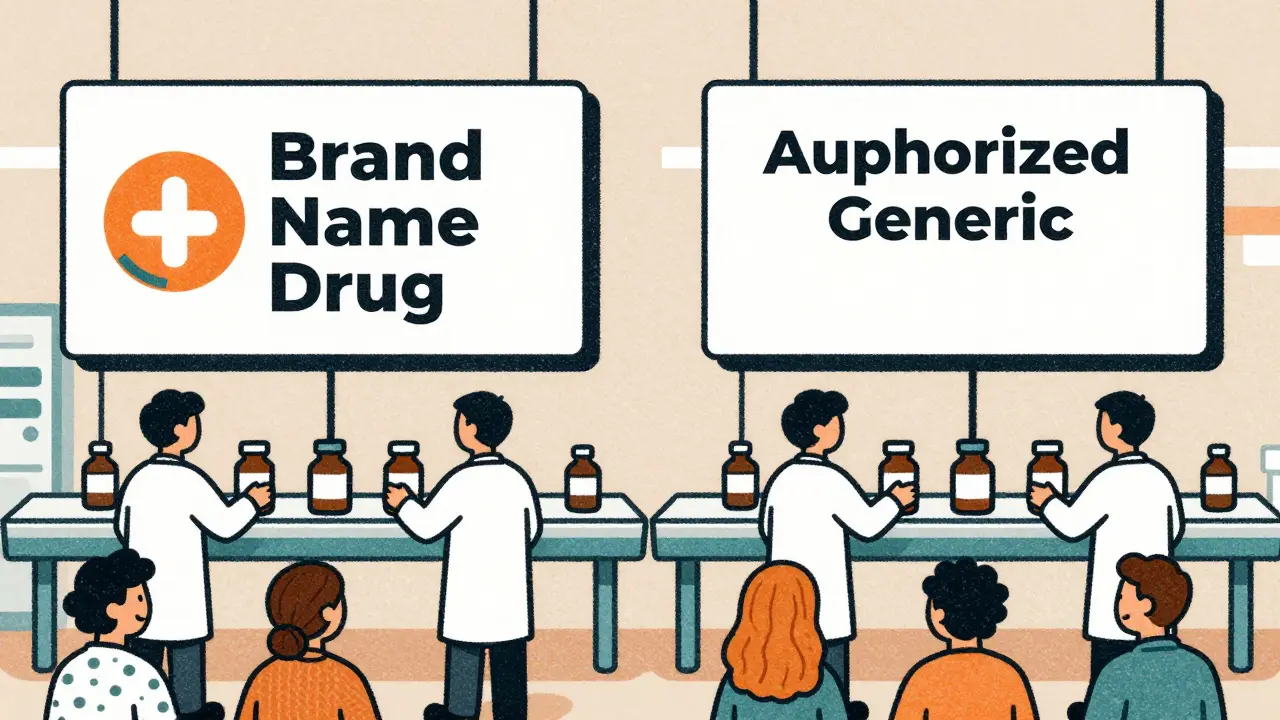
When a brand-name drug loses its patent, you’d expect a flood of cheap generics to hit the market. But sometimes, the brand company itself starts selling the exact same drug under a generic label. That’s an authorized generic-a product made by the original manufacturer but sold without the brand name, often at a lower price. It’s not a traditional generic. It’s not a biosimilar. It’s a strategic move by the brand to stay in the game after exclusivity ends.
What Exactly Are Authorized Generics?
Authorized generics are identical to the brand-name drug in active ingredient, dosage, strength, and formulation. The only difference? No brand name on the bottle. They’re manufactured by the same company that made the original, often on the same production line. The FDA has tracked these since 1999, and since 2010, over 850 have launched in the U.S. Most appear after the first traditional generic gets approval-never before. Why? Because brand companies don’t want to hurt their own sales early. They wait until generic competition starts to bite, then drop their own version to undercut the competition.These aren’t random. They’re concentrated in oral tablets and capsules-easy to replicate, easy to manufacture. In 2024, nearly 70% of authorized generics entered the market during or right after the 180-day exclusivity window granted to the first generic filer. That’s not coincidence. It’s precision targeting.
Why Do Brand Companies Use Them?
It’s not charity. It’s economics. When a drug like imatinib or celecoxib loses patent protection, revenue can drop 80% within a year. Traditional generics price aggressively. But if the brand company launches its own generic, it captures a chunk of that market-often 30-50%-before the cheaper competitors fully take over. It’s a way to keep revenue flowing while pretending to support lower prices.For patients, it might look like a win: same drug, lower cost. But for the system? It’s complicated. Studies from Health Affairs show that authorized generics delay true competition. They reduce the incentive for independent generic manufacturers to invest in production because the brand company already owns the market share. That means fewer players, less pricing pressure over time.
How the Market Is Changing
The trend isn’t static. Between 2010 and 2019, brand companies often delayed launching authorized generics to maximize brand sales. But since 2023, that’s changed. According to RAPS in June 2025, the practice of holding back authorized generics is declining. Why? Two reasons: regulatory pressure and market reality.Regulators are watching closer. Policymakers are pushing back against tactics that extend market control beyond patent life. The JAMA Health Forum found that extending exclusivity by even a few months adds $2.5 billion in extra costs to commercial insurers and Medicare. That’s money patients and taxpayers pay. Brand companies are feeling the heat.
At the same time, the generic market is exploding. By 2034, the U.S. generic drug market is projected to hit $197 billion-up from $138 billion in 2024. That’s a 3.6% annual growth rate. Why? Because over $200 billion in annual brand drug sales are set to lose exclusivity between 2025 and 2030. Drugs like ustekinumab and vedolizumab are next in line. These aren’t small pills-they’re high-cost biologics. And for those, biosimilars are the real threat.
The FDA’s New Move: Domestic Production Priority
In October 2025, the FDA launched a pilot program that fast-tracks ANDA approvals for generic drugs made entirely in the U.S. This is a big deal. For years, most generic manufacturing moved overseas-India, China-because it was cheaper. But supply chain risks, especially after the pandemic, changed that. Now, the government wants drug production back on American soil.What does this mean for authorized generics? A lot. Brand companies that make their own generics now have a new incentive: faster approval if they use U.S.-sourced ingredients and testing. That could make authorized generics more attractive than ever-not just as a competitive tool, but as a way to qualify for quicker market access.
It also shifts the playing field. Traditional generic manufacturers without U.S. facilities may fall behind. Authorized generics, already made in U.S. plants by brand companies, get a built-in advantage. That could mean fewer independent generics entering the market-and more control staying with the big pharma players.
Biosimilars Are Coming-and They’re Different
The next wave of expirations isn’t just pills. It’s biologics. Drugs like Humira, Enbrel, and now ustekinumab are multi-billion-dollar sellers. Their patents are expiring, and biosimilars are ready to enter. Unlike small-molecule generics, biosimilars aren’t exact copies. They’re highly similar, but harder to make. And they cost more to develop.So far, brand companies haven’t launched authorized biosimilars. Why? Because the science is too complex. You can’t just repackage a biologic. But that doesn’t mean they won’t try. Some experts predict brand companies will partner with biosimilar makers or launch their own versions under generic labels once the technology matures. The $25 billion opportunity in oncology and immunology by 2029 could trigger a new wave of authorized biologic strategies.
What This Means for Patients and Payers
On the surface, authorized generics seem like a win: lower prices, same drug. But look deeper. When a brand company controls both the branded version and the authorized generic, it can manipulate pricing. They might lower the generic price just enough to stay competitive-but keep the branded version expensive for patients without insurance.Meanwhile, independent generic manufacturers struggle. If the brand company owns the cheapest version, why would a smaller company invest millions to get FDA approval? The answer: they often don’t. That reduces competition. And less competition means prices don’t drop as far or as fast as they should.
But here’s the flip side: if authorized generics are launched earlier and more transparently-as the trend suggests-they can help drive down prices faster than if the brand company tried to fight generics with lawsuits or patent extensions. The key is timing and transparency.
The Future: More Transparency, Less Control
The future of authorized generics isn’t about blocking competition. It’s about managing it. With the FDA’s new domestic production program, regulatory scrutiny rising, and biosimilars looming, brand companies can’t afford to be seen as anti-competitive. The days of hiding authorized generics behind patent cliffs are fading.Expect more authorized generics to launch sooner after generic approval. Expect more to be made in the U.S. Expect more pressure to disclose pricing and timing. And expect policymakers to keep pushing for faster, fairer access to low-cost drugs.
The bottom line? Authorized generics aren’t going away. But their role is shifting-from a weapon to delay competition, to a tool for controlled market transition. For patients, that could mean better access. For the system, it could mean lower costs-if regulators keep the pressure on.
Are authorized generics the same as traditional generics?
Yes and no. Authorized generics contain the exact same active ingredients, dosage, and formulation as the brand-name drug. The only difference is the label-they’re sold without the brand name. Traditional generics are made by different companies that file ANDAs with the FDA. Authorized generics are made by the original brand manufacturer, often on the same production line.
Why do brand companies sell authorized generics?
To maintain market share after patent expiration. Instead of losing all revenue to independent generics, brand companies launch their own version at a lower price. This lets them capture a portion of the generic market while reducing the financial hit from price erosion.
Do authorized generics lower drug prices?
They can, but not always. Authorized generics often start at a lower price than the brand version, which can push down overall market prices. However, because they’re made by the brand company, they can also reduce competition from independent generics, which may prevent prices from dropping even further. The net effect depends on timing and market structure.
Is the FDA doing anything to change how authorized generics work?
Yes. In October 2025, the FDA launched a pilot program that fast-tracks approval for generic drugs made entirely in the U.S. This gives brand companies an incentive to produce authorized generics domestically, potentially increasing their use. It also shifts the competitive balance, favoring manufacturers with U.S.-based production.
Will authorized generics be used for biologics and biosimilars?
Not yet, but it’s likely. Biosimilars are more complex than small-molecule generics, and no brand company has launched an authorized biosimilar so far. But as patents expire on drugs like ustekinumab and vedolizumab, and biosimilar production scales up, brand companies may start offering their own versions under generic labels to control market entry.
How do authorized generics affect patient access?
They can improve access by offering lower-cost versions of brand drugs. But if they reduce competition from independent generics, they may limit long-term price declines. The best outcomes happen when authorized generics are launched early and transparently, without blocking other generic entrants.

Erwin Kodiat
January 19, 2026 AT 06:11Man, I just read this whole thing and I’m sitting here thinking-this is like watching a chess match where the same player controls both sides. Brand companies playing the hero by lowering prices while quietly shutting out the underdogs? That’s not capitalism, that’s corporate parkour.
Lydia H.
January 20, 2026 AT 10:29It’s wild how something that looks like a win for patients-cheaper meds-can actually be a trap. The brand keeps its grip, the little guys can’t afford to play, and we’re all just hoping the price drops far enough to matter. Feels like we’re being sold a mirage of affordability.
Christi Steinbeck
January 20, 2026 AT 21:08Let’s not forget-this is why we need public drug manufacturing. If the government made generics, we wouldn’t have to rely on Big Pharma’s ‘generous’ side-hustles. This system is rigged, and patients are the ones paying the price.
Malikah Rajap
January 22, 2026 AT 13:57So… authorized generics are basically the pharma version of a influencer posting ‘I’m not rich, I just know how to save’ while owning three mansions? 😅
Josh Kenna
January 24, 2026 AT 04:43Wait so if the FDA is fast-tracking U.S.-made generics… does that mean the brand companies are basically getting a government subsidy to crush their own competition? That’s not regulation-that’s a corporate bailout with a side of irony.
Phil Hillson
January 26, 2026 AT 01:44Y’all acting like this is new. Big Pharma’s been doing this since the 80s. Patent cliff? Nah. Patent cliff with a backdoor exit. They’re not selling generics-they’re selling control. And we’re the ones buying it
Jacob Hill
January 27, 2026 AT 20:39I think the real win here is transparency-if they launch these earlier and don’t hide them behind legal loopholes, it actually helps. But the moment they start whispering to regulators or lobbying against independent generics? That’s when it turns toxic.
Jackson Doughart
January 28, 2026 AT 09:30One cannot ignore the structural imbalance: the entity that created the drug, funded its development, and bore the risk of failure is now being vilified for attempting to mitigate the consequences of its own innovation’s expiration. The market does not reward altruism-only strategic adaptation.
Jake Rudin
January 28, 2026 AT 11:15If we’re going to talk about market control, let’s not pretend that independent generics are saints. Most of them are bought out by private equity firms that squeeze margins until the pills taste like regret. Who’s really protecting patients here? The system? Or just the illusion of competition?
Astha Jain
January 29, 2026 AT 18:53lol so brand companies are just doing what every startup does-launch a ‘lite’ version to kill the competition. But now with more lawsuits and less conscience. #capitalism
sujit paul
January 31, 2026 AT 03:55Mark my words-this FDA pilot is just the first step. Next thing you know, the government will mandate that all drug manufacturing be done in underground bunkers by patriotic scientists. The Chinese are already laughing. The Indians? They’re buying the patents.
Valerie DeLoach
January 31, 2026 AT 23:59For patients who can’t afford copays, even a slightly cheaper version matters. But we can’t let the system get away with pretending this is altruism. We need public oversight, price caps, and real transparency-not just ‘hey, we made a generic now we’re good people.’
Aman Kumar
February 2, 2026 AT 20:18The entire pharmaceutical industrial complex is a Ponzi scheme built on patent extensions, regulatory capture, and the quiet desperation of chronically ill people who just want to live. Authorized generics? Just the glitter on the coffin.
Lewis Yeaple
February 4, 2026 AT 06:17It is worth noting that the FDA’s designation of ‘authorized generic’ carries no regulatory distinction from traditional generics under 21 CFR § 314.3. The only difference lies in branding and corporate strategy-not pharmacology, not safety, not efficacy. Therefore, consumer perception is being manipulated by semantics.