Imagine sitting down to a normal dinner, only to feel an urgent, undeniable need to run to the bathroom within minutes. It’s not just indigestion; it’s a relentless cycle of watery diarrhea that disrupts your life. If you’ve been diagnosed with irritable bowel syndrome-diarrhea (IBS-D) but standard treatments aren’t working, you might be dealing with something else entirely. You could have bile acid diarrhea, also known as bile acid malabsorption (BAM).
This condition affects roughly 25% to 30% of people labeled with IBS-D, yet it is frequently missed because specific testing isn't routine. When bile acids fail to reabsorb properly in the small intestine, they spill into the colon, irritating the lining and triggering rapid fluid secretion. The result? Chronic, urgent diarrhea that feels impossible to control. But here is the good news: unlike many chronic gut issues, this condition has a clear path to management through targeted medication and specific dietary changes.
Understanding the Mechanism Behind Bile Acid Malabsorption
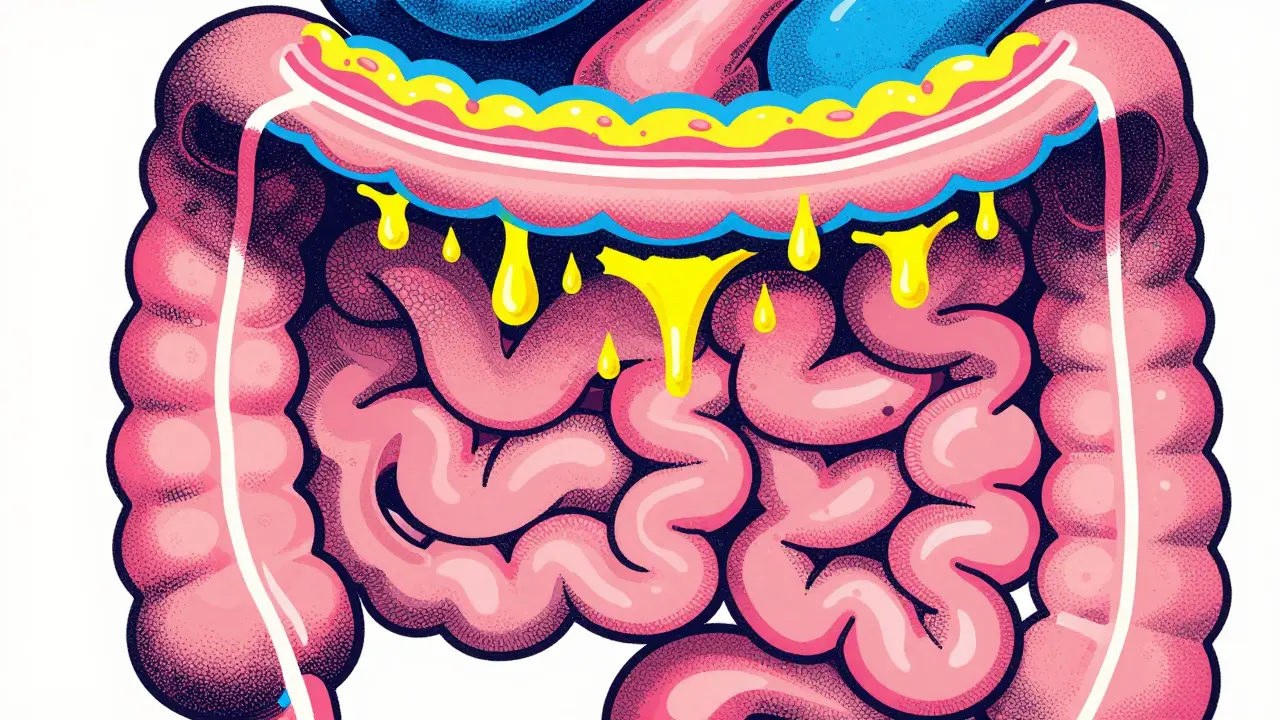
To fix the problem, we first need to understand what is going wrong inside your digestive tract. Normally, your liver produces bile to help digest fats. After doing its job, about 95% of those bile acids are reabsorbed in the terminal ileum-the very last part of your small intestine. In healthy individuals, this recycling process keeps things moving smoothly.
In bile acid diarrhea, this reabsorption breaks down. Excess bile acids reach the colon, where they don't belong. There, they act like irritants. They stimulate water and electrolyte secretion into the stool and speed up colonic motility. Think of it as pouring salt on a wound; the colon reacts by flushing everything out quickly to get rid of the irritant.
Doctors categorize this into three types based on the cause:
- Type I: Caused by physical damage or disease in the terminal ileum, such as Crohn's disease or surgical resection.
- Type II: Idiopathic, meaning there is no visible structural damage, but the absorption mechanism simply doesn't work right. This is often linked to functional disorders like IBS.
- Type III: Secondary to other gastrointestinal conditions, such as gallbladder removal or chronic pancreatitis.
Recent research from the National Institute of Diabetes and Digestive and Kidney Diseases (NIDDK) highlights that patients with this condition often have faster stool transit times-averaging 18 hours compared to 24 hours in controls. They also tend to have less diverse gut microbiomes, with lower levels of beneficial bacteria like Bifidobacteria. Understanding these biological shifts helps explain why general probiotics or fiber supplements alone rarely solve the issue.
Navigating the Diagnostic Maze
One of the biggest frustrations for patients is the diagnostic delay. On average, it takes six years to get a correct diagnosis. Why? Because many doctors stop at "IBS" without looking deeper. However, getting the right label is crucial because it opens the door to effective treatment.
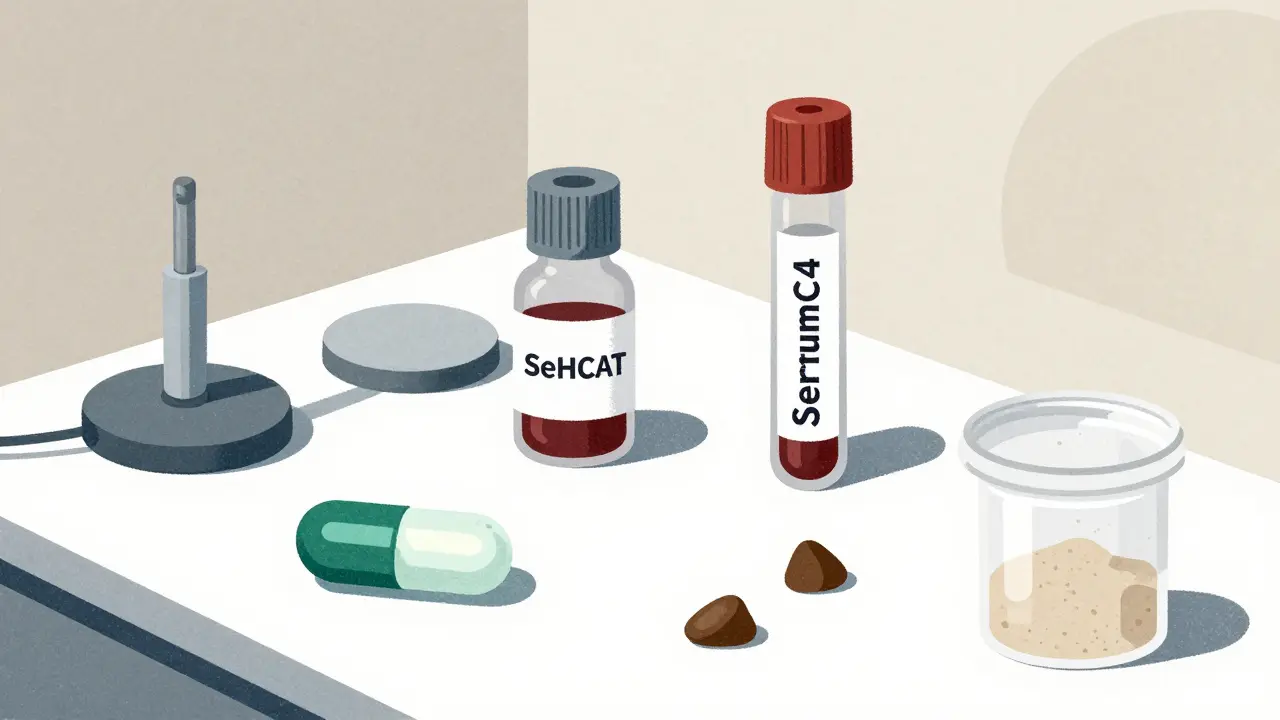
There are a few ways to confirm bile acid malabsorption, though availability varies significantly by region.
| Test Name | How It Works | Availability | Key Metric |
|---|---|---|---|
| SeHCAT Test | You swallow a capsule containing a radioactive tracer. A scan measures retention after 7 days. | Common in Europe/Australia; rare in the US. | Retention below 15% indicates severe malabsorption. |
| Fecal Bile Acid Test | Collects stool samples over 48 hours to measure total bile acid content. | Available at specialized labs (e.g., Mayo Clinic Labs). | High levels confirm excess bile in the colon. |
| Serum C4 Test | A blood test measuring 7α-hydroxy-4-cholesten-3-one, a marker of bile acid synthesis. | Growing availability; emerging standard. | Levels above 15.3 ng/mL suggest BAD (77% sensitivity). |
| FGF-19 Test | Measures Fibroblast Growth Factor 19, which regulates bile acid production. | Research/Emerging clinical use. | Levels below 85 pg/mL associated with BAD. |
If you live in the United States, the SeHCAT test is largely unavailable. Instead, doctors may rely on the serum C4 test or a therapeutic trial of bile acid binders. Dr. Michael Camilleri from Mayo Clinic emphasizes that if you have chronic diarrhea lasting more than four weeks, especially with an IBS-D diagnosis, asking for bile acid screening is a smart move. It’s a treatable condition that is often missed.
The Role of Bile Acid Binders in Treatment
If tests confirm the diagnosis, or if your doctor decides on a therapeutic trial, the primary treatment involves bile acid binders. These medications work like sponges in your intestines, soaking up the excess bile acids before they can irritate your colon. About 70% of confirmed patients see significant improvement within 48 to 72 hours of starting these drugs.
There are three main binders available, each with different pros and cons:
Cholestyramine (Questran)
This is the oldest binder on the market. It comes as a powder that you mix with water or juice. While effective, many patients struggle with it. The texture is chalky, the taste is unpleasant, and it often causes bloating and constipation. The typical dose starts at 4 grams once or twice daily, going up to 16 grams max. Because of the side effects, about 35% of patients stop taking it within six months.
Colestipol (Colestid)
Similar to cholestyramine, this is also a powder. It offers slightly better palatability for some users but still carries the risk of gastrointestinal discomfort. Dosage usually ranges from 5 grams once or twice daily.
Colesevelam (Welchol)
This is generally the preferred option for long-term management. It comes in tablet form, making it much easier to take. Studies show that only 5% of patients report constipation with colesevelam, compared to 20-30% with older binders. The dose is typically 1.875 to 3.75 grams daily. However, cost can be a barrier; without insurance, it can run $350-$450 monthly. Many patients find generic versions or patient assistance programs helpful.
Pro tip: If you are taking other medications, take them at least one hour before or four to six hours after your binder. Bile acid binders can interfere with the absorption of other drugs, including vitamins and thyroid medication.

Dietary Strategies to Manage Symptoms
Medication is powerful, but diet plays a huge role in keeping symptoms under control. Since bile acids are released to digest fat, reducing fat intake is the most logical step. But it’s not just about eating "healthy"; it’s about precision.
The Low-Fat Approach
Research from University Hospitals Coventry & Warwickshire suggests aiming for 20-40 grams of fat per day. Specifically, keeping fat under 30 grams daily has been shown to decrease stool frequency by 40%. This doesn't mean eliminating all fat, but rather choosing lean proteins and avoiding fried foods, fatty cuts of meat, and creamy sauces.
Fiber: Soluble vs. Insoluble
Not all fiber is created equal here. Insoluble fiber (like wheat bran) can speed up digestion and worsen diarrhea. Soluble fiber, however, acts like a gel and can help bind bile acids. Psyllium husk is a top choice. Taking 5-10 grams daily has been shown to reduce daily bowel movements by 35%. Start slow-half a teaspoon mixed in water-and work your way up to avoid gas and bloating.
Meal Patterns Matter
How you eat is as important as what you eat. Large meals trigger a massive release of bile. Switching to five or six smaller meals throughout the day reduces the bile acid load on your system. A study documented a 25% decrease in postprandial (after-meal) urgency when patients adopted this pattern.
Identifying Your Triggers
While low-fat is the baseline, individual triggers vary. Common culprits include:
- Caffeine: Increases colonic motility by 15-20%.
- Artificial Sweeteners: Sorbitol and mannitol have an osmotic effect, pulling water into the gut.
- Lactose: Many with gut issues have secondary lactose intolerance.
Keeping a food diary for four weeks can help you pinpoint exactly what sets off your symptoms. Apps like the BAD Tracker can simplify this process.
Living with Bile Acid Diarrhea: Practical Next Steps
Diagnosing and managing bile acid diarrhea is a journey, but it is one with a clear destination. If you suspect you have this condition, start by tracking your symptoms. Note the timing relative to meals, the consistency of your stool, and any potential triggers. Bring this data to your gastroenterologist.
Ask specifically about bile acid malabsorption. If you are in the US, inquire about the Serum C4 test or a trial of colesevelam. If you are elsewhere, ask if SeHCAT testing is available. Remember, you don't have to navigate this alone. Support groups, both online and offline, provide valuable resources and emotional support. With the right combination of binders and dietary tweaks, most people find their quality of life improves dramatically within weeks.
Is bile acid diarrhea the same as IBS?
No, but they are closely related. Bile acid diarrhea (BAD) is a distinct physiological condition where bile acids irritate the colon. Irritable Bowel Syndrome (IBS) is a broader functional disorder. Research shows that 25-30% of people diagnosed with IBS-D actually have underlying BAD. Treating the BAD often resolves the IBS-like symptoms, which is why accurate diagnosis is critical.
Can I cure bile acid malabsorption naturally?
There is no natural "cure" that eliminates the condition permanently, especially if it is Type I (structural). However, many patients manage symptoms effectively through a combination of strict low-fat diets, soluble fiber supplementation, and stress management. For others, medication like bile acid binders is necessary to achieve normal bowel function. Natural remedies alone are rarely sufficient for severe cases.
Why do bile acid binders cause constipation?
Bile acid binders work by absorbing bile acids in the intestine so they don't irritate the colon. Sometimes, they absorb too much, slowing down digestion excessively and leading to constipation. This is common with older binders like cholestyramine. Doctors often adjust the dose or switch to newer options like colesevelam, which has a lower risk of constipation.
What should I avoid eating if I have bile acid diarrhea?
You should primarily avoid high-fat foods, as fat stimulates bile release. This includes fried foods, fatty meats, full-fat dairy, and creamy sauces. Additionally, limit caffeine, alcohol, and artificial sweeteners like sorbitol, as these can increase gut motility or draw water into the intestines, worsening diarrhea.
How long does it take for bile acid binders to work?
Most patients experience symptom improvement within 48 to 72 hours of starting bile acid binders. However, finding the right dosage can take a few weeks. Some people need to titrate up slowly to minimize side effects like bloating or constipation while achieving optimal symptom control.