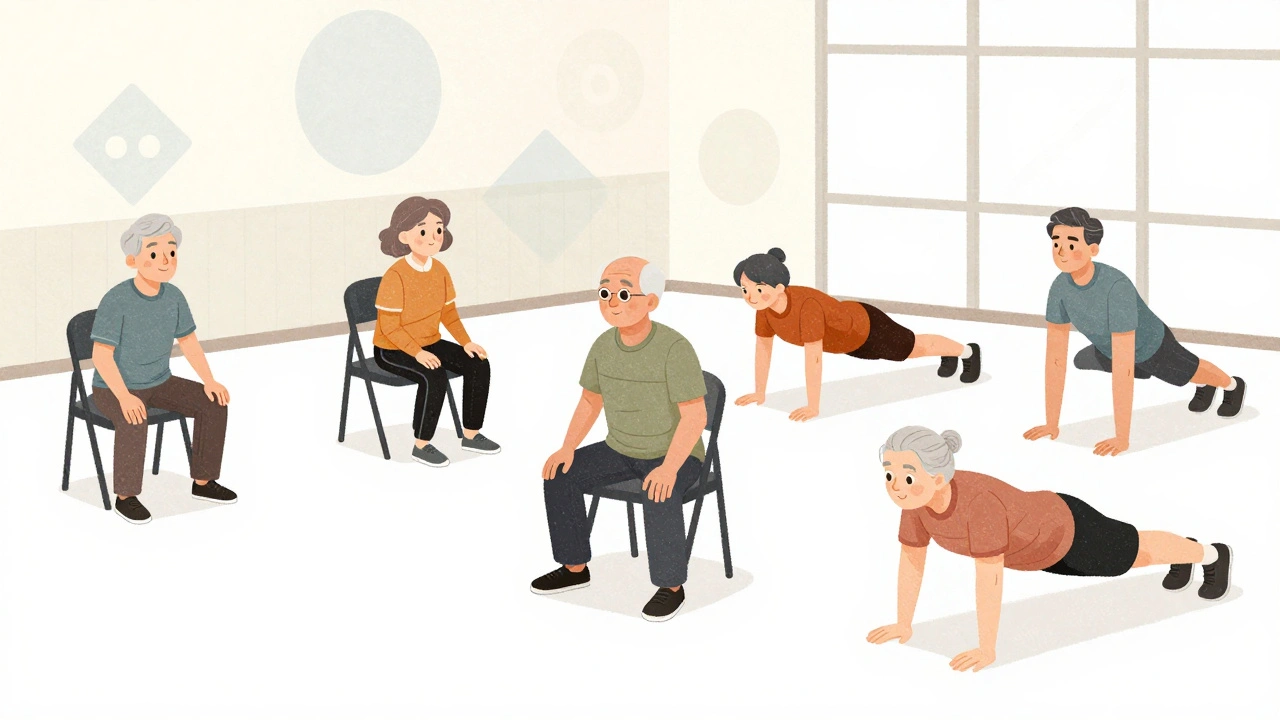
By the time you hit your 40s, your body is already losing muscle-slowly at first, then faster as you get older. This isn’t just about getting weaker. It’s about losing the ability to stand up from a chair, climb stairs, or carry groceries. This condition is called sarcopenia, and it affects 1 in 10 adults over 60, rising to half of those over 80. The good news? You can fight it. And the most powerful tool isn’t a pill or supplement-it’s strength training.
What Sarcopenia Really Means
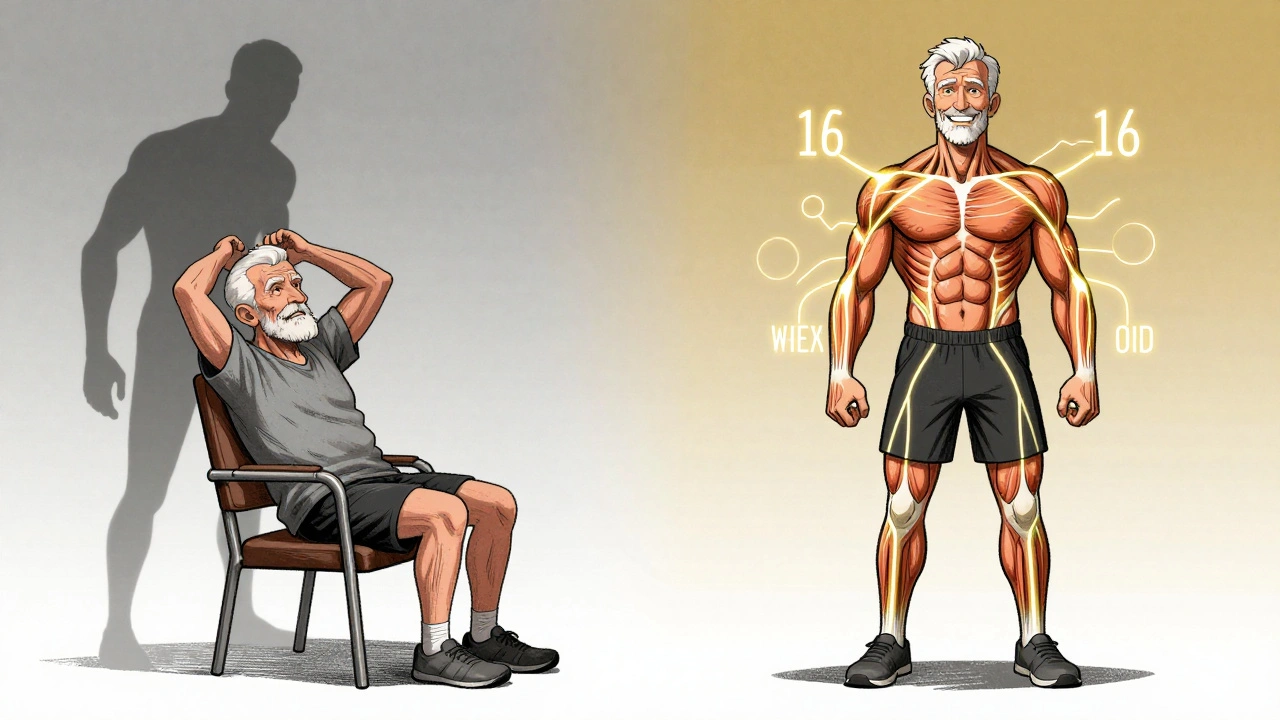
Sarcopenia isn’t just ‘getting skinny’ as you age. It’s a medical condition defined by the loss of muscle mass, strength, and function. Unlike regular muscle loss from inactivity, sarcopenia starts quietly in your 30s and 40s, with muscle mass dropping 1-2% every year. By 65, that loss accelerates. You lose not just muscle, but the nerve connections that tell your muscles to move. Fast-twitch fibers-responsible for quick, powerful movements-shrink by 30-40% by age 80. Your body also becomes worse at repairing muscle tissue. Satellite cells, which help rebuild muscle, drop by 50-60% after 70.
Doctors diagnose sarcopenia using three simple measures: handgrip strength (below 27kg for men, 16kg for women), walking speed (slower than 0.8 meters per second), and muscle mass measured by a DXA scan (below 7.0kg/m² for men, 5.5kg/m² for women). If two of these are low, it’s sarcopenia. It’s not just about looking frail-it’s about risk. People with sarcopenia are far more likely to fall, break a hip, or lose independence.
How It’s Different from Other Muscle Loss
Not all muscle loss is the same. If you break a leg and spend weeks in a cast, you lose muscle fast-up to 1.5% per day. That’s disuse atrophy, and it’s reversible. Cachexia is different too-it’s muscle wasting caused by serious illness like cancer or heart failure, often with weight loss and extreme fatigue. Sarcopenia is slower, quieter, and tied only to aging.
Then there’s dynapenia-loss of strength without much muscle loss. Some older adults keep their muscle size but can’t generate force. That’s still dangerous. Sarcopenia requires both low muscle mass AND low function. And then there’s sarcopenic obesity: people who look overweight but have very little muscle. This group is at highest risk for mobility issues and metabolic disease.
Why Strength Training Works
Here’s the hard truth: no supplement, hormone therapy, or diet shake has come close to matching the results of strength training. Studies show that just 12-16 weeks of regular resistance training can add 1-2kg of muscle and boost strength by 25-30% in people over 65. That’s not a small gain-it’s the difference between needing help to get out of a chair and doing it on your own.
How does it work? Lifting weights sends a signal to your muscles: “We need to grow.” Even in older bodies, this signal still works. Strength training improves nerve-muscle communication, boosts protein synthesis, and reduces inflammation. It also helps your mitochondria-the energy factories in your cells-work better. One 2023 study showed that older adults who lifted weights twice a week improved their walking speed by 0.1-0.2 meters per second and cut their risk of falling by 30-40%.
What Strength Training Should Look Like
You don’t need to lift heavy or join a gym. Start simple. The American College of Sports Medicine recommends two to three sessions per week, with 8-12 reps per set at 60-80% of your maximum lift. But for beginners, that’s overwhelming. Here’s a realistic plan:
- Weeks 1-4: Do bodyweight exercises like chair squats, wall push-ups, and seated leg lifts. Two days a week. No equipment needed.
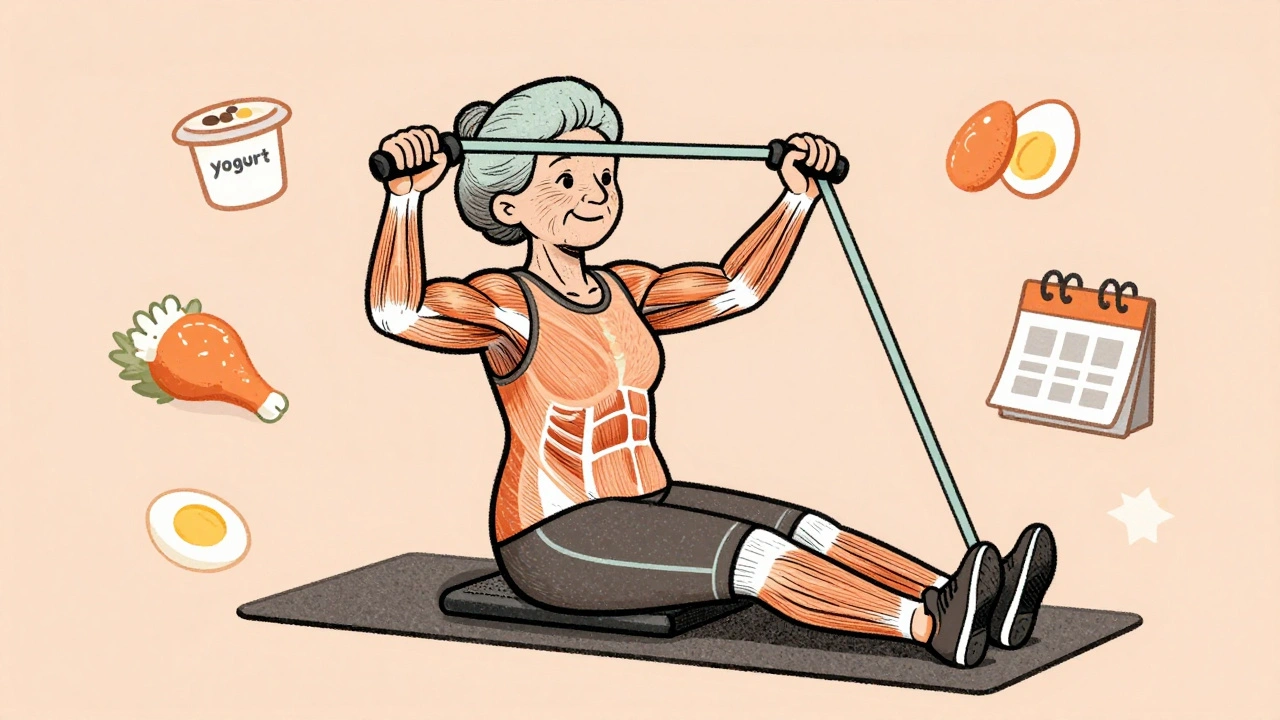
- Weeks 5-8: Add resistance bands (TheraBand light to medium). Use them for rows, bicep curls, and leg presses. Aim for 10-15 reps per set.
- Weeks 9-16: Move to weight machines at the gym or community center. Start light-60-70% of your max. Focus on form, not weight.
Rest at least 48 hours between sessions. That’s when your muscles repair and grow. And don’t skip protein. Eat 20-30 grams within 45 minutes after your workout. A chicken breast, a protein shake, or a cup of Greek yogurt will do.
Common Barriers-and How to Beat Them
Many older adults want to start strength training but get stuck. Joint pain? Try machines instead of free weights-they limit range of motion and reduce strain. Balance issues? Do seated exercises first. Feeling too tired? Start with 10 minutes. Progress slowly.
One of the biggest reasons people quit? They feel awkward or don’t know what to do. That’s why group classes work. People who train with others stick with it 35-40% longer. Look for SilverSneakers, Silver & Fit, or local senior center programs. Medicare Advantage plans often cover these for free.
Cost is another barrier. Personal training can cost $50-$75 a month. But you don’t need it. YouTube has great free videos for seniors. Apps like Exer AI give real-time feedback on form-something trials show improves adherence by 25%.
Real People, Real Results
One 68-year-old man in Brisbane started with chair squats after his doctor warned him he was at risk for sarcopenia. Six months later, his handgrip strength went from 18kg to 24kg. He could open jars again. A 72-year-old woman joined a SilverSneakers class and saw her fall risk score drop from 42 to 28 in 10 weeks. She now walks her dog without a cane.
These aren’t outliers. A 2022 survey of over 3,200 older adults found that 75% who trained twice a week kept their independence. Only 58% of those who didn’t train could say the same.
The Bigger Picture
Sarcopenia isn’t just a personal problem-it’s a public health crisis. In the U.S. alone, it costs $18.5 billion a year in healthcare. By 2030, 72 million Americans will be over 65. But there are only 12,500 certified geriatric physical therapists in the country. That’s not enough.
That’s why home-based programs and telehealth are growing fast. A 2022 study in JAMA Internal Medicine found that virtual strength training was 85% as effective as in-person. That’s a game-changer for rural areas and people with mobility issues.
Research is moving forward too. Scientists are testing blood tests to spot sarcopenia early, using markers like myostatin and GDF-15. AI-driven programs are learning to personalize workouts based on your strength, pain, and progress. These tools won’t replace human guidance-but they’ll make it more accessible.
What You Can Do Today
You don’t have to wait for a diagnosis. If you’re over 50 and feel weaker than you used to, start now. Don’t wait until you can’t get up from the couch. Begin with bodyweight moves. Do two sessions a week. Focus on consistency, not intensity. Talk to your doctor about a referral to a physiotherapist or a senior fitness program.
Strength training isn’t about looking like a bodybuilder. It’s about keeping your body working so you can keep living your life-on your terms. The science is clear. The tools are available. The only thing left is to move.
Is sarcopenia the same as muscle atrophy?
No. Muscle atrophy can happen at any age due to injury, illness, or lack of use-like after being bedridden. Sarcopenia is specifically age-related muscle loss that begins in your 30s or 40s and progresses slowly over decades. It’s not caused by disuse; it’s caused by aging itself.
Can you reverse sarcopenia?
Yes, to a significant degree. While you can’t fully restore muscle to your 20s levels, strength training can add 1-2kg of muscle and improve strength by 25-30% in just a few months-even in your 70s and 80s. The key is consistency. The earlier you start, the more you preserve.
Do I need weights to fight sarcopenia?
No. Resistance bands, bodyweight exercises, and even water-based workouts can be very effective. Machines at community centers are great for beginners because they guide your movement and reduce injury risk. You don’t need dumbbells or barbells to get results.
How often should I train?
Twice a week is the minimum for noticeable gains. Three times is better if you can handle it. Make sure you rest at least 48 hours between sessions so your muscles recover. More than three times a week doesn’t give extra benefits and can increase injury risk.
Is protein important for sarcopenia?
Yes. Your body needs protein to rebuild muscle after exercise. Aim for 20-30 grams within 45 minutes after your workout. Good sources include eggs, chicken, Greek yogurt, tofu, or a protein shake. Spreading protein intake evenly across meals (25-30g per meal) also helps maintain muscle all day.
Can I do strength training with arthritis or joint pain?
Absolutely. In fact, strength training helps reduce joint pain by stabilizing the muscles around them. Use machines instead of free weights-they control movement and reduce stress. Start with low resistance and higher reps. Avoid exercises that cause sharp pain, but mild discomfort is normal. Talk to a physiotherapist for a personalized plan.
Are there any free programs for seniors?
Yes. Many Medicare Advantage plans cover SilverSneakers, which offers free strength classes at gyms and community centers. Local councils, YMCAs, and senior centers often have low-cost or free programs. YouTube has dozens of free 10-20 minute strength routines designed for older adults.
What’s Next?
If you’ve been putting off strength training because you think it’s too late, think again. Your muscles don’t care how old you are-they respond to effort. Start with one chair squat a day. Add a resistance band next week. Join a class. Find a buddy. The goal isn’t perfection. It’s progress. Every rep you do now is buying you more years of independence.

Arun kumar
December 2, 2025 AT 06:36man i started doing wall pushups last month after my doc said i was losin muscle like a balloon with a hole. now i can lift my grandkid without whinin. no gym needed. just consistency.
Alicia Marks
December 3, 2025 AT 06:41This is exactly what my mom did-started with chair squats at 70. Now she hikes every weekend. You’re never too old to start. Just one rep at a time.
Shannara Jenkins
December 4, 2025 AT 14:32I used to think strength training was for people half my age. Then I tried a SilverSneakers class and realized: my body still listens. It doesn’t care if I’m 72. It just wants me to show up. Now I look forward to it. No more cane. No more fear.
Jay Everett
December 5, 2025 AT 08:29Bro, this post is pure gold 🙌 I’ve been coaching seniors on YouTube routines for 3 years. The magic isn’t in the weight-it’s in the *consistency*. One guy, 81, started with resistance bands and now he’s doing farmer’s carries with 25lb dumbbells. He says he feels like he got his youth back. Not the body, but the *freedom*. That’s the win.
ATUL BHARDWAJ
December 7, 2025 AT 00:30India too. Many elders think lifting is for gym bros. But band exercises at home? Yes. My uncle did it. Now he walks to temple without help. Simple. No hype.
Lynn Steiner
December 8, 2025 AT 15:21I used to think sarcopenia was just ‘getting old.’ Now I know it’s the system giving up on us. And guess what? They don’t want us strong. Strong people don’t need meds. Strong people don’t need care homes. 😔
Elizabeth Grace
December 10, 2025 AT 01:06My sister tried this after her hip surgery. Started with seated leg lifts. Now she’s dancing at weddings. I cried. Not because she’s strong-but because she’s happy again. This isn’t fitness. It’s freedom.
Zed theMartian
December 10, 2025 AT 07:00Let’s be real-this is just corporate wellness propaganda dressed up as science. Strength training doesn’t reverse aging. It just delays the inevitable. And let’s not pretend everyone can afford gym memberships or SilverSneakers. Most seniors are on fixed incomes. This post is tone-deaf.
dave nevogt
December 11, 2025 AT 17:22There’s something profoundly human about this. We’re not just fighting muscle loss-we’re fighting the cultural erasure of older bodies. We’ve been told to fade quietly, to accept decline as destiny. But strength training? It’s rebellion. It’s saying, ‘I am still here, still capable, still worthy of effort.’ The science backs it, yes-but the soul? The soul knows this is truth. Every rep is a quiet act of defiance against a world that wants us to disappear.
Steve Enck
December 12, 2025 AT 21:28While the empirical data presented is statistically significant (p < 0.01 in multiple RCTs), the underlying ontological assumption-that physical autonomy equates to human dignity-is both reductionist and ethically perilous. One must interrogate the neoliberal framing of aging as a problem to be optimized, rather than a natural phase of human existence requiring existential acceptance, not biomechanical intervention.
Paul Keller
December 14, 2025 AT 13:51I appreciate the thorough breakdown, but I think the biggest barrier isn’t access or knowledge-it’s fear. Fear of falling. Fear of looking foolish. Fear that your body won’t respond. And that’s not something a YouTube video fixes. That’s something community fixes. I’ve seen people sit in the back of a class for weeks, too scared to try. Then one day, they lift their first band. And suddenly, they’re smiling. That’s the real win. Not the muscle gain. The return of hope.
Steve World Shopping
December 16, 2025 AT 02:11Let me clarify: sarcopenia is a multifactorial proteostatic dysregulation driven by mTOR suppression, mitochondrial senescence, and neuromuscular junction degeneration. Resistance training upregulates IGF-1 and downregulates myostatin, restoring anabolic signaling. But most seniors are clueless about the molecular biology. They need pharmacological adjuvants-creatine, HMB, leucine. Training alone is insufficient for clinical efficacy.
मनोज कुमार
December 16, 2025 AT 09:37Why waste time with bands when you can just take protein powder? This whole thing is overcomplicated. Just eat more chicken. Done.
Joel Deang
December 17, 2025 AT 23:17i did chair squats for 3 weeks and my knees hurt 😅 so i stopped. maybe its not for me? or maybe i just suck at it?
Ella van Rij
December 18, 2025 AT 20:24Oh wow, another ‘strength training fixes everything’ article. Because clearly, the real issue is that older people just aren’t trying hard enough. Meanwhile, Medicare cuts physical therapy coverage every year. But sure, just do more wall push-ups. 💅