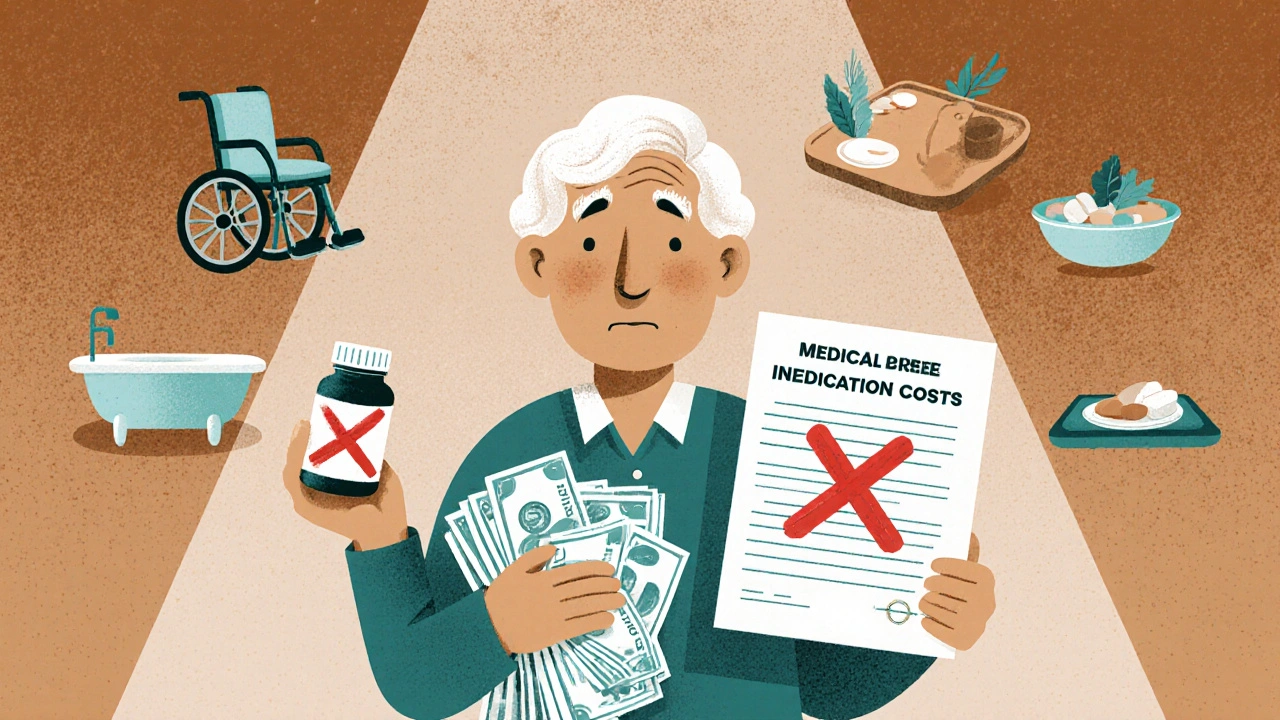
Many people assume that if they have long-term care insurance, it will cover everything that comes with living in a nursing home-room, meals, help with bathing, and even their daily medications. But that’s not true. Long-term care insurance does not pay for prescription drugs, not even generic ones. This misunderstanding leaves families shocked when they get a bill for pills they thought were covered.
The truth is simple: long-term care insurance pays for the cost of care-help with dressing, eating, moving around-when you can’t do it yourself anymore. It doesn’t pay for medical treatment. That’s where Medicare, Medicaid, or private health insurance come in. And for most nursing home residents, that means Medicare Part D is the main source of drug coverage.
Here’s how it actually works. If you’re in a nursing home and need medications, your drugs are not billed to your long-term care policy. Instead, they’re billed to your prescription drug plan. For about 82% of residents, that’s Medicare Part D. The rest are covered by Medicaid, Veterans Affairs, or private insurance. A startling 9% of long-stay residents pay for their own medications out of pocket because they don’t have any coverage at all.
Generic drugs make up about 90% of all prescriptions given in nursing homes. They’re cheaper, just as safe, and just as effective as brand-name versions. Medicare Part D plans cover generics, and they usually charge much lower copays for them. But here’s the catch: not all generic drugs are covered by every plan. Each Part D plan has its own list of approved drugs, called a formulary. If your medication isn’t on that list, you might be denied coverage-unless you go through an exception process.
That exception process can take time. For nursing home residents, delays in getting meds can be dangerous. A resident needing an antibiotic for pneumonia can’t wait weeks. That’s why CMS requires Part D plans to approve non-formulary drug requests for nursing home residents within 72 hours. But not all plans follow this rule consistently. Facilities report that some insurers drag their feet, forcing staff to call, fax, and appeal repeatedly.
Managing this system is a nightmare for nursing homes. A single facility might have residents enrolled in 10 or more different Part D plans. Each one has different rules, different formularies, different pharmacies they work with. Staff spend an average of 10 to 15 hours a week just sorting out drug coverage. That’s over 700 hours a year per facility-time that could be spent on patient care.
Some nursing homes hire dedicated pharmacy liaisons to handle this. Others use electronic systems that automatically check which drugs are covered by each resident’s plan. One study found that facilities using these systems reduced medication delays from 3.2 days to just 0.7 days. That’s the difference between a resident getting their medicine on time and waiting until they get sicker.
What about Medicaid? If you’re low-income and qualify for both Medicare and Medicaid, your drugs are usually covered under Medicare Part D-but Medicaid steps in to cover your copays. If you’re only on Medicaid, then Medicaid pays for your prescriptions directly, often at cost plus a small dispensing fee. But Medicaid rules vary by state, and not all nursing homes accept every Medicaid plan.
There’s also the issue of the Part D coverage gap-the so-called “donut hole.” Before 2025, once your drug spending hit a certain threshold, you had to pay more out of pocket until you reached catastrophic coverage. Starting in 2025, that changes. Medicare will cap out-of-pocket drug spending at $2,000 a year. That’s huge for nursing home residents who take multiple medications daily. But even with this cap, if your plan doesn’t cover a drug you need, you’re still stuck.
And here’s the scary part: if you’re not enrolled in Part D, you’re probably paying full price. A 2020 study found that residents without drug coverage got significantly fewer prescriptions than those who were enrolled. They skipped doses. They delayed refills. They ended up back in the hospital. That’s not just expensive-it’s dangerous.
Some families try to rely on long-term care insurance to cover drugs anyway. They call their insurer, explain the situation, and get a flat “no.” The policy documents are clear: prescription drugs are excluded. There’s no loophole. There’s no hidden benefit. This isn’t a trick. It’s how the system was designed.
So what should you do? First, make sure your loved one is enrolled in Medicare Part D. If they’re not, sign them up immediately. If they’re already enrolled, find out which plan they’re on. Ask the nursing home’s pharmacy team for a copy of the formulary. Check if their key medications are covered. If not, ask about the exception process. Don’t wait until they run out of pills.
Also, talk to the nursing home about their pharmacy. Do they work with a long-term care pharmacy that contracts with most Part D plans? If they use a pharmacy that only works with one or two insurers, you’re at risk of delays. A good facility will have relationships with multiple pharmacies and know how to switch if needed.
Finally, don’t assume long-term care insurance will save you from drug costs. It won’t. That’s why many people now buy separate prescription drug coverage or supplemental insurance that includes medication benefits. If you’re thinking about buying long-term care insurance, ask your agent: “Does this policy cover any part of prescription drugs?” If they say yes, get it in writing. If they hesitate, walk away.
The system is complex, but it’s not impossible to navigate. The key is knowing what’s covered and who pays for it. Long-term care insurance pays for care. Medicare Part D pays for drugs. And if you don’t understand that, you’ll be left holding the bill.
Robert Bashaw
November 30, 2025 AT 07:23This system is a goddamn circus. I watched my grandma go without her blood pressure meds for five days because some insurance rep ‘forgot’ to approve the exception. Five days. She ended up in the ER. And the nursing home staff? They were crying in the break room, begging for help. This isn’t healthcare-it’s a bureaucratic horror movie with no director.
Steven Howell
November 30, 2025 AT 09:22While the article accurately outlines the structural gaps in drug coverage, it fails to emphasize the role of pharmacy benefit managers (PBMs) in exacerbating formulary restrictions. PBMs negotiate rebates with manufacturers, often incentivizing the inclusion of higher-cost brand-name drugs over generics-even when clinical equivalence is established. This creates perverse incentives that directly impact formulary access for nursing home residents, particularly those on Medicare Part D.
Brandy Johnson
December 1, 2025 AT 21:05Of course the system is broken-because we let bureaucrats and leftist policymakers turn healthcare into a welfare program. If people would just save for their own medications instead of relying on Medicare, we wouldn’t have this mess. Medicaid expansion? More government overreach. The solution isn’t more bureaucracy-it’s personal responsibility. And if you can’t afford your pills, maybe you shouldn’t be in a nursing home in the first place.
stephen idiado
December 3, 2025 AT 18:54Formulary arbitrage. PBM rent-seeking. Adverse selection in Part D enrollment. The real issue is asymmetric information between provider and beneficiary. You’re not paying for drugs-you’re paying for administrative friction.
Mary Kate Powers
December 5, 2025 AT 09:47Thank you for writing this. I’m a nurse’s aide and I see this every single day. One woman skipped her insulin because her plan didn’t cover it-she didn’t tell anyone. We found out because she passed out. Please, if you’re reading this: check the formulary. Ask for help. Don’t suffer in silence.
tushar makwana
December 5, 2025 AT 10:55my aunt had the same problem. she got her meds late and got sick. the staff tried their best but they were overwhelmed. i wish there was a simpler way. maybe if we all just talked more to each other, we could fix this together. not everyone has to be a hero, but we can all be kind.
Richard Thomas
December 6, 2025 AT 10:36It is imperative to underscore that the structural inefficiencies inherent in the current Medicare Part D framework are not merely administrative inconveniences but systemic failures of risk pooling and benefit design. The fragmentation of formularies across 200+ Part D sponsors, coupled with the absence of centralized adjudication protocols, results in a non-coherent delivery architecture that is fundamentally incompatible with the needs of a chronically ill, institutionalized population. Furthermore, the 72-hour exception requirement, while laudable in intent, remains unenforced due to lack of meaningful oversight mechanisms and punitive sanctions for noncompliance.
Sara Shumaker
December 6, 2025 AT 18:52I keep thinking about how we treat people at the end of their lives. We give them IVs and oxygen monitors, but we let them go without their daily pills because of paperwork? We’ve built a society that can send robots to Mars but can’t make sure someone gets their blood pressure medicine on time. What does that say about us? Maybe the real problem isn’t the formulary-it’s that we stopped seeing these people as human beings who deserve dignity, not just claims.
Sohini Majumder
December 8, 2025 AT 15:56OMG this is sooo true!!! I’m like… why is this even a thing?? Like, my uncle was on 7 meds and they kept getting denied?? I had to call 12 different people and cry on the phone like 3 times!! Like… why is this so HARD?? #MedicareFail #NursingHomeNightmare
Steven Howell
December 9, 2025 AT 10:23Your point about PBMs is valid, but it’s only half the picture. The real bottleneck is the lack of interoperability between nursing home EMRs and Part D plan systems. Most facilities still rely on faxed prior authorization requests-some even use paper forms. A 2023 GAO report found that 68% of nursing homes still use manual processes for drug coverage verification. Until CMS mandates API-based real-time formulary checks across all Part D sponsors, we’re just rearranging deck chairs on the Titanic.