When a drug causes a serious allergic reaction-like hives, swelling, trouble breathing, or anaphylaxis-it’s natural to assume you’ll never be able to take it again. But for many people, that’s not the full story. If that drug is the only one that works for your condition-whether it’s chemotherapy for cancer, an antibiotic for a life-threatening infection, or a biologic for rheumatoid arthritis-there’s a safe, proven way to get back on it: drug desensitization.
What Drug Desensitization Actually Means
Drug desensitization isn’t a cure for your allergy. It doesn’t change your immune system permanently. Instead, it’s a temporary, controlled way to help your body tolerate a drug you’re allergic to, just long enough to get through the treatment you need. Think of it like slowly walking into a cold pool-you don’t jump in all at once. You let your body adjust, step by step, under close watch. This process has been used for decades, especially in hospitals like Brigham and Women’s, where specialists have refined protocols for everything from penicillin to cancer drugs. The goal? To get you to the full therapeutic dose without triggering a dangerous reaction. And it works. Studies show success rates above 90% when done correctly by trained teams.When Is Desensitization Used?
You don’t get desensitized just because you had a rash. It’s reserved for situations where:- There’s no safe alternative drug available
- The drug is essential for survival or quality of life
- Your reaction was confirmed as IgE-mediated (immediate-type allergy) or a well-documented non-IgE reaction like aspirin-exacerbated respiratory disease
- Patients with cancer needing chemotherapy like carboplatin or paclitaxel
- People with autoimmune diseases requiring monoclonal antibodies like rituximab or infliximab
- Those with cystic fibrosis who need specific antibiotics like vancomycin or meropenem
- Patients with severe aspirin or NSAID allergies who need pain relief or heart protection
- Individuals allergic to local anesthetics who need surgery
How the Process Works Step by Step
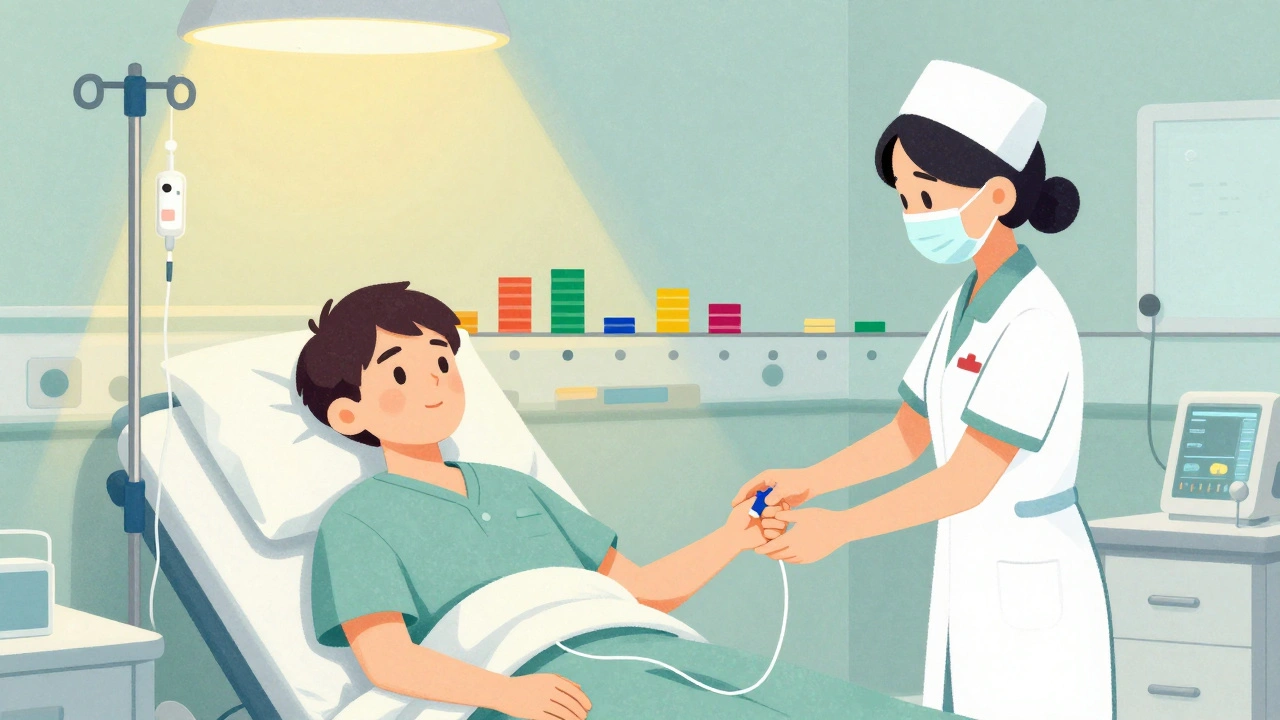
Desensitization isn’t something you do at home. It’s done in a hospital or specialized allergy clinic with emergency equipment and staff ready to respond. Here’s how it typically unfolds:- You start with a tiny fraction of the full dose-often 1/10,000th.
- Each dose is doubled at set intervals: every 15 to 30 minutes for IV drugs, every hour for oral ones like aspirin.
- By the end of the session, you’ve received the full therapeutic dose.
What’s Monitored During the Procedure?
Your safety is the top priority. While you’re being desensitized, medical staff track:- Heart rate and blood pressure every 5 to 10 minutes
- Oxygen levels with pulse oximetry
- Respiratory function-especially if you have asthma
- Skin reactions like hives or flushing
- Any signs of swelling, nausea, or dizziness
What Drugs Can Be Used for Desensitization?
Not all drug allergies can be desensitized. The procedure works best for:- Antibiotics: Penicillin, cephalosporins, vancomycin, sulfonamides
- Chemotherapy agents: Carboplatin, paclitaxel, oxaliplatin
- Monoclonal antibodies: Rituximab, cetuximab, infliximab, omalizumab
- NSAIDs and aspirin: Even if your reaction isn’t IgE-mediated
- Local anesthetics: Like lidocaine or bupivacaine
- Iron infusions: For patients with severe anemia
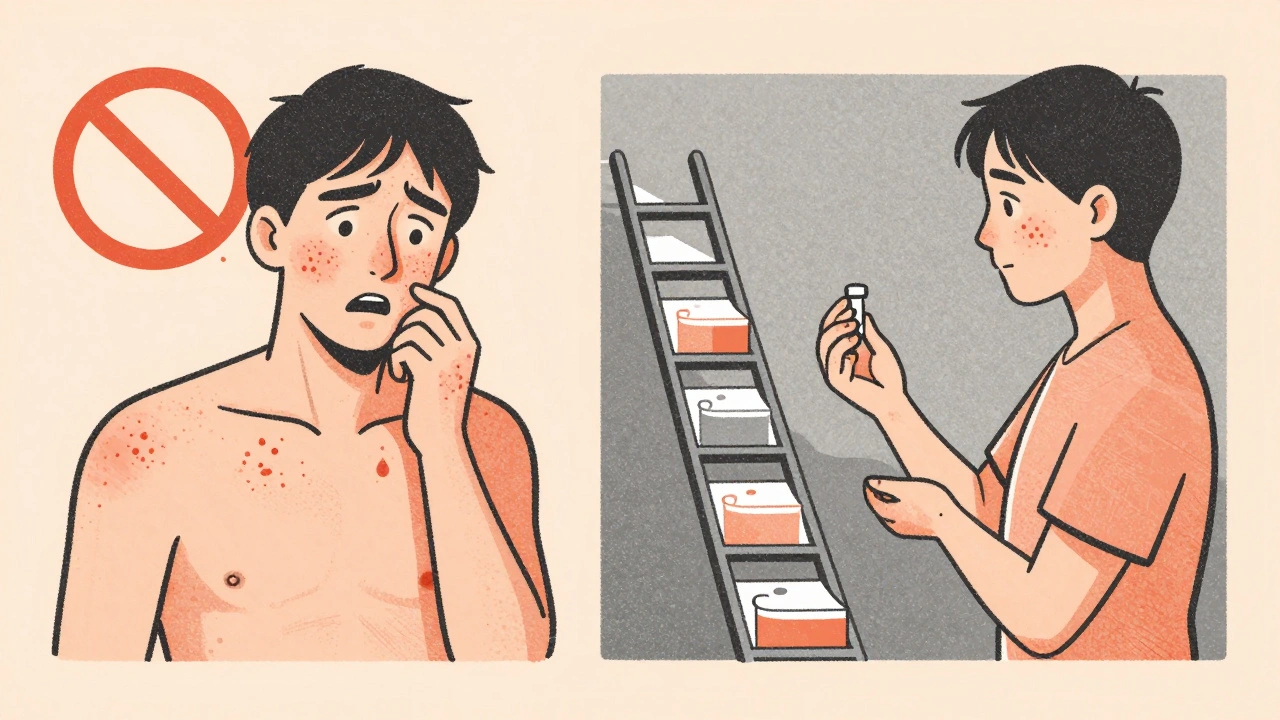
- Stevens-Johnson syndrome
- Toxic epidermal necrolysis
- Erythema multiforme with blistering
- Drug-induced hepatitis or kidney inflammation
- Serum sickness reactions
Why You Can’t Do This at Home
You might think, “I’ve taken this drug before-I know how I react.” But that’s exactly why you can’t try this alone. Allergic reactions can escalate quickly. A small rash can turn into swelling in your throat within minutes. Blood pressure can crash. Oxygen levels can drop. Without epinephrine, IV fluids, and trained staff on standby, it’s too risky. Every desensitization protocol is personalized. A written plan is created for you before the procedure, reviewed by an allergist, and approved by the team. No two patients get the same plan. Your history, your drug, your condition-all factor in.What Happens After You Finish?
Here’s the catch: the tolerance doesn’t last. If you stop taking the drug for more than 48 to 72 hours, your allergy can come back. That means:- If you need another dose next week, you’ll need to repeat the full desensitization
- If you miss a dose, you can’t just resume-you must restart the process
- Long-term daily use (like with aspirin) can sometimes maintain tolerance, but that’s only under strict medical supervision
Who Performs This Procedure?
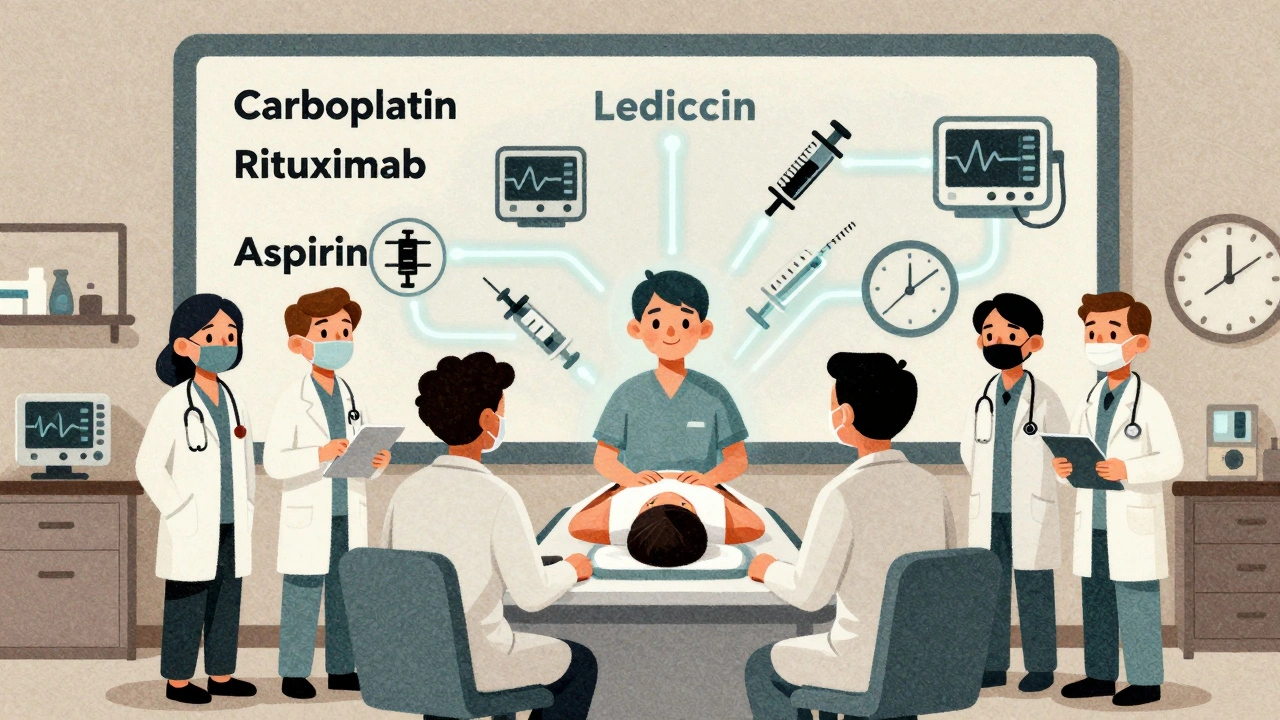
This isn’t something a general practitioner does. It requires specialists:- Allergists or immunologists trained in desensitization
- Nurses experienced in high-risk drug administration
- Access to emergency medications: epinephrine, antihistamines, corticosteroids, IV fluids
- A setting equipped for resuscitation-like a hospital or dedicated allergy center
What If the Procedure Doesn’t Work?
Sometimes, despite careful planning, a reaction happens that can’t be controlled. In those cases, the team stops the procedure. They treat the reaction, stabilize you, and then decide:- Is there another drug that could work?
- Can we try a different protocol with slower steps?
- Is this drug truly non-negotiable?
Is There Any Alternative?
For most patients with true drug allergies, there isn’t. Substitutes may exist-but they’re often less effective, more toxic, or more expensive. For example:- Replacing carboplatin with cisplatin increases kidney damage risk
- Switching from penicillin to a different antibiotic for a resistant infection may fail
- Using non-steroidal drugs instead of aspirin for heart protection doesn’t offer the same benefit
What’s New in 2025?
The American Academy of Allergy, Asthma & Immunology updated its guidelines in 2022, and those are still the gold standard. But new applications are emerging:- Desensitization for immune checkpoint inhibitors (like pembrolizumab) used in melanoma and lung cancer
- Protocols for tyrosine kinase inhibitors used in leukemia and other cancers
- Expanded use for monoclonal antibodies targeting rare autoimmune diseases
Can I be desensitized if I had anaphylaxis to a drug?
Yes. Anaphylaxis is actually one of the most common reasons people are desensitized. The procedure is designed for severe reactions. Teams use slower, more cautious protocols for these cases, starting with extremely small doses. Success rates remain high when done by experienced teams.
How long does drug desensitization take?
It varies. IV drug desensitization usually takes 5 to 6 hours. Oral desensitization for aspirin or NSAIDs can take several days, with doses given every hour or longer. The timeline depends on the drug, your reaction history, and the protocol used.
Will I be allergic to the drug forever after desensitization?
No. Desensitization creates temporary tolerance. If you stop taking the drug for more than 48 to 72 hours, your allergy can return. You’ll need to repeat the full process if you need the drug again. It doesn’t cure the allergy-it just lets you take the drug safely when you need it.
Can children be desensitized?
Yes. Children with severe drug allergies who need essential medications like antibiotics or chemotherapy can be desensitized. Protocols are adjusted for weight and age, and the procedure is done under the same strict supervision as in adults.
Is desensitization safe for pregnant women?
Yes, if the drug is necessary for maternal or fetal health. For example, pregnant women with penicillin allergies who need antibiotics for Group B Strep can be safely desensitized. The procedure is done with extra monitoring, but the benefits usually outweigh the risks when the drug is critical.
What if I have asthma or other chronic conditions?
Having asthma doesn’t rule out desensitization-it just means the team will monitor your breathing more closely. Spirometry tests are done before and after each dose. If your lung function drops, they’ll slow down or pause the process. Many patients with asthma successfully complete desensitization.
Can I eat or drink before the procedure?
Usually yes. For IV desensitization, you can typically eat a light meal beforehand. For oral desensitization, you’ll be given specific instructions about food timing. The team will tell you what to do based on your drug and protocol.
Do I need to stay overnight after desensitization?
Not usually. Most patients go home the same day after being observed for a few hours. But if you had a reaction during the process or have other health risks, you might be asked to stay overnight for monitoring.
Is there a risk of long-term side effects from desensitization?
No. The procedure itself doesn’t cause long-term side effects. The only risks are those tied to the drug you’re receiving or the immediate allergic reaction. Once you’re done and stable, your body returns to its normal state. The process doesn’t damage your immune system.
Can I get desensitized to multiple drugs at once?
No. Desensitization is done one drug at a time. Trying to do more than one simultaneously increases risk and makes it impossible to tell which drug caused a reaction. If you need multiple drugs, each one gets its own separate procedure, spaced days or weeks apart.
If you’ve been told you can’t take a life-saving drug because of an allergy, don’t accept that as final. Ask your doctor about desensitization. It’s not magic-but it’s science, and it’s worked for thousands of people. With the right team, the right plan, and the right timing, you can get back on the treatment you need.


alaa ismail
December 1, 2025 AT 18:11Wow, this is actually the most clear explanation I’ve ever read on desensitization. I had no idea it was this structured. I thought if you had anaphylaxis, you were just out of luck forever. Guess I was wrong.
Thanks for laying it out like this. Even my grandma could understand it now.
ruiqing Jane
December 1, 2025 AT 21:45This is critical information that should be mandatory reading for every patient told they can't take a life-saving medication. Too many people accept 'no alternatives' as a death sentence when science has already built a bridge. The 90%+ success rate isn't just a statistic-it's a second chance.
Also, the fact that tolerance resets after 72 hours is something every patient needs to write down and keep on their fridge. Missing a dose isn't just inconvenient-it's a medical reset. This deserves a pamphlet in every oncology clinic.
Fern Marder
December 2, 2025 AT 22:07OMG this is 🔥🔥🔥
So you can literally trick your body into not killing you? Like, I thought allergies were forever. This is next-level medicine. 🤯
Also, I just realized my cousin did this for chemo last year and nobody told me it was a thing. Why isn’t this on TikTok??
Saket Modi
December 3, 2025 AT 05:20So you’re telling me I gotta sit in a hospital for 6 hours just to take a pill? Sounds like a scam to make hospitals richer.
Why not just give me the full dose and deal with it? I’ve got better things to do.
william tao
December 4, 2025 AT 15:31While the clinical efficacy of this procedure is statistically significant, one must interrogate the institutional hegemony that renders such interventions necessary in the first place. The medical-industrial complex has engineered a paradigm wherein pharmaceutical innovation outpaces immunological adaptability, necessitating this costly, time-intensive protocol. One cannot help but wonder: is desensitization a therapeutic breakthrough-or a Band-Aid on a systemic failure?
Furthermore, the exclusion criteria for Stevens-Johnson syndrome are prudent, yet the absence of long-term immunological monitoring raises epistemological concerns regarding the durability of tolerance.
Sandi Allen
December 5, 2025 AT 03:52Wait… wait… WAIT. So you’re telling me that if I take this drug, my body will ‘tolerate’ it… but only if I’m hooked up to machines in a hospital??
And if I miss a dose by 73 hours, I’m back to square one??
Who’s REALLY behind this? Big Pharma? The AMA? The FDA? They’re keeping us dependent on this! They don’t want us to find a cure-they want us to keep coming back for more $10,000 hospital visits!
And why aren’t they testing this on animals first?? I mean, seriously-what if it backfires and turns people into zombies??
Someone needs to investigate this. I’m calling my senator.
John Webber
December 6, 2025 AT 05:26i had this happen to me with penicillin. they did the slow thing and it worked. but i forgot to take my next dose and had to do it all over again. total pain in the butt. why can’t they just fix the allergy??
also, i think the docs are just scared to give you the real dose. they like to make you sit there for hours so they can bill more.
but hey, at least i’m alive. so i guess it’s cool.
Shubham Pandey
December 7, 2025 AT 00:12Works for cancer drugs. Makes sense. But why not just use something else?
Too much hassle.
Elizabeth Farrell
December 7, 2025 AT 03:40I just want to say how deeply moved I am by the care and precision that goes into these protocols. It’s not just about the medicine-it’s about the humanity behind every single step. The way the team pauses, adjusts, listens, and adapts… that’s what healing really looks like.
I’ve seen patients who were told they’d never get another round of chemo… and then, after this process, they’re back at their kid’s soccer game, alive and present. That’s not just medical science-that’s hope, made visible.
To the nurses who sit there for hours, watching vitals, holding hands, staying calm when everything’s on the line-you are the quiet heroes of modern medicine. Thank you.
And to anyone reading this who’s been told ‘no’-please, don’t give up. Ask again. Ask for a specialist. Ask for the protocol. You deserve a chance to keep living.
Sheryl Lynn
December 8, 2025 AT 21:13How quaint. A 19th-century paradigm of pharmacological appeasement masquerading as innovation. One wonders if this isn’t merely a performative ritual-a theatrical enactment of control, designed to assuage the existential dread of both patient and practitioner.
The very notion of ‘temporary tolerance’ is a poetic tragedy: we are not curing disease, merely negotiating with it like a capricious deity. And yet… I must confess, there’s a certain sublime elegance in the choreography of incremental dosing. It’s alchemy disguised as protocol.
Still, one cannot help but wonder: is this not a glorified version of Pavlovian conditioning with IV drips? The body, reduced to a conditioned reflex. How… anthropological.
Paul Santos
December 10, 2025 AT 17:56Interesting. So we’re essentially reverse-engineering anaphylaxis through controlled exposure? Reminds me of exposure therapy for PTSD-same principle, different neurotransmitter.
Though I must say, the 48–72hr tolerance window feels like a loophole in evolutionary biology. Why would the immune system reset so quickly? Is it a failsafe? Or just bad design?
Also, anyone else think this is the future of personalized medicine? We’re moving from ‘one-size-fits-all’ to ‘one-dose-fits-one’. 🤔
Still… 90% success rate? That’s not medicine. That’s magic with a consent form.