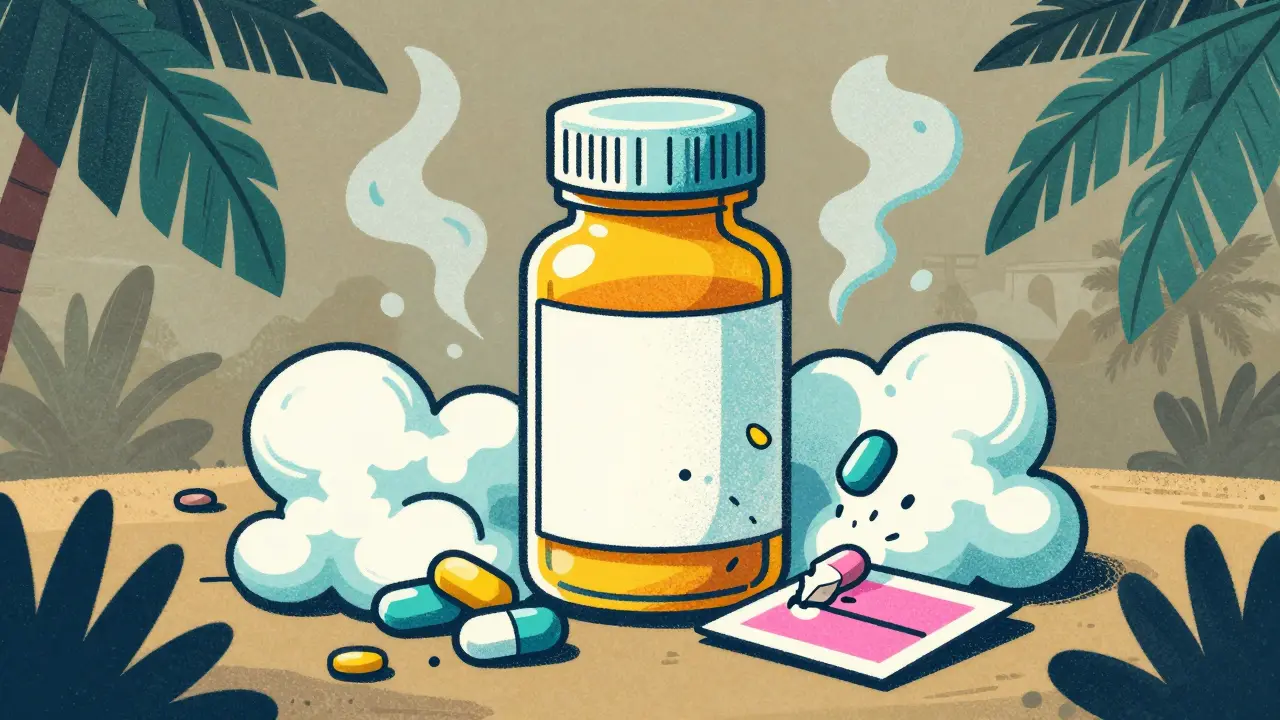
Why Medications Fail in Tropical Climates
Imagine packing your asthma inhaler or antibiotics for a trip to Bali, Thailand, or the Philippines-only to find it doesn’t work when you need it most. In tropical humidity, pills, capsules, and inhalers don’t just sit there quietly. They break down. Moisture in the air sneaks in, softens shells, clumps powders, and eats away at active ingredients. The result? A pill that looks fine but delivers half the dose-or none at all. This isn’t rare. According to the World Health Organization, about 30% of medications in tropical regions lose effectiveness before reaching patients. And it’s not just developing countries. Travelers, expats, and even locals in places like Brisbane, Singapore, or Puerto Rico face the same risk.
The science behind this is simple: water breaks chemical bonds. This process, called hydrolysis, is responsible for 70% of moisture-related drug degradation, according to NIH studies. Drugs like amoxicillin, tetracycline, and lamotrigine absorb water like sponges. At 75% relative humidity and 28°C, amoxicillin can lose 50% of its potency in just 30 days. Antibiotics degrade up to 3.5 times faster under these conditions. Even your daily blood pressure pill might not work if it’s been sitting in a steamy bathroom for weeks.
Which Medications Are Most at Risk?
Not all drugs are equally vulnerable. Some are practically built to fail in humid air. Here’s what you need to watch out for:
- Antibiotics (amoxicillin, tetracycline, doxycycline): Moisture causes clumping and chemical breakdown. Visible color changes-yellowing or darkening-are a red flag.
- Antifungals and antivirals: These often contain hygroscopic ingredients that pull water from the air, reducing effectiveness.
- Orally disintegrating tablets (ODTs): These dissolve on your tongue. Humidity makes them stick together or take forever to break down-up to 500% longer at 80% RH.
- Dry powder inhalers (DPIs): Moisture causes powder particles to clump. This cuts the amount of medicine reaching your lungs by 15-25%.
- Freeze-dried vaccines and biologics: These need humidity below 20% RH. Even brief exposure can ruin them.
- Pediatric formulations: Syrups, chewables, and suspensions often contain sugars and binders that attract moisture and grow mold.
If you’re taking any of these, don’t assume your pill bottle is enough. The packaging you see on the shelf is designed for a cool, dry warehouse-not your humid hotel room.
What Perfect Storage Looks Like
There’s a science to keeping meds safe. The ideal environment for most medications in tropical climates is:
- Humidity: 30-45% RH (relative humidity)
- Temperature: 15-25°C (59-77°F)
- Darkness: Light speeds up degradation in 65% of drugs
- Sealed: No air exchange
That’s not the same as “room temperature.” The WHO says “controlled room temperature” means below 30°C and 65% RH-but that’s the maximum, not the goal. For real safety, aim lower. Every 10°C above 25°C doubles the rate of chemical breakdown. That’s why your medicine cabinet above the toilet is the worst place in the house. Humidity there regularly hits 80-90% after showers.
Refrigeration (2-8°C) helps for some drugs, but only if the container is sealed. Condensation forms when cold medicine meets warm air-and that water can ruin your pills faster than humidity alone.
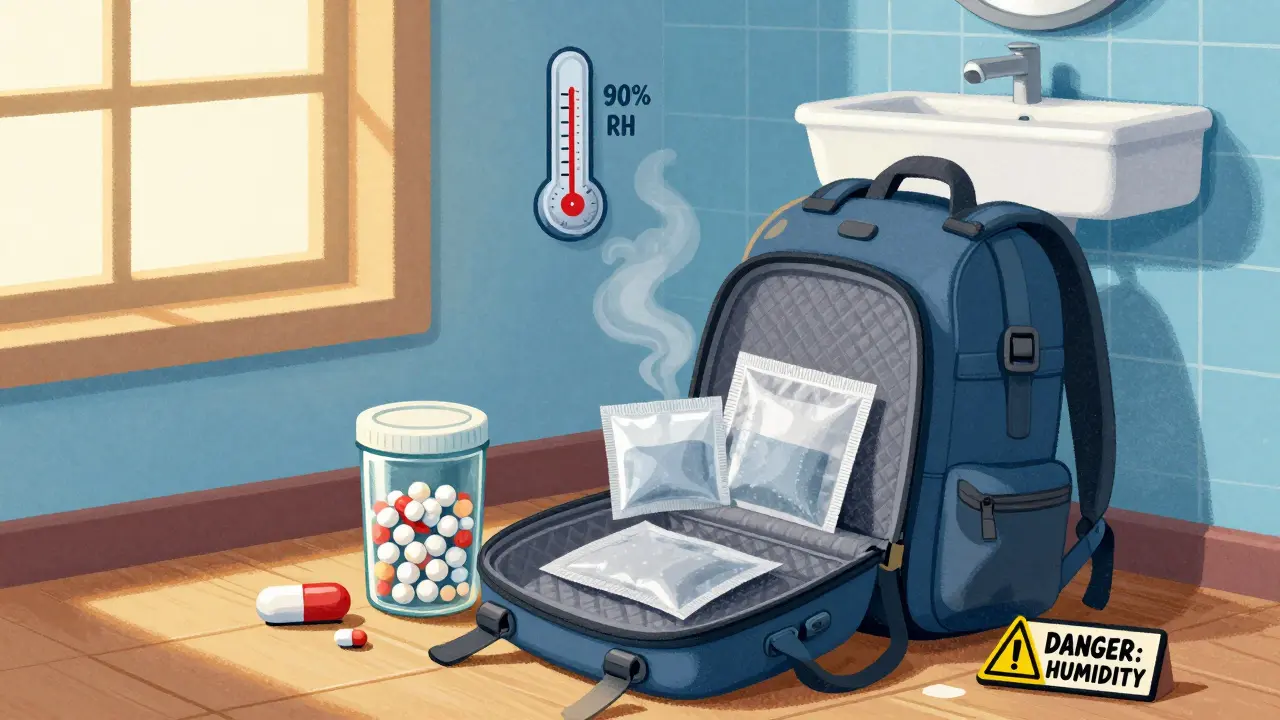
How to Protect Your Medications on the Go
You can’t control the weather, but you can control what’s inside your bag. Here’s how:
- Use airtight containers: Swap your original pill bottle for a small, hard-shell container with a tight seal. Glass or hard plastic with a rubber gasket works best.
- Add desiccants: Silica gel packs are cheap and effective. Put one or two in every container. You can buy them online or save them from new shoeboxes or vitamin bottles. Use 1-2 grams per 100mL of container space.
- Replace desiccants monthly: Once they turn from dry (blue or white) to damp (pink or cloudy), they’re full. In tropical humidity, they saturate fast. Carry extras.
- Never store meds in bathrooms or kitchens: These are the most humid rooms in any home or hotel. Even a fan won’t help.
- Keep meds in your carry-on: Checked luggage can sit in hot, humid cargo holds for hours. Your meds belong with you.
- Use humidity indicator cards: These small cards change color when humidity rises above 55%. Blue means dry. Pink means danger. Keep one in your container.
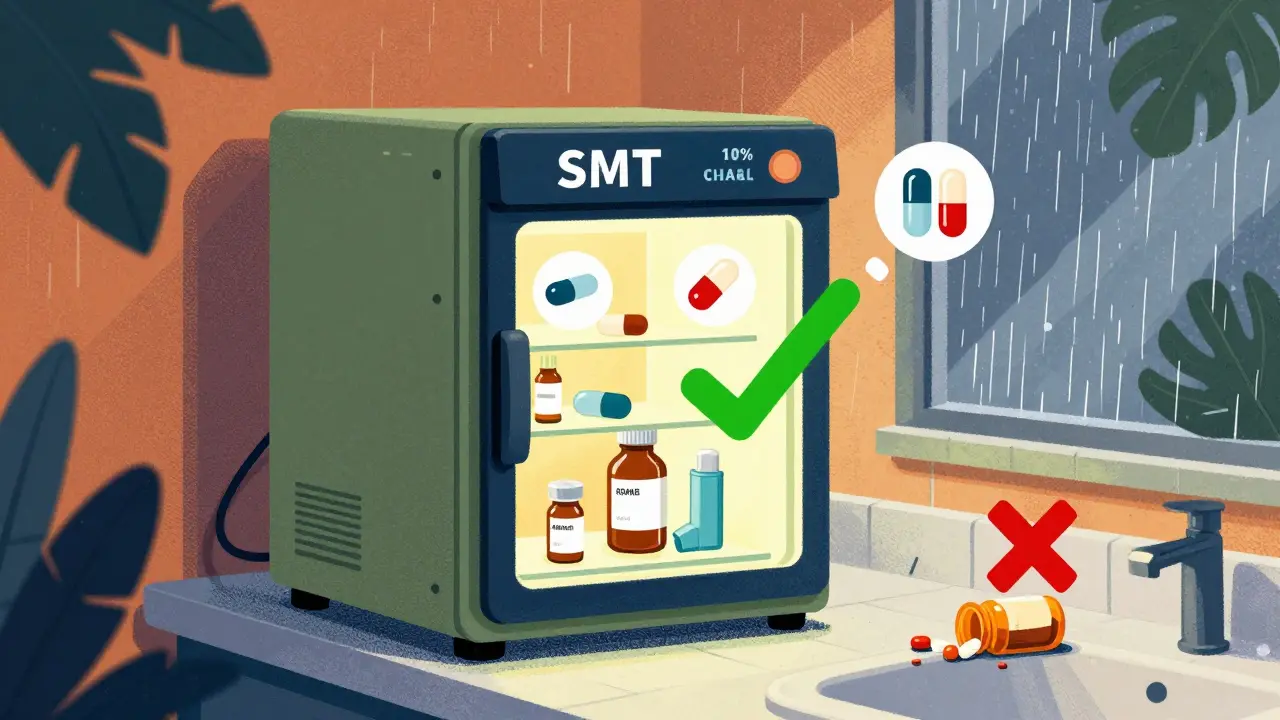
For long-term storage or if you’re living in a tropical country, consider a dry cabinet like the SMT DryBox. These maintain humidity at 5-15% RH and cost $500-$2,000. For most travelers, a sealed container with silica gel is enough.
What Pharmacies and Health Systems Are Doing
It’s not just you. Global health groups are fighting this too. Since 2018, the WHO has distributed over 500 million blister packs with built-in desiccants across Africa and Southeast Asia. These packs use a special polymer that absorbs moisture 200-300% better than old-school silica gel. The result? A 58% drop in medication spoilage.
In Uganda, clinics use “desiccant closets”-metal cabinets with 5kg silica gel canisters inside. They cost $120 each and keep humidity at 35-45% RH for months. In the Philippines, community health workers follow the “30-30 Rule”: replace desiccants every 30 days if the temperature is above 30°C. That simple step cut spoilage by 47% in a 2022 trial.
Pharmaceutical companies now design products for tropical markets. Blister packs with aluminum backing block 99.9% of moisture. Some bottle caps now have moisture-scavenging polymers built in-like Aptar’s Activ-Polymer™. They keep humidity below 30% RH for 18 months. These aren’t luxury features anymore. They’re becoming standard for drugs sold in hot, humid countries.
What to Do If Your Medication Looks Weird
Don’t guess. If you see any of these signs, stop using the medication:
- Pills are stuck together or crumbly
- Tablets have changed color (yellow, brown, green)
- Capsules are soft, sticky, or leaking
- Powder clumps like wet sand
- Odor has changed-musty, sour, or chemical
- Humidity card is pink
Even if it looks fine but you’re unsure, don’t risk it. A degraded antibiotic won’t kill you right away-but it could let an infection grow resistant to treatment. That’s worse than not taking it at all. If you’re traveling, ask a local pharmacist to check it. In many tropical countries, pharmacies have humidity monitors and can tell you if your meds are still good.
Future Solutions Coming Soon
Scientists are working on even better tools. MIT researchers have developed a graphene oxide coating that reduces moisture penetration by 99.7% compared to aluminum foil. It’s still in testing, but it could one day make pill bottles waterproof. The ICH (International Council for Harmonisation) is also preparing new guidelines-Q1H-expected in 2025. These will require all new drugs targeting tropical markets to prove they survive 6 months at 30°C and 75% RH before approval.
For now, the best defense is simple: control the environment. You don’t need fancy tech. You just need to understand how moisture kills medicine-and take two minutes a month to check your desiccants.
Frequently Asked Questions
Can I just keep my pills in the fridge to avoid humidity?
Not always. While refrigeration keeps temperature low, it doesn’t control humidity-and it can make things worse. When you take a cold pill bottle into warm air, moisture condenses on the surface and inside. That water can dissolve coatings, cause clumping, or promote mold. Only refrigerate if the label says to-and make sure the container is completely sealed. For most medications, a cool, dry room with desiccants is safer than the fridge.
Are silica gel packs safe if I accidentally swallow one?
Silica gel is non-toxic. If you swallow a pack, you won’t be poisoned. But it’s not food. It can cause choking or stomach irritation. Don’t eat it. Keep packs out of reach of children and pets. If swallowed, drink water and call poison control. Most silica gel packs say “Do Not Eat” for legal reasons, not because they’re dangerous.
How do I know if my humidity indicator card is working?
Most cards change from blue to pink when humidity hits 55%. If it’s blue, your meds are dry. If it’s pink, humidity is too high. Test it by placing the card in a sealed container with a damp cloth for a few hours-it should turn pink. Then let it dry out for a day-it should turn blue again. If it doesn’t change, replace it. Cheap cards from online sellers are often unreliable. Buy from medical supply companies or pharmaceutical distributors.
Can I reuse silica gel packs?
Yes, if they’re the type that can be reactivated. Most silica gel packs are reusable. Just spread them on a baking sheet and heat them in an oven at 120°C (250°F) for 2-3 hours. Let them cool completely before putting them back in your container. Don’t microwave them-they can overheat and burst. If the packs are labeled “non-rechargeable,” replace them instead.
What’s the cheapest way to protect my meds in a tropical country?
Use airtight containers (like small Tupperware or glass jars with rubber seals) and add silica gel packs from shoeboxes or electronics packaging. Replace the gel every 30 days. Store the container in a closet or drawer-not near a window, shower, or kitchen sink. This method costs less than $5 to set up and cuts degradation risk by over 70%. It’s what WHO recommends for low-resource settings.
Gaurav Meena
January 31, 2026 AT 15:56Katie and Nathan Milburn
February 1, 2026 AT 09:03Claire Wiltshire
February 2, 2026 AT 15:00Niamh Trihy
February 3, 2026 AT 17:34Sarah Blevins
February 4, 2026 AT 20:15Diana Dougan
February 5, 2026 AT 07:46Holly Robin
February 6, 2026 AT 19:22Shubham Dixit
February 8, 2026 AT 08:49