C. diff Symptom Checker
Important Warning
This tool is for informational purposes only and should not replace professional medical advice. If you experience any of the symptoms described, seek immediate medical attention.
Check Your Symptoms
Answer the following questions based on your current symptoms. This tool is designed for those who have taken clindamycin within the last 12 weeks.
Please complete the form to see your results
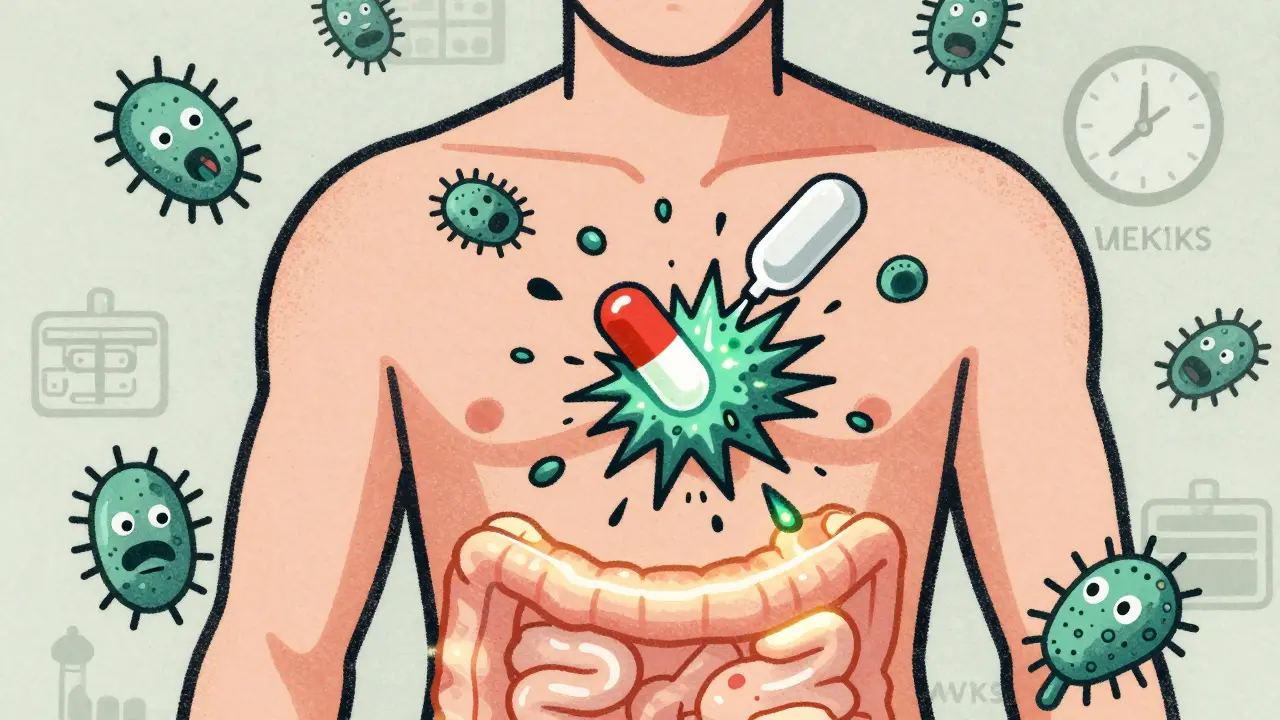
When you take clindamycin for a tooth infection, a skin abscess, or even as a preventive shot before surgery, you’re trusting it to kill the bad bacteria. But what you might not realize is that it’s also wiping out the good ones-your gut’s natural defenders. And that’s when clindamycin becomes a silent trigger for something far more dangerous: Clostridioides difficile, or C. diff. This isn’t just a case of ‘stomach upset.’ It’s a life-threatening gut infection that can spiral fast. If you’re on clindamycin-or just finished it-you need to know the warning signs and when to act.
Why Clindamycin Is Different
Not all antibiotics carry the same risk. Clindamycin stands out because of how brutally it targets gut bacteria. Unlike broad-spectrum drugs that hit a wide range of bugs, clindamycin zeroes in on gram-positive bacteria, which includes most of the friendly microbes keeping C. diff in check. Studies analyzing over 150,000 patients found clindamycin carries the highest risk of triggering C. diff among all commonly prescribed antibiotics. Even a single dose can be enough to disrupt your gut balance. The CDC calls it a top-tier threat, and for good reason: your gut microbiome doesn’t bounce back quickly after clindamycin. The drug lingers in your intestines longer than most, giving C. diff a wide-open window to multiply and release toxins that attack your colon lining.What C. diff Actually Does
C. diff doesn’t just cause diarrhea. It causes inflammation so severe it can lead to ulcers, toxic megacolon, or even bowel perforation. The bacteria produce two main toxins-TcdA and TcdB-that destroy the cells lining your colon. This leads to watery, foul-smelling stools, often with mucus or blood. But here’s the trap: some people don’t have diarrhea at all. In advanced cases, the colon becomes paralyzed (ileus), so you stop having bowel movements entirely. That’s not improvement-it’s a red flag. You might feel bloated, nauseous, and in intense pain, but no bathroom trips. That’s why counting stools isn’t enough. You need to pay attention to the quality-loose, unformed stools that take the shape of the toilet bowl-are a classic sign.When to Worry: The Red Flags
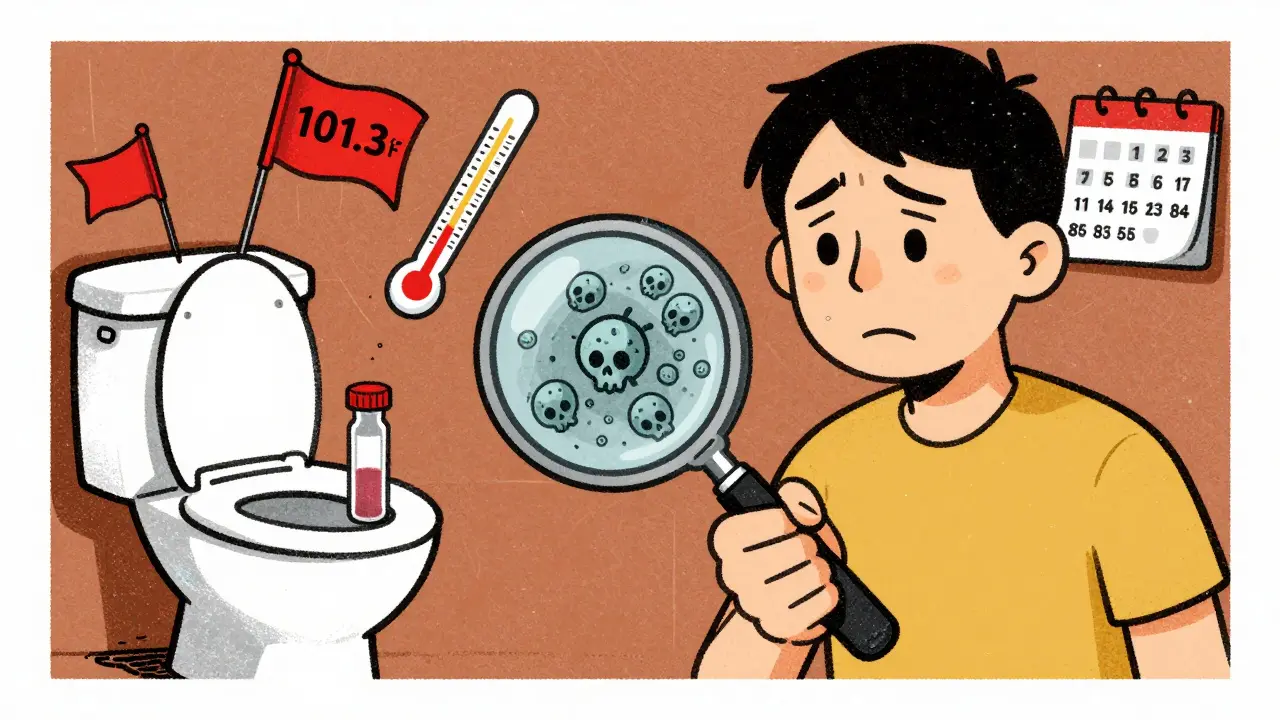
You don’t need to wait for a week of diarrhea to seek help. If you’re on clindamycin or have taken it in the last 12 weeks, watch for these signs:- Three or more unformed stools in 24 hours for two days straight
- Abdominal cramping or pain that doesn’t go away
- Fever above 101.3°F (38.5°C)
- Blood or pus in your stool
- Signs of dehydration: dizziness, very dark urine, or not peeing for more than 8 hours
These aren’t vague symptoms. They’re clinical indicators. The CDC and major medical societies agree: if you have diarrhea plus one of these signs, you need evaluation now. For people over 65, those with weakened immune systems, or anyone who’s had C. diff before, don’t wait two days. Call your doctor after just 24 hours of loose stools. Delaying care increases your risk of needing surgery by more than double.
Timing Matters-It’s Not Just While You’re Taking It
Many people think the danger ends when they finish their pill bottle. It doesn’t. The median time for C. diff symptoms to appear after starting clindamycin is 5 to 10 days. But cases have been reported as early as one day after the first dose-and as late as 12 weeks after stopping. Nearly half of all clindamycin-related cases happen within a week of finishing the course. That’s why you can’t just ignore diarrhea that shows up two weeks after your last pill. If you’re feeling off and recently took clindamycin, treat it as a possible infection until proven otherwise.Who’s Most at Risk?
Some people are far more vulnerable:- Age 65 or older
- Recent hospital stay or long-term care facility residence
- History of C. diff infection
- Chronic kidney disease or dialysis
- Immunosuppression from chemo, steroids, or autoimmune drugs
- Long-term antibiotic use or multiple courses
Even if you’re young and healthy, don’t assume you’re safe. Community-associated C. diff is rising, and nearly 20% of cases now come from outside hospitals. Dentists prescribe clindamycin often for patients allergic to penicillin-and that’s a major source of exposure. A 2023 CDC report found 13% of community C. diff cases linked to dental antibiotic use. If you got clindamycin for a toothache, your risk isn’t zero.
What Happens If You Delay Care?
Waiting too long can cost you your colon-or your life. Data from the University of Michigan shows patients who waited more than 72 hours before seeking help had a 14.2% death rate. Those who acted within 48 hours? Only 3.5%. Those who waited also had nearly three times higher rates of needing a colectomy (removal of part of the colon). C. diff doesn’t wait. It spreads. It weakens your body. It can trigger sepsis. Early diagnosis means starting treatment like fidaxomicin or vancomycin before damage becomes irreversible. Newer treatments like VOWST (a pill made of bacterial spores) can even prevent recurrence-but only if caught early.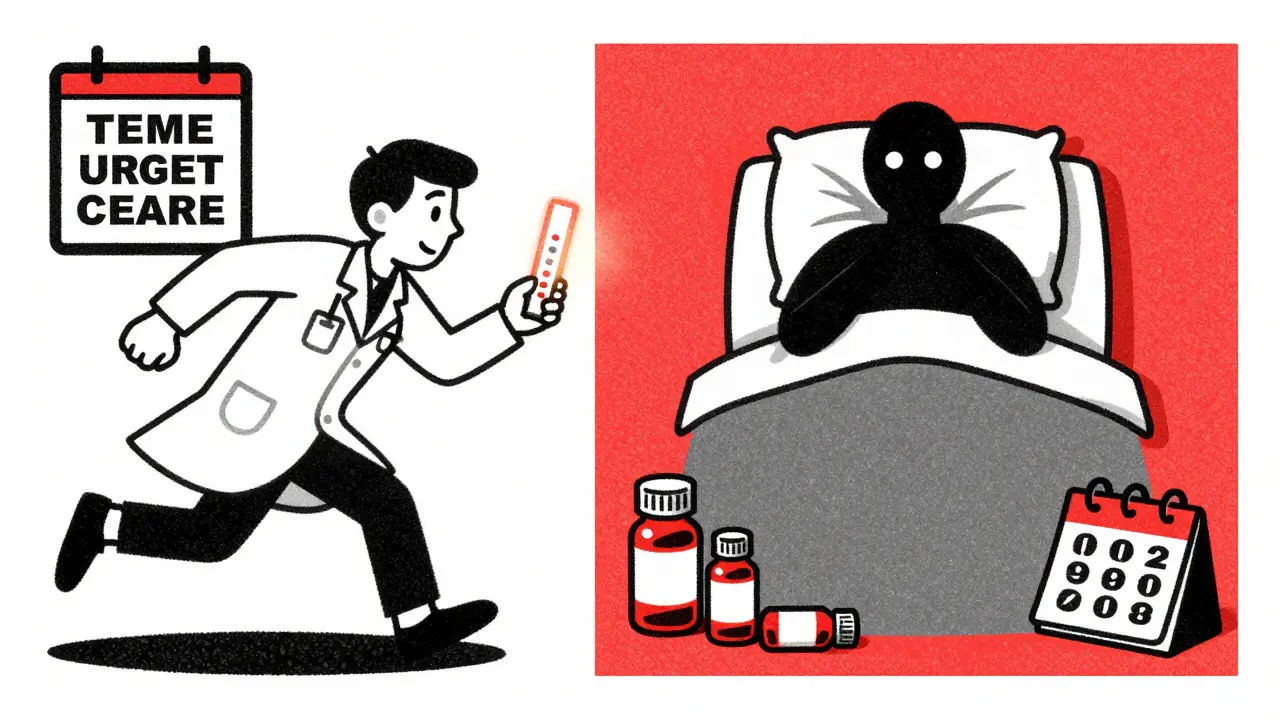
What to Do If You Suspect C. diff
Don’t take loperamide (Imodium) to stop the diarrhea. That traps toxins inside your body and makes things worse. Don’t rely on probiotics to fix it-they won’t reverse an active infection. Here’s what actually helps:- Stop clindamycin immediately-unless your doctor says otherwise. Sometimes, continuing it is necessary if you’re treating a life-threatening infection.
- Call your doctor or go to urgent care. Tell them you took clindamycin and now have diarrhea.
- Request a stool test for C. diff toxin. Rapid tests are widely available and accurate.
- Stay hydrated. Sip water, broth, or oral rehydration solutions. Avoid caffeine and alcohol.
- Don’t go to work, school, or public places. C. diff spores spread easily and survive on surfaces for months.
If you’re vomiting, can’t keep fluids down, or feel faint, go to the ER. Those are signs of severe dehydration or toxic megacolon-both emergencies.
Alternatives to Clindamycin
Clindamycin isn’t always the best choice. For skin infections, trimethoprim-sulfamethoxazole or doxycycline are safer. For dental infections, amoxicillin or penicillin (if you’re not allergic) are first-line and carry far lower C. diff risk. The CDC explicitly advises doctors to avoid clindamycin when equally effective, lower-risk options exist. If your doctor prescribed clindamycin without discussing alternatives, ask: “Is there a safer antibiotic I could take instead?” Most of the time, yes.What’s Changing in Treatment
The medical world is catching up. The FDA approved VOWST in 2023-a first-of-its-kind pill made of bacterial spores that helps restore your gut microbiome after C. diff. It cuts recurrence rates by nearly 40%. New antibiotics like ridinilazole are showing promise in trials, with fewer relapses than vancomycin. But none of these help if you don’t catch it early. That’s why guidelines are shifting. The IDSA now recommends seeking care after just two loose stools in 24 hours if you’re high-risk. That’s not alarmism-it’s science.Can I get C. diff from just one dose of clindamycin?
Yes. While the absolute risk is low (around 1-2% of people who take clindamycin), even a single dose can trigger C. diff in susceptible individuals. Case reports exist of patients developing severe infection after just one pill, especially if they’re older, have a history of gut issues, or are on other medications that weaken their immune system.
How long after stopping clindamycin can I still get C. diff?
You’re at risk for up to 12 weeks after your last dose. Most cases show up within 14 days, but it’s not uncommon for symptoms to appear 3, 6, or even 10 weeks later. Don’t assume you’re safe just because you finished the pills.
Is C. diff contagious?
Yes. C. diff spreads through spores in feces. These spores can survive on doorknobs, toilets, and clothing for months. If you have C. diff, wash your hands with soap and water (alcohol gel doesn’t kill spores), clean surfaces with bleach-based cleaners, and avoid sharing towels or bedding until cleared by your doctor.
Can probiotics prevent C. diff from clindamycin?
There’s no strong evidence that over-the-counter probiotics prevent C. diff. Some strains like Saccharomyces boulardii may help reduce recurrence in people who’ve had it before, but they won’t stop the infection from starting. Don’t rely on them as protection. The best prevention is avoiding clindamycin unless absolutely necessary.
What’s the difference between regular diarrhea and C. diff diarrhea?
C. diff diarrhea is usually watery, frequent (three or more times a day), foul-smelling, and may contain mucus or blood. It’s often accompanied by cramping, fever, and a strong urge to go-even if you just went. Regular diarrhea from food or stress usually resolves in a day or two and doesn’t come with fever or severe pain.
If you’ve taken clindamycin and feel off-especially with diarrhea, pain, or fever-don’t wait. Don’t assume it’s just a stomach bug. Your gut is fighting a battle you can’t see. Early action saves lives, and sometimes, your colon.



Ryan Pagan
January 29, 2026 AT 23:05Clindamycin is basically the antibiotic equivalent of nuking your gut from orbit. I’ve seen patients come in with C. diff after a single dental prescription-no warning, no mercy. It’s not ‘bad luck,’ it’s a known risk that docs still treat like an afterthought. If you’re allergic to penicillin, fine-but ask for doxycycline or clavulanate first. The fact that clindamycin is still a go-to for tooth infections is criminal. My grandma got it for a root canal and ended up in ICU. Don’t let this be your story.
Sheryl Dhlamini
January 31, 2026 AT 01:53I took clindamycin for a cyst last year and thought my diarrhea was just ‘stress.’ Two weeks later I was in the ER with a fever and my colon felt like it was being stabbed with a fork. They told me I was lucky I didn’t need surgery. I still have anxiety about antibiotics now. If you’re on it and feel even a little off-just call your doctor. Don’t wait for it to get ‘bad.’
Frank Declemij
January 31, 2026 AT 15:55Stop taking clindamycin if you get diarrhea. Simple. No probiotics. No Imodium. Just stop and call your doctor. Done.
Megan Brooks
February 1, 2026 AT 18:08It’s chilling how often we treat antibiotics like candy-pop a pill, forget it, assume it’s harmless. But the gut isn’t just a pipe; it’s a living ecosystem, and clindamycin doesn’t just kill bad bacteria-it obliterates the infrastructure that keeps the whole system balanced. We’ve spent decades learning about microbiomes, yet we still hand out this drug like it’s aspirin. Maybe it’s time we stop treating patients like data points and start treating them like whole human beings with fragile internal worlds.
Robin Keith
February 2, 2026 AT 09:52Let’s be real-this whole thing is a perfect storm of pharmaceutical negligence, lazy prescribing, and a medical-industrial complex that profits from complications. Clindamycin is cheap, it’s easy to write, and it’s been around since the 60s, so why change? Meanwhile, people are getting colectomies because no one bothered to say, ‘Hey, maybe try something less destructive.’ And don’t even get me started on how the FDA approves drugs based on outdated data while new treatments like VOWST sit on the shelf for years because Big Pharma doesn’t see a profit in ‘restoring nature’-they want you to buy another bottle of antibiotics next time. It’s not just a medical issue-it’s a moral failure.
Andy Steenberge
February 2, 2026 AT 16:43One of the most important things here is the timeline. People think if they’re not symptomatic while taking the drug, they’re safe. But C. diff doesn’t care about your pill schedule. The 12-week window is real, and it’s under-discussed. I’ve had patients come in three months after finishing clindamycin, convinced it’s ‘just a virus.’ If you’ve taken it recently and have unexplained GI symptoms, don’t second-guess yourself-get tested. Early detection saves not just your colon, but your life.
LOUIS YOUANES
February 4, 2026 AT 03:28Everyone’s freaking out about clindamycin like it’s the devil’s potion but have you seen how many people take amoxicillin and still get sick? This is just fearmongering. I’ve been on clindamycin three times and never had an issue. Your microbiome is tougher than you think. Stop listening to alarmist blog posts and trust your body.
Kacey Yates
February 4, 2026 AT 20:42My dentist gave me clindamycin for a tooth abscess and told me it was ‘the best option’-no mention of C. diff. I got diarrhea after day 3 and ignored it because I thought it was ‘normal.’ By day 5 I was vomiting blood. ER. ICU. 4 days in the hospital. They told me if I’d waited another 12 hours I might not have made it. DON’T IGNORE IT. And if your doctor doesn’t warn you-ask. Demand to know the risks. You’re not being difficult-you’re being smart.
Pawan Kumar
February 5, 2026 AT 19:21Clindamycin is a tool of the pharmaceutical elite to control the masses. The CDC is a puppet of Big Pharma, and C. diff is just a manufactured scare to sell more expensive antibiotics and fecal transplants. Real healers use herbs, fasting, and sunlight. You don’t need labs or pills-you need to cleanse your soul and stop trusting the system.
DHARMAN CHELLANI
February 7, 2026 AT 16:34clindamycin? more like clindamycin-why-did-i-take-this. i got it for a pimple and ended up in the bathroom for 3 days. my mom said ‘just take pepto’ and i almost died. never again. doctors are clueless.
kabir das
February 9, 2026 AT 08:41And what about the spores? The spores are everywhere-on your phone, your keyboard, your partner’s hands-and they survive bleach, heat, time… They’re waiting… They’re patient… They’re ancient… They remember when the Earth was young… And now, they’re using your gut as their cathedral… You think you’re safe because you washed your hands? HA! You think soap works? NO. Only fire. Only pure, holy fire can cleanse the spores… And your doctor won’t tell you that… They’re afraid… They’re afraid of the truth…
Paul Adler
February 10, 2026 AT 10:22Thank you for laying this out so clearly. I’m a nurse, and I’ve seen too many patients dismissed because their symptoms didn’t fit the textbook. The fact that C. diff can present without diarrhea is terrifying-and under-taught. I’ve started including a one-page handout on clindamycin risks in every prescription I give out. Small actions matter. If we all start asking, ‘Is there a safer alternative?’ we can change this.