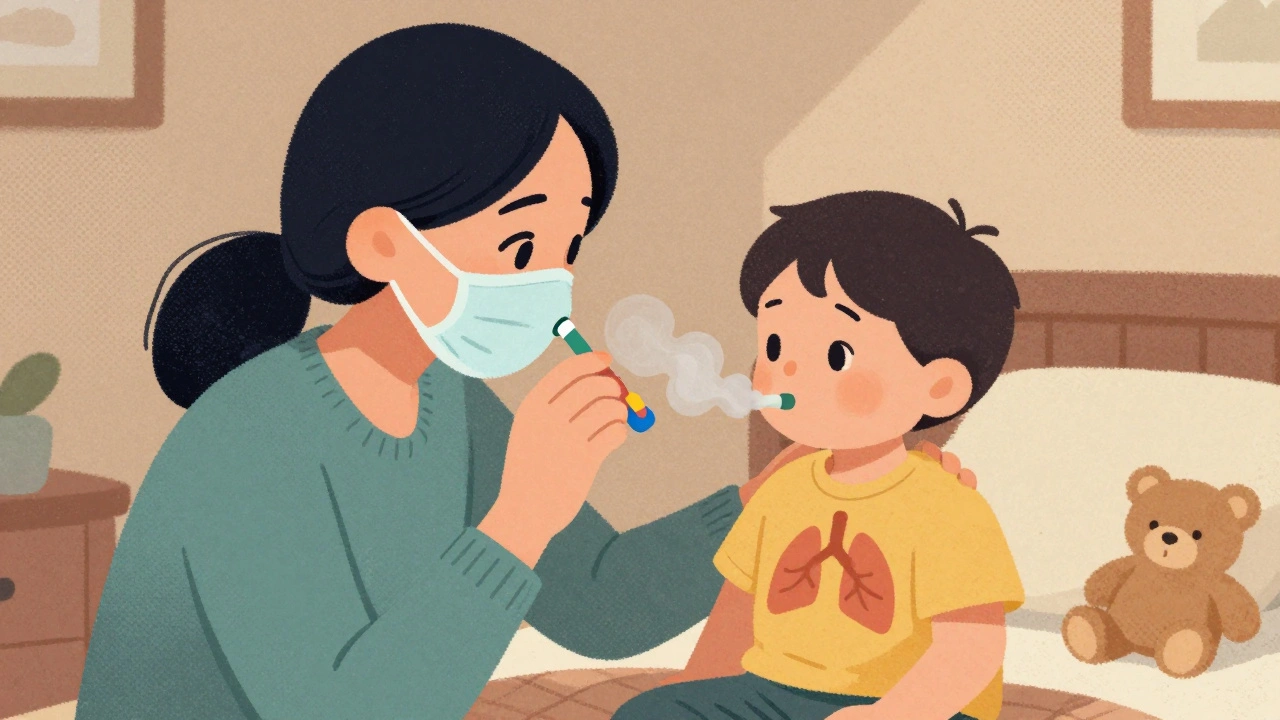
When a child has asthma, their inhaler isn’t just a device-it’s a lifeline. But if the technique is wrong, that lifeline barely works. Studies show that without a spacer and mask, kids get less than 20% of the medicine into their lungs. That means most of the dose is stuck in their mouth or throat, doing almost nothing to stop a flare-up. The good news? With the right technique-using a spacer and mask-up to 90% of the medicine reaches the lungs. And that’s the difference between a child who’s breathing easily and one who’s in the emergency room.
Why the spacer and mask are non-negotiable
Young children can’t coordinate pressing the inhaler and breathing in at the same time. Even older kids often breathe too fast or too shallow. That’s where the spacer comes in. Think of it like a little air chamber that holds the medicine after you press the inhaler. The mask fits snugly over the nose and mouth, so the child can breathe normally-no timing needed.
The American Lung Association and Johns Hopkins both say: if your child is under 8, you must use a spacer with a mask. No exceptions. Dry powder inhalers won’t work for them-they need a strong, fast breath that most kids just can’t manage. Spacers fix that. They turn a complicated action into something simple: press, wait, breathe.
And the numbers don’t lie. A 2022 study in the Journal of Allergy and Clinical Immunology: In Practice found that kids using spacer masks got 78% of the medicine into their lungs. Without them? Just 13%. That’s a six-fold difference. This isn’t just theory-it’s why hospitals and clinics across the U.S. now require parents to demonstrate proper technique before leaving with a new prescription.
Choosing the right spacer and mask
Not all spacers are made the same. Size matters. For babies under 12 months, you need a mask with a volume of 150-350 mL. Toddlers (1-3 years) need 350-500 mL. Preschoolers (3-8 years) need 500-750 mL. Too small? The medicine leaks. Too big? It’s awkward and hard to hold still.
Look for spacers made with anti-static materials. Plastic spacers can build up static charge, which pulls the medicine to the walls instead of letting it float into the lungs. The American Academy of Pediatrics recommends washing your spacer once a week with mild soap and water. Don’t towel-dry it-let it air-dry. Static builds up faster with towels. Some brands, like AeroChamber and Vortex, are top sellers in the U.S., but even a plain plastic bottle can work if the technique is right. As one pediatric pulmonologist put it: “Proper technique is ten times more important than the brand.”
Step-by-step: How to use an inhaler with a spacer and mask
Here’s the exact process, broken down into simple steps. Do this every time, no matter how many times you’ve done it before.
- Shake the inhaler for 5-10 seconds. Don’t just give it a quick shake. You need to mix the medicine and propellant properly. Most parents rush this. Don’t.
- Attach the inhaler to the spacer. Make sure it clicks or snaps in securely. If it wobbles, it’s not right.
- Place the mask over your child’s nose and mouth. Press gently but firmly. The mask should cover from the bridge of the nose to the bottom of the chin. No gaps. If you see their cheeks puffing out, the seal is broken.
- Press the inhaler once to release one puff into the spacer. Don’t press more than once at a time.
- Let your child breathe normally for 5-10 breaths. For babies and toddlers, this means 5-10 regular breaths. Don’t force a deep breath. Just let them breathe in and out slowly. For kids over 5, you can ask them to take one deep breath and hold it for 5-10 seconds.
- Wait 30-60 seconds before giving another puff. If your child needs more than one puff, wait at least a full minute between doses. Rushing this wastes medicine and can cause side effects.
- Remove the mask and wipe your child’s face gently. This helps prevent skin irritation from the medicine.
- Wash the spacer once a week. Use warm water and a drop of dish soap. Let it air-dry overnight. Never use a towel.
That’s it. Eight steps. Takes about 90 seconds. But if you skip one, you’re losing up to half the medicine.
Common mistakes parents make (and how to fix them)
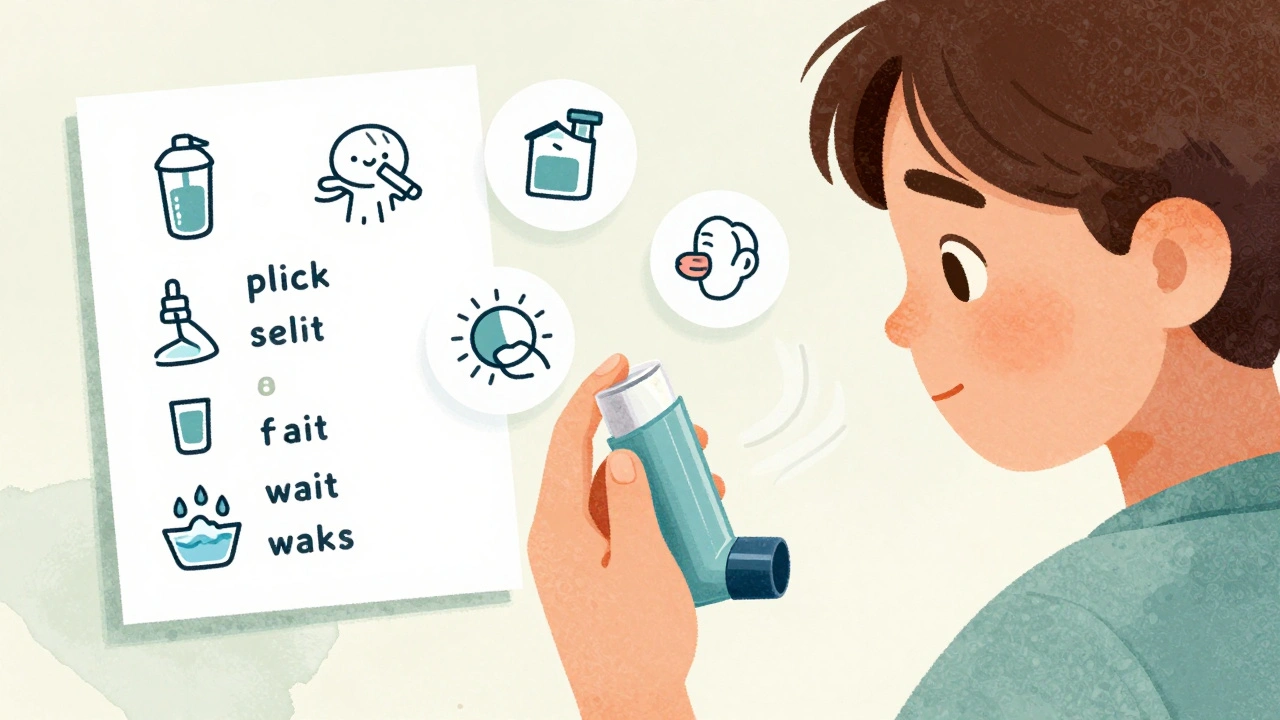
Most families think they’re doing it right-until they’re filmed. A 2022 audit of 400 families found that 63% had a bad mask seal. Other top errors:
- Not shaking long enough (43% of parents)-Shake it like you’re making a cocktail, not like you’re checking a thermometer.
- Pressing the inhaler too early or too late-Wait until the mask is sealed before pressing. Pressing before the mask is on wastes medicine.
- Not waiting between puffs-If you give two puffs back-to-back, the second one gets blocked by the first. Wait a full minute.
- Using the wrong mask size-If the mask overlaps the cheeks or doesn’t cover the chin, it’s too small or too big. Measure from nose bridge to chin.
- Wiping the spacer with a towel-That creates static. Air-dry only.
One mom in Brisbane told me her son was labeled “steroid-resistant” for six months. Then they filmed her technique. She was pressing the inhaler before the mask was sealed. After fixing that, his symptoms disappeared.
How to get your child to cooperate
Let’s be honest: kids hate masks. Especially when they’re scared or in the middle of a coughing fit. So how do you get them to sit still?
- Use distraction-Play a short video on a tablet, sing a song, or read a book while you administer the dose. One study found 63% of parents had better success with distraction.
- Let them choose the mask-Some spacers come with cartoon characters. Let your child pick. It gives them control. One dad said his daughter went from screaming to smiling just because her mask had a dinosaur on it.
- Practice without medicine-Use the spacer and mask just to breathe through it. Make it a game. “Let’s see how long you can breathe like a dragon!”
- Use the “blow out birthday candles” trick-Before you give the medicine, ask your child to blow out imaginary candles. This helps them exhale fully, making room for the medicine to go deep.
One parent on a parenting forum said her 2-year-old refused the mask for months. Then she started using it during bath time-while he was distracted by bubbles. Within a week, he’d ask for it.
When to switch from mask to mouthpiece
As kids grow, they get better at coordination. Around age 5-6, many can switch from a mask to a mouthpiece. But only if they can:
- Close their lips tightly around the spacer
- Take one slow, deep breath
- Hold it for 5-10 seconds
Studies show that for kids over 5, the mouthpiece delivers more medicine than the mask-69% vs. 52%. But if they can’t seal their lips, go back to the mask. Don’t force it. The goal isn’t to grow up fast-it’s to get the medicine in.
Some clinics use a “teach-to-goal” method: parents practice until they get 90% technique accuracy. Most need 3 sessions, each about 20 minutes. Hospitals with asthma educators spend 15 minutes per visit teaching this. You don’t need a clinic to do it right-just patience and repetition.
What to do if the medicine isn’t working
If your child’s symptoms aren’t improving, don’t assume the medicine is weak. Assume the technique is wrong. A 2022 study found that 68% of kids labeled “steroid-resistant” had perfect lung function once their inhaler technique was fixed.
Here’s what to do:
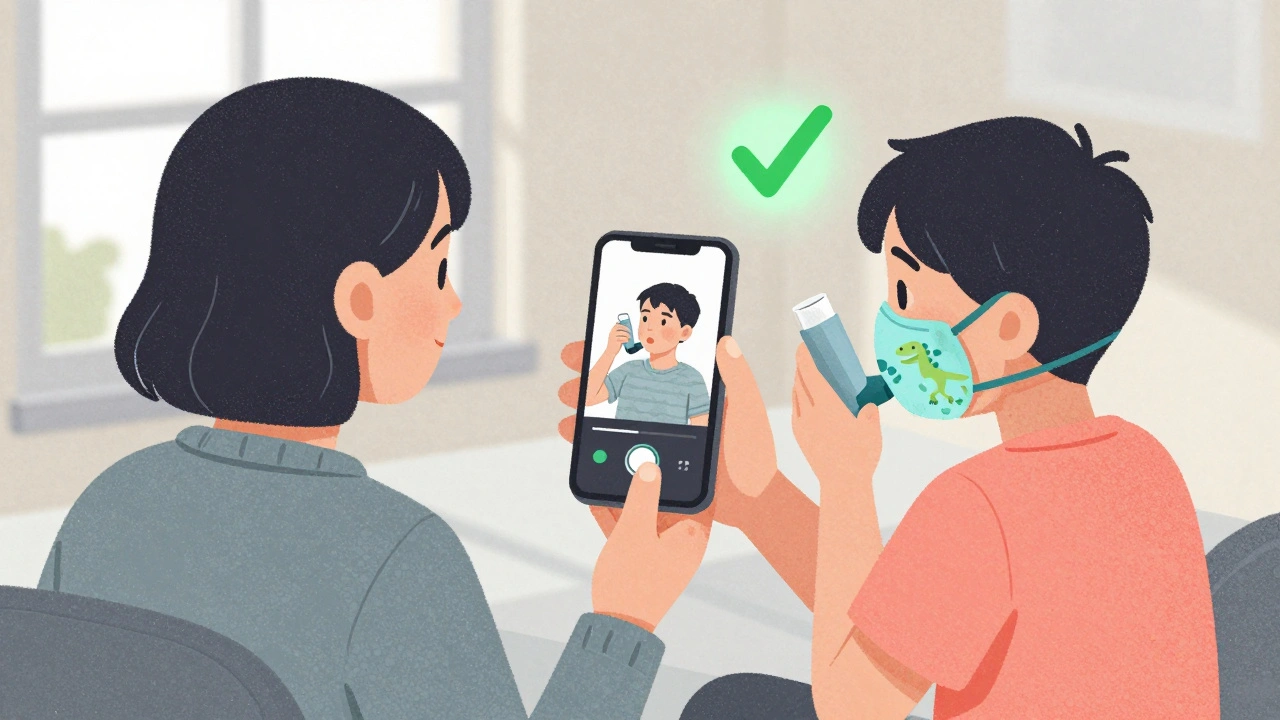
- Record yourself giving the dose. Use your phone.
- Watch it. Check for mask seal, shaking, timing.
- Ask your pediatrician or asthma educator to review it. Many now accept video check-ins.
- If you’re still unsure, go to a clinic for a live demonstration. Most hospitals offer free asthma education sessions.
One family in Queensland started filming every dose after their child had three ER visits in three months. Within a month, they caught a pattern: the dad was pressing the inhaler before the mask was sealed. Fix that, and their ER visits stopped.
What’s new in 2025
The FDA cleared a new “smart spacer” in 2023 that gives audio feedback-like a little beep if the child breathes too fast or doesn’t hold long enough. Early results show it improves technique by 33%. More clinics are starting to offer video reviews through telehealth. By 2025, nearly two-thirds of pediatric pulmonologists plan to require technique videos before refilling prescriptions.
It’s not about surveillance. It’s about safety. Every missed dose adds up. And every correct dose keeps a child out of the hospital.
Final reminder: Technique beats equipment
You don’t need the most expensive spacer. You don’t need the fanciest mask. You need consistency. You need attention to detail. You need to treat this like brushing teeth-something you do the same way, every single time.
And if you forget the steps? Watch a video. Johns Hopkins’ YouTube tutorial has over 147,000 views. The American Lung Association has a free printable guide. Don’t guess. Don’t hope. Do it right.
Because when it comes to your child’s breathing, there’s no room for error. Just precision. Just care. Just the right technique, done right.





Sean McCarthy
December 2, 2025 AT 03:29Spacers work. No debate. My kid was in the ER three times last year. Got the spacer right. Zero visits this year. Simple as that.
Jaswinder Singh
December 4, 2025 AT 01:40People still don't get it. You think your kid is breathing fine because they're not coughing? That's the worst lie parents tell themselves. That 13% vs 78% stat? That's not a suggestion. That's a death sentence if you ignore it. My cousin's daughter almost died because her mom thought shaking the inhaler for two seconds was enough. Don't be that person.
Bee Floyd
December 5, 2025 AT 21:02I used to think this was overkill until my niece started using the dinosaur mask. Now she asks for it before bath time. We do the whole routine-shake, attach, press, breathe. No rush. No drama. Just quiet, consistent care. It’s not about being perfect. It’s about being present. And honestly? Watching her breathe easy after a dose? That’s the quietest kind of victory.
Jeremy Butler
December 7, 2025 AT 20:33It is axiomatic that the efficacy of pharmacological intervention in pediatric respiratory pathology is contingent upon the fidelity of mechanical delivery. The statistical disparity between 13% and 78% is not merely quantitative; it is ontological. The spacer, as a mediating apparatus, reconstitutes the epistemological relationship between the patient and the therapeutic agent. One cannot, therefore, reduce this to a mere technique-it is a metaphysical act of stewardship over biological vulnerability.
Courtney Co
December 9, 2025 AT 08:37I tried everything. The mask, the spacer, the videos, the songs, the dinosaur thing-nothing worked. My son screamed like he was being tortured. I cried every time. Then I realized… I was the problem. I was so stressed I was holding the mask too tight. I started breathing with him. Just… slow. Calm. He stopped fighting. He started trusting. I didn’t fix the technique-I fixed me. And now? We do it together. Every time. Like a ritual. I’m not proud of how I used to be. But I’m proud of how we are now.
Shashank Vira
December 9, 2025 AT 09:02Let me tell you something about American pediatric care. It’s all about gadgets and compliance. But what about the root cause? Why do so many children need inhalers in the first place? Air pollution? Processed food? The decline of outdoor play? Nobody talks about that. They just hand you a spacer and say ‘do this.’ The real tragedy isn’t bad technique-it’s a society that treats symptoms like solutions. I’ve read the studies. I’ve seen the stats. But I also see the bigger picture. And it’s broken.
Eric Vlach
December 10, 2025 AT 22:01Washing the spacer with soap and air drying? Yes. Towel drying? No. That’s the one thing everyone messes up. I used to towel dry mine for years. My kid kept getting thrush. Turned out it was the static pulling the medicine to the walls. Once I switched to air drying? No more mouth sores. Simple fix. Don’t overthink it. Just don’t use a towel.
Souvik Datta
December 12, 2025 AT 10:55Every parent thinks they’re doing enough. But doing enough isn’t enough. You have to do it right. Every. Single. Time. I used to rush through the steps because I was late for work. Then my daughter had her first hospital stay. That day changed everything. Now I sit with her. I count the breaths. I watch the mask. I let her choose the color. I don’t just give her medicine-I give her safety. And that’s not just care. That’s love in action.
Priyam Tomar
December 12, 2025 AT 19:21Everyone’s talking about spacers like they’re magic. But have you tried a dry powder inhaler with a breath-holding trainer? The newer ones are way more efficient. And why are you still using masks for 6-year-olds? Kids can learn to seal their lips by age 4. You’re coddling them. Stop making it a ritual. Make it a skill. And for god’s sake, stop using those plastic spacers-they’re all static and junk. Get a metal one. Real science, not mom’s YouTube hacks.