
Perioperative Anticoagulant Management Calculator
This calculator helps determine safe timing for stopping and restarting anticoagulants before and after surgery based on current clinical guidelines. Always consult your healthcare provider for personalized medical advice.
Why Managing Blood Thinners Before Surgery Isn’t Just a Checklist Item
Imagine you’re scheduled for knee replacement surgery. You’ve been on a blood thinner for atrial fibrillation for years. Your doctor says, "Stop your pill three days before." But what if you don’t? What if you stop too early? One wrong step can mean a stroke-or a bleed that lands you back in the hospital. This isn’t hypothetical. In 2024, the American College of Cardiology reported that 17% to 23% of patients on direct oral anticoagulants (DOACs) had serious bleeding during emergency surgeries because their anticoagulation wasn’t managed properly.
It’s not about being scared. It’s about knowing the rules-and why they exist. The goal is simple: prevent clots without causing bleeding. But the details? They’re complex. And they’ve changed dramatically in the last five years. Heparin bridges? Mostly gone. Timing? Precise. Reversal drugs? Expensive and risky. This isn’t old-school warfarin management anymore. We’re in the DOAC era, and the playbook is different.
DOACs vs. Warfarin: The Big Shift in How We Handle Blood Thinners
Five years ago, most patients on blood thinners were on warfarin. You needed weekly blood tests. You had to avoid spinach and grapefruit. You got heparin shots before surgery to "bridge" the gap. That’s not the norm anymore. Today, over 70% of patients on anticoagulants are on DOACs-drugs like apixaban, rivaroxaban, dabigatran, and edoxaban.
Why the shift? DOACs work faster, wear off faster, and don’t need constant monitoring. Their half-lives are short: apixaban clears in 8-15 hours, rivaroxaban in 5-9 hours. That means you don’t need to bridge with heparin in most cases. The PAUSE study (2018) proved it. Patients who stopped DOACs for a few days and restarted after surgery had no more strokes than those who got heparin shots-but they had far fewer bleeds.
Warfarin is different. It takes days to clear. If you’re on it and need surgery, you stop five days out. Then you check your INR. If it’s below 1.5, you’re safe. But if you’re at high risk for clots-say, you have a mechanical heart valve-you might still need heparin bridging. The 2023 CHEST guidelines say even then, the evidence is weak. The risk of bleeding from heparin often outweighs the tiny chance of a clot.
When to Stop: The Exact Timing Rules for Different Drugs
You can’t guess when to stop. Timing matters down to the day. Here’s what the latest guidelines say:
- Apixaban, rivaroxaban, edoxaban: Stop 3 days before surgery. If you have poor kidney function, go to 4 days.
- Dabigatran: Stop 4 days before. It’s cleared by the kidneys, so if your kidney function is low, you need even more time.
- Warfarin: Stop 5 days before. Check INR on day 4. If it’s above 1.5, you might need vitamin K or fresh frozen plasma to bring it down faster.
- Low-molecular-weight heparin (LMWH): Stop 24 hours before. If the surgery is high-risk for bleeding, wait 48-72 hours.
- Unfractionated heparin: Stop 4-6 hours before. It wears off fast.
Neuraxial anesthesia-spinal or epidural-needs extra caution. The risk of a spinal hematoma is real. ASRA guidelines say: don’t do the block until at least 3 days after the last DOAC dose. For dabigatran, wait 4 days. If you’re unsure, check with your anesthesiologist. Don’t assume your surgeon knows this.

When to Restart: The Most Common Mistake After Surgery
Most mistakes happen after surgery-not before. Patients get discharged, and nobody tells them when to restart their pill. That’s dangerous. Too early? Bleeding. Too late? Clot.
General rule: restart DOACs 24 hours after surgery, but only if bleeding is under control. Then, pick the dose based on your procedure:
- Low bleeding risk (cataract, dental work, skin biopsies): Restart full therapeutic dose at 24 hours.
- High bleeding risk (joint replacement, brain surgery, major abdominal surgery): Start with prophylactic dose at 24-48 hours, then switch to full dose after 72 hours if no bleeding.
For warfarin, restart 12-24 hours after surgery if there’s no active bleeding. Check INR in 24-48 hours. Don’t wait. If it’s too high, you’re at risk. Too low? You’re at risk for clots.
One big mistake: restarting before the surgical site has sealed. A hip replacement? Wait 48 hours. A colon resection? Wait 72. No shortcuts. The PAUSE study showed that even 24 hours was safe for most, but only if the surgery wasn’t high-risk.
Reversal Agents: The Emergency Lifeline (With Big Drawbacks)
What if you have a sudden bleed-or need emergency surgery? You can’t wait three days. That’s where reversal agents come in.
- Idarucizumab reverses dabigatran. Works in minutes. Cost: $3,700 per vial.
- Andexanet alfa reverses apixaban, rivaroxaban, edoxaban. Also fast. Cost: $19,000 per dose.
But here’s the catch: these drugs aren’t magic. The ANNEXA-4 trial found that 13% of patients who got andexanet alfa had a stroke or heart attack within 30 days. Why? Because once you reverse the anticoagulant, the underlying clotting risk comes roaring back. You’re not fixing the problem-you’re just pausing it. And you’re left with a huge bill.
Reversal agents are for emergencies only. Not for planned surgeries. Not for minor bleeds. And not as a substitute for good timing. If you’re relying on reversal, you’ve already failed at prevention.
Who’s at Highest Risk? The Scores That Save Lives
You can’t manage anticoagulants without knowing two scores:
- CHA₂DS₂-VASc: Measures stroke risk in atrial fibrillation. Points for age, heart failure, high blood pressure, diabetes, prior stroke, vascular disease, female sex. Score ≥2? You’re at risk. Score 0? You might not even need a blood thinner.
- HAS-BLED: Measures bleeding risk. Points for high blood pressure, liver/kidney disease, stroke history, labile INR, elderly, drugs/alcohol. Score ≥3? You’re at higher bleeding risk. That doesn’t mean stop the drug-it means be extra careful with timing.
Here’s the hard truth: a 2023 ACC study found that 32% of bad outcomes came from doctors misapplying these scores. They’d see a 75-year-old with high blood pressure and assume they need bridging. But if their CHA₂DS₂-VASc is only 2, the stroke risk over three days is less than 0.1%. Bridging adds no benefit-just bleeding.
Use the scores. Don’t guess. Don’t rely on memory. Write them down. Share them with your surgical team.
The Hidden Problem: Emergency Surgeries and the System That Fails
Guidelines work great for planned surgeries. They don’t work for emergencies. A car crash. A ruptured appendix. A brain bleed. You don’t have three days to wait.
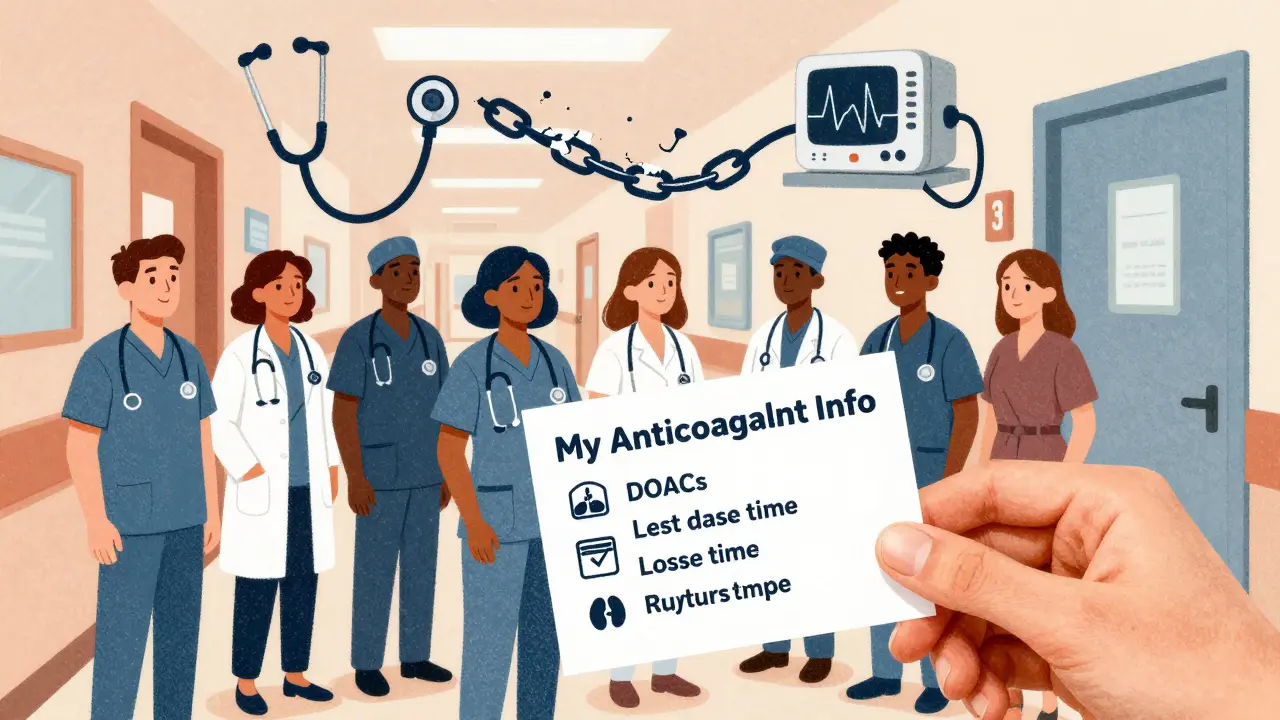
In these cases, the system breaks down. Emergency departments don’t always know what anticoagulant the patient is on. Labs don’t always test for DOAC levels-because guidelines say it’s not useful. And reversal agents? They’re not always on hand. A 2022 JAMA study of 45 hospitals found that only 63% had andexanet alfa available on weekends.
The real solution? Communication. Every patient on a blood thinner should carry a card or app listing their drug, dose, and last dose time. Hospitals need protocols to quickly identify anticoagulant use in the ER. And surgeons need to know: if you’re operating on someone on a DOAC, assume they’re still at risk-even if they stopped it "three days ago." Kidney function changes. Drug interactions happen. Don’t assume.
What’s Next? The Future of Blood Thinner Management
There’s a new drug in the pipeline: ciraparantag. It’s a universal reversal agent-works on all DOACs, heparin, even warfarin. Phase 3 trials are ongoing. Early data shows it reverses anticoagulation in under 10 minutes. If approved, it could change everything.
But even then, the core principle won’t change: don’t interrupt unless you have to. Don’t bridge unless you must. Time it right. The fundamental math hasn’t changed. Bleeding and clotting are two sides of the same coin. You’re not eliminating risk-you’re balancing it.
The future isn’t about new drugs. It’s about better systems. Better communication. Better training. A 2021 survey of 127 hospitals found that clinicians needed 3-5 complex cases to get comfortable with DOAC management. That’s not enough. We need standardized protocols in every OR, every ER, every clinic.
Can I keep taking my blood thinner before minor surgery like a tooth extraction?
Yes, for most minor procedures-dental work, cataract surgery, skin biopsies-you can continue your DOAC without stopping. The bleeding risk is low, and the risk of a clot from stopping is higher. Always check with your doctor, but current guidelines support continuing anticoagulants for these procedures.
Is heparin bridging still used for patients on DOACs?
No. Major guidelines from CHEST, ASH, and ACC all recommend against heparin bridging for patients on DOACs. The short half-life of these drugs means you only need to stop them for a few days. Bridging adds bleeding risk without reducing clot risk. It’s outdated for DOACs.
What if I forget to stop my blood thinner before surgery?
Tell your surgical team immediately. They may delay the procedure, especially if it’s high-risk. For DOACs, they can check if the drug is still active with a specific lab test (anti-Xa for factor Xa inhibitors, ecarin clotting time for dabigatran). If it’s still high, they may use a reversal agent or proceed with extreme caution. Never hide this-it’s a safety issue.
Are DOACs safer than warfarin for surgery patients?
Yes, overall. DOACs have predictable effects, fewer interactions, and don’t require blood tests. Studies show lower rates of major bleeding during surgery compared to warfarin, especially when bridging isn’t used. The main downside is cost and limited reversal options-but even those are improving.
How do I know if I’m at high risk for clots after stopping my blood thinner?
Use the CHA₂DS₂-VASc score. If you have atrial fibrillation and a score of 2 or higher, you’re at higher risk. Other high-risk conditions include recent deep vein thrombosis (within 3 months), mechanical heart valves, or a history of pulmonary embolism. Your doctor should assess this before surgery and decide if you need special precautions.
Final Thought: This Isn’t Just About Drugs-It’s About Systems
Managing anticoagulants around surgery isn’t a one-time decision. It’s a chain: patient education, doctor communication, lab timing, surgical planning, post-op follow-up. Break any link, and someone gets hurt.
The data is clear. The guidelines are solid. The tools exist. What’s missing is consistency. Every hospital, every clinic, every surgeon needs a protocol. Every patient needs a card. Every nurse needs to ask: "Are you on blood thinners?"
Because in the end, it’s not about the drug. It’s about the person. And they deserve a system that doesn’t let them fall through the cracks.


Susie Deer
January 15, 2026 AT 08:56TooAfraid ToSay
January 16, 2026 AT 15:26Allison Deming
January 17, 2026 AT 09:28Robert Way
January 18, 2026 AT 06:25Vicky Zhang
January 18, 2026 AT 11:25says haze
January 20, 2026 AT 11:14Sarah -Jane Vincent
January 22, 2026 AT 01:15Anna Hunger
January 23, 2026 AT 17:50shiv singh
January 24, 2026 AT 02:59Sarah Triphahn
January 25, 2026 AT 16:57Dylan Livingston
January 26, 2026 AT 02:42Andrew Freeman
January 26, 2026 AT 14:48Alvin Bregman
January 27, 2026 AT 08:07